







Question: The corporate valuation model, the price-to-eamings (PIE) multiple approach, and the economic value-added (EVA) approach are some examples of valuation techniques. The corporate valuation
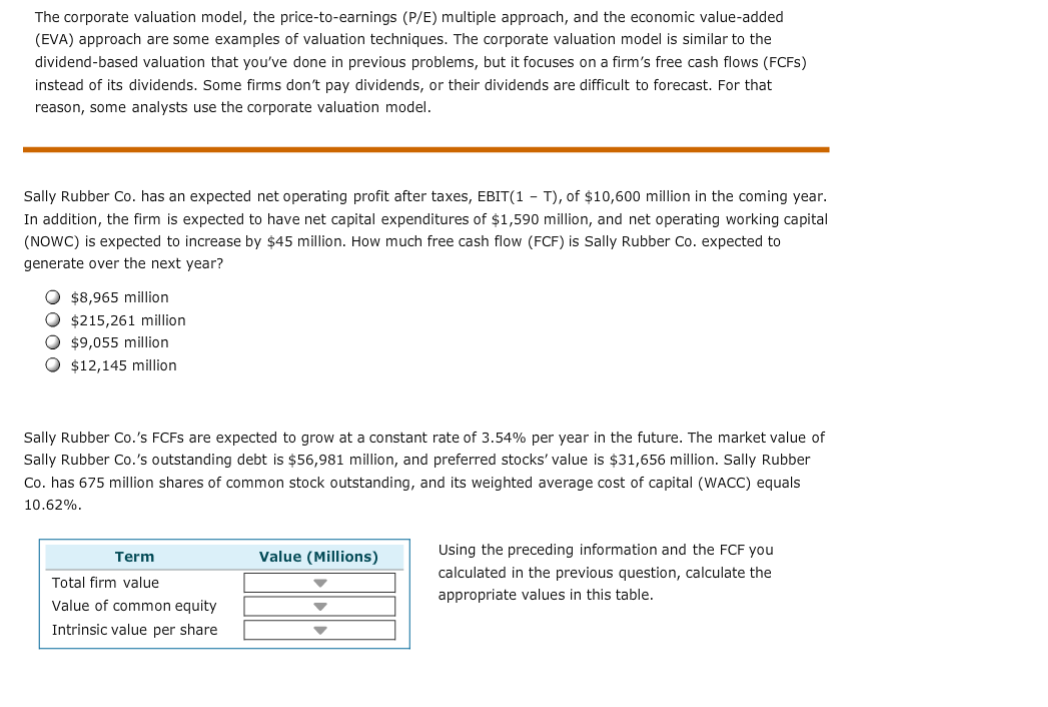
The corporate valuation model, the price-to-eamings (PIE) multiple approach, and the economic value-added (EVA) approach are some examples of valuation techniques. The corporate valuation model is similar to the dividend-based valuation that you've done in previous problems, but it focuses on a firm's free cash flows (FCFs) instead of its dividends. Some firms don't pay dividends, or their dividends are difficult to forecast. For that reason, some analysts use the corporate valuation model. Sally Rubber Co. has an expected net operating profit after taxes, EBIT(I - T), of $10,600 million in the coming year. In addition, the firm is expected to have net capital expenditures of $1,590 million, and net operating working capital (NOWC) is expected to increase by $45 million. How much free cash flow (FCF) is Sally Rubber Co. expected to generate over the next year? O $8,965 million O $215,261 million O $9,055 million O $12,145 million Sally Rubber Co.'s FCFs are expected to grow at a constant rate of 3.54% per year in the future. The market value of Sally Rubber Co.'s outstanding debt is $56,981 million, and preferred stocks' value is $31,656 million. Sally Rubber Co. has 675 million shares of common stock outstanding, and its weighted average cost of capital (WACC) equals 10.62%. Term Total firm value Value of common equity Intrinsic value per share Value (Millions) using the preceding information and the FCF you calculated in the previous question, calculate the appropriate values in this table.
Step by Step Solution
There are 3 Steps involved in it

Get step-by-step solutions from verified subject matter experts
 Study Help