







Question: 1. A proton is accelerated from rest through a potential difference. The potential difference is produced by two parallel plates with a separation of
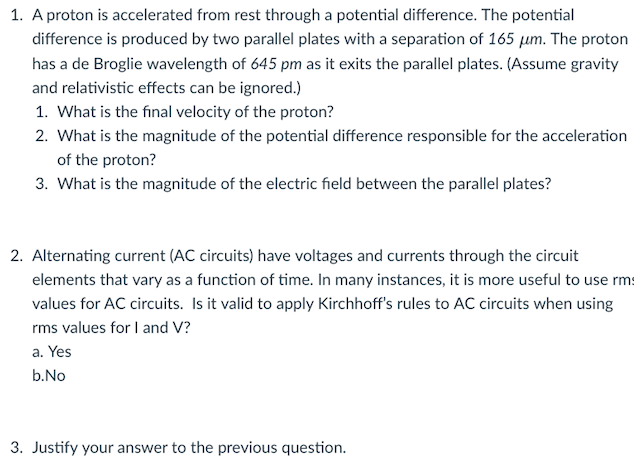
1. A proton is accelerated from rest through a potential difference. The potential difference is produced by two parallel plates with a separation of 165 '1m. The proton has a de Broglie wavelength of 645 pm as it exits the parallel plates. (Assume gravity and relativistic effects can be ignored.) 1. What is the final velocity of the proton? 2. What is the magnitude of the potential difference responsible for the acceleration of the proton? 3. What is the magnitude of the electric field between the parallel plates? 2. Alternating current (AC circuits) have voltages and currents through the circuit elements that vary as a function of time. In many instances, it is more useful to use rm! values for AC circuits. Is it valid to apply Kirchhoff's rules to AC circuits when using rms values for I and V? a. Yes b. No 3. Justify your answer to the previous question.
Step by Step Solution
There are 3 Steps involved in it

Get step-by-step solutions from verified subject matter experts
 Study Help