







Question: 5. Consider a market with two firms, firm 1 and firm 2, each producing a homogeneous good. The market demand is given by the
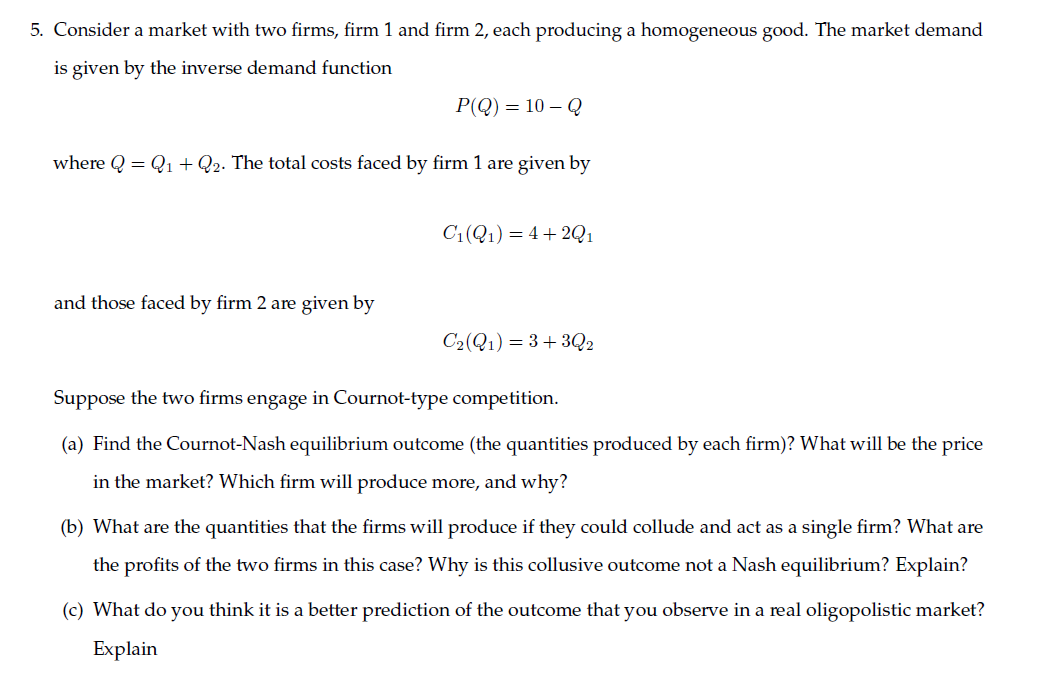
5. Consider a market with two firms, firm 1 and firm 2, each producing a homogeneous good. The market demand is given by the inverse demand function P(Q) = 10 Q where Q = QI + Q2. The total costs faced by firm 1 are given by CI(QI) = 4+ 2Q1 and those faced by firm 2 are given by C2(Q1) = 3 + 3Q2 Suppose the two firms engage in Cournot-type competition. (a) Find the Cournot-Nash equilibrium outcome (the quantities produced by each firm)? What will be the price in the market? Which firm will produce more, and why? (b) What are the quantities that the firms will produce if they could collude and act as a single firm? What are the profits of the two firms in this case? Why is this collusive outcome not a Nash equilibrium? Explain? (c) What do you think it is a better prediction of the outcome that you observe in a real oligopolistic market? Explain
Step by Step Solution
There are 3 Steps involved in it

Get step-by-step solutions from verified subject matter experts
 Study Help