







Question: I. Car-owners value gasoline because it allows them to produce travel services according to s = I + g, where s denote* travel services
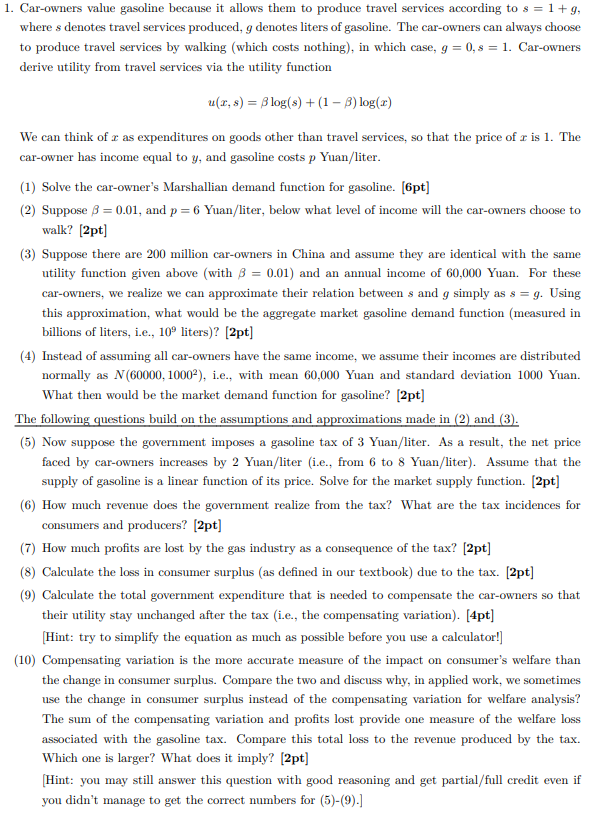
I. Car-owners value gasoline because it allows them to produce travel services according to s = I + g, where s denote* travel services produced, g denotes liters of gasoline. The car-owners can always to produce travel services by walking (which costs nothing), in which case, g = O, s = I. Car-owners derive utility from travel services via the utility function u(m, s) = "log(s) + (I Jj) log(x) We can think of as expenditures on goods other than travel services, so that the price of is I. The car-owner has income equal to y, and gasoline ces p Yuan/ liter. (I) Solve the car-owner's Marshallian demand function for gasoline. IGptl (2) Suppose = 0.01, and p = 6 Yuan/liter, below what level of income will the choose to walk? [2ptl (3) Suppose there are 200 million car-owners in China and assume they are identical with the same utility function given above (with s'3 = 0.01) and an annual income of Yuan. For these car-owners, we realize we can approximate their relation between s and g simply as s = g. Using this approximation, what would be the aggregate market gasoline demand function (measured in billions of liters, i.e., 109 liters)? [2ptJ (4) Instead of assuming all car-owners have the same income, we assume their income* are distributed normally as N(60000, i.e., with mean Yuan and standard deviation 1000 Yuan. What then would be the market demand function for gasoline? 12ptl The following questions build on the assumptions and approximations made in (2) and (5) Now suppCN the government impCNes a gasoline tax of 3 Yuan/liter. As a result, the net price faced by increases by 2 Yuan/liter (i.e., from 6 to S Yuan/liter). Assume that the supply of gasoline is a linear function of its price. Solve for the market supply function. 12ptl (G) How much revenue deus the government realize from the tax? What are the tax incidences for consumers and producers? 12ptl (7) How much profits are lost by the gas industry as a consequencr of the tax? 12pt] (8) Calculate the loss in consumer surplus (as defined in our textbook) due to the tax. 12ptJ (9) Calculate the total government expenditure that is necxled to compensate the car-owners so that their utility stay unchanged after the tax (i.e., the compensating variation). [4ptl [Hint: try to simplify the as much as possible before you use a calculator!] (10) Compensating variation is the more accurate measure of the impact on consumes welfare than the change in consumer surplus. Compare the two and discuss why, in applied work, we sometimes use the change in consumer surplus instead of the compensating variation for welfare analysis? The sum of the compensating variation and profits lost provide one measure of the welfale loss associated with the gasoline tax. Compare this total loss to the revenue produced by the tax. Which one is larger? What it imply? 12ptl [Hint: you may still answer this question with good reasoning and get partial/full credit twen if you didn't manage to get the correct numbers for
Step by Step Solution
There are 3 Steps involved in it

Get step-by-step solutions from verified subject matter experts
 Study Help