







Question: f Being conservative: Being inert in processing the new information related to the market or companies usually results overly slow responses to new evidence, causing
f
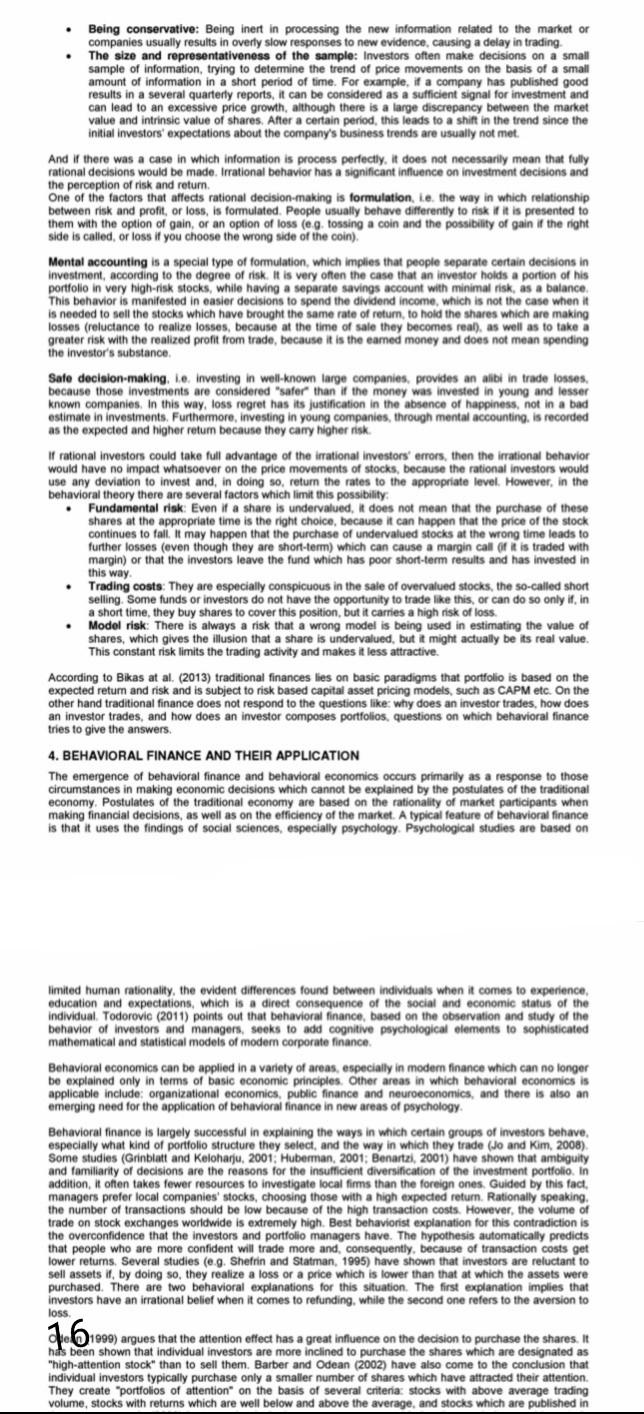
Being conservative: Being inert in processing the new information related to the market or companies usually results overly slow responses to new evidence, causing a delay in trading The size and representativeness of the sample: Investors often make decisions on a small sample of information, trying to determine the trend of price movements on the basis of a small amount of information in a short period of time. For example, if a company has published good results in a several quarterly reports, it can be considered as a sufficient signal for investment and can lead to an excessive price growth, although there is a large discrepancy between the market value and intrinsic value of shares. After a certain period, this leads to a shift in the trend since the initial investors' expectations about the company's business trends are usually not met And if there was a case in which information is process perfectly. It does not necessarily mean that fully rational decisions would be made. Irrational behavior has a significant influence on investment decisions and the perception of risk and return One of the factors that affects rational decision-making is formulation, le the way in which relationship between risk and profit, or loss, is formulated. People usually behave differently to risk if it is presented to them with the option of gain, or an option of loss (eg, tossing a coin and the possibility of gain if the right side is called, or loss if you choose the wrong side of the coin), Mental accounting is a special type of formulation, which implies that people separate certain decisions in investment, according to the degree of risk. It is very often the case that an investor holds a portion of his portfolio in very high-risk stocks, while having a separate savings account with minimal risk, as a balance This behavior is manifested in easier decisions to spend the dividend income, which is not the case when it is needed to sell the stocks which have brought the same rate of return, to hold the shares which are making losses (reluctance to realize losses, because at the time of sale they becomes real), as well as to take a greater risk with the realized profit from trade, because it is the earned money and does not mean spending the investor's substance Safe decision-making, le investing in well-known large companies, provides an albi in trade fosses. because those investments are considered "safer than if the money was invested in young and lesser known companies. In this way, loss regret has its justification in the absence of happiness, not in a bad estimate in investments. Furthermore, investing in young companies, through mental accounting, is recorded as the expected and higher retum because they carry higher risk If rational investors could take full advantage of the irrational investors' errors, then the irrational behavior would have no impact whatsoever on the price movements of stocks, because the rational investors would use any deviation to invest and, in doing so, return the rates to the appropriate level. However, in the behavioral theory there are several factors which limit this possibility: Fundamental risk: Even if a share is undervalued, it does not mean that the purchase of these shares at the appropriate time is the right choice, because it can happen that the price of the stock continues to fall. It may happen that the purchase of undervalued stocks at the wrong time leads to further losses (even though they are short-term) which can cause a margin call of it is traded with margin) or that the investors leave the fund which has poor short-term results and has invested in this way Trading costs: They are especially conspicuous in the sale of overvalued stocks, the so-called short seling. Some funds or investors do not have the opportunity to trade like this, or can do so only if, in a short time, they buy shares to cover this position, but it carries a high risk of loss Model risk: There is always a risk that a wrong model is being used in estimating the value of shares, which gives the illusion that a share is undervalued, but it might actually be its real value This constant risk limits the trading activity and makes it less attractive. According to Bikas at al. (2013) traditional finances lies on basic paradigms that portfolio is based on the expected return and risk and is subject to risk based capital asset pricing models, such as CAPM etc. On the other hand traditional finance does not respond to the questions like: why does an investor trades, how does an investor trades, and how does an investor composes portfolios, questions on which behavioral finance tries to give the answers. 4. BEHAVIORAL FINANCE AND THEIR APPLICATION The emergence of behavioral finance and behavioral economics occurs primarily as a response to those circumstances in making economic decisions which cannot be explained by the postulates of the traditional economy. Postulates of the traditional economy are based on the rationality of market participants when making financial decisions, as well as on the efficiency of the market. A typical feature of behavioral finance is that it uses the findings of social sciences, especially psychology, Psychological studies are based on limited human rationality, the evident differences found between individuals when it comes to experience, education and expectations, which is a direct consequence of the social and economic status of the individual. Todorovic (2011) points out that behavioral finance, based on the observation and study of the behavior of investors and managers, seeks to add cognitive psychological elements to sophisticated mathematical and statistical models modern corporate finance Behavioral economics can be applied in a variety of areas, especially in modern finance which can no longer be explained only in terms of basic economic principles. Other areas in which behavioral economics is applicable include: organizational economics, public finance and neuroeconomics, and there is also an emerging need for the application of behavioral finance in new areas of psychology Behavioral finance is largely successful in explaining the ways in which certain groups of investors behave, especially what kind of portfolio structure they select, and the way in which they trade (Jo and Kim, 2008) Some studies (Grinblatt and Keloharju. 2001. Huberman, 2001: Benartal, 2001) have shown that ambiguity and familiarity of decisions are the reasons for the insufficient diversification of the investment portfolio in addition, it often takes fewer resources to investigate local firms than the foreign ones. Guided by this fact. managers prefer local companies' stocks, choosing those with a high expected return. Rationally speaking, the number of transactions should be low because of the high transaction costs. However, the volume of trade on stock exchanges worldwide is extremely high. Best behaviorst explanation for this contradiction is the overconfidence that the investors and portfolio managers have. The hypothesis automatically predicts that people who are more confident will trade more and consequently, because of transaction costs get lower returns. Several studies (0.g. Shefrin and Statman, 1995) have shown that investors are reluctant to sell assets if, by doing so, they realize a loss or a price which is lower than that at which the assets were purchased. There are two behavioral explanations for this situation. first explanation implies that investors have an irrational belief when it comes to refunding, while the second one refers to the aversion to loss 166 1999) argues that the attention effect has a great influence on the decision to purchase the shares. It has been shown that individual investors are more inclined to purchase the shares which are designated as "high-attention stock" than to sell them. Barber and Odean (2002) have also come to the conclusion that individual investors typically purchase only a smaller number of shares which have attracted their attention They create "portfolios of attention on the basis of several criteria: stocks with above average trading volume, stocks with returns which are well below and above the average, and stocks which are published inStep by Step Solution
There are 3 Steps involved in it
1 Expert Approved Answer
Step: 1 Unlock

Question Has Been Solved by an Expert!
Get step-by-step solutions from verified subject matter experts
Step: 2 Unlock
Step: 3 Unlock
 Study Help