



Question: (f) Noise in the communication process refers to ... i. competitors' efforts to block a firm's message channel. ii. the encoded message before it is
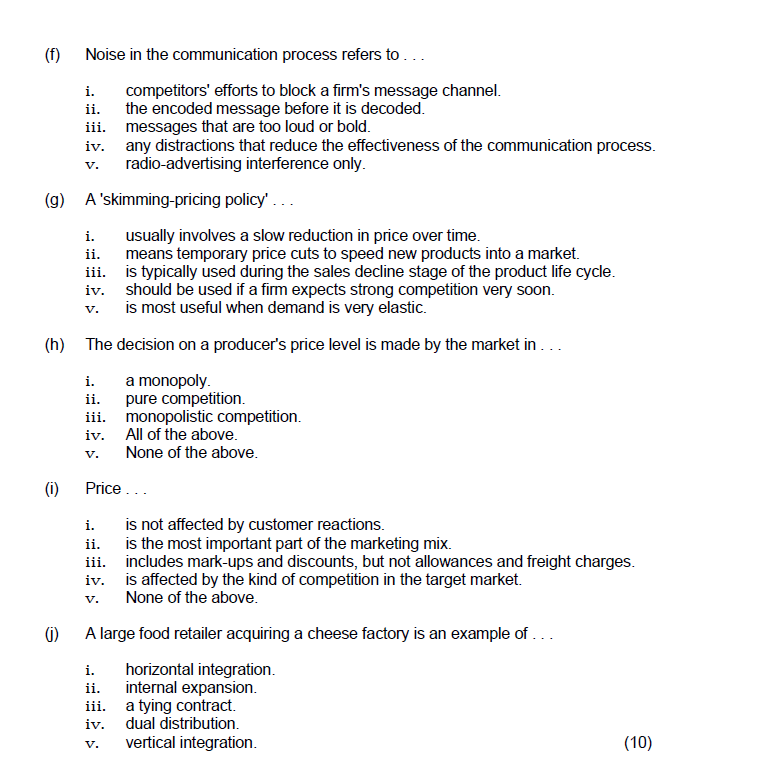
(f) Noise in the communication process refers to ... i. competitors' efforts to block a firm's message channel. ii. the encoded message before it is decoded. iii. messages that are too loud or bold. iv. any distractions that reduce the effectiveness of the communication process. v. radio-advertising interference only. (g) A 'skimming-pricing policy' i. usually involves a slow reduction in price over time. ii. means temporary price cuts to speed new products into a market. iii. is typically used during the sales decline stage of the product life cycle. iv. should be used if a firm expects strong competition very soon. v. is most useful when demand is very elastic. (h) The decision on a producer's price level is made by the market in i. a monopoly. ii. pure competition. iii. monopolistic competition. iv. All of the above. v. None of the above. (i) Price ... i. is not affected by customer reactions. ii. is the most important part of the marketing mix. iii. includes mark-ups and discounts, but not allowances and freight charges. iv. is affected by the kind of competition in the target market. v. None of the above. (j) A large food retailer acquiring a cheese factory is an example of i. horizontal integration. ii. internal expansion. iii. a tying contract. iv. dual distribution. v. vertical integration
Step by Step Solution
There are 3 Steps involved in it

Get step-by-step solutions from verified subject matter experts