







Question: (F) Use interval notation to indicate where f (x) is concave up. Concave up: NONE (G) Use intenral notation to indicate where f (x) is
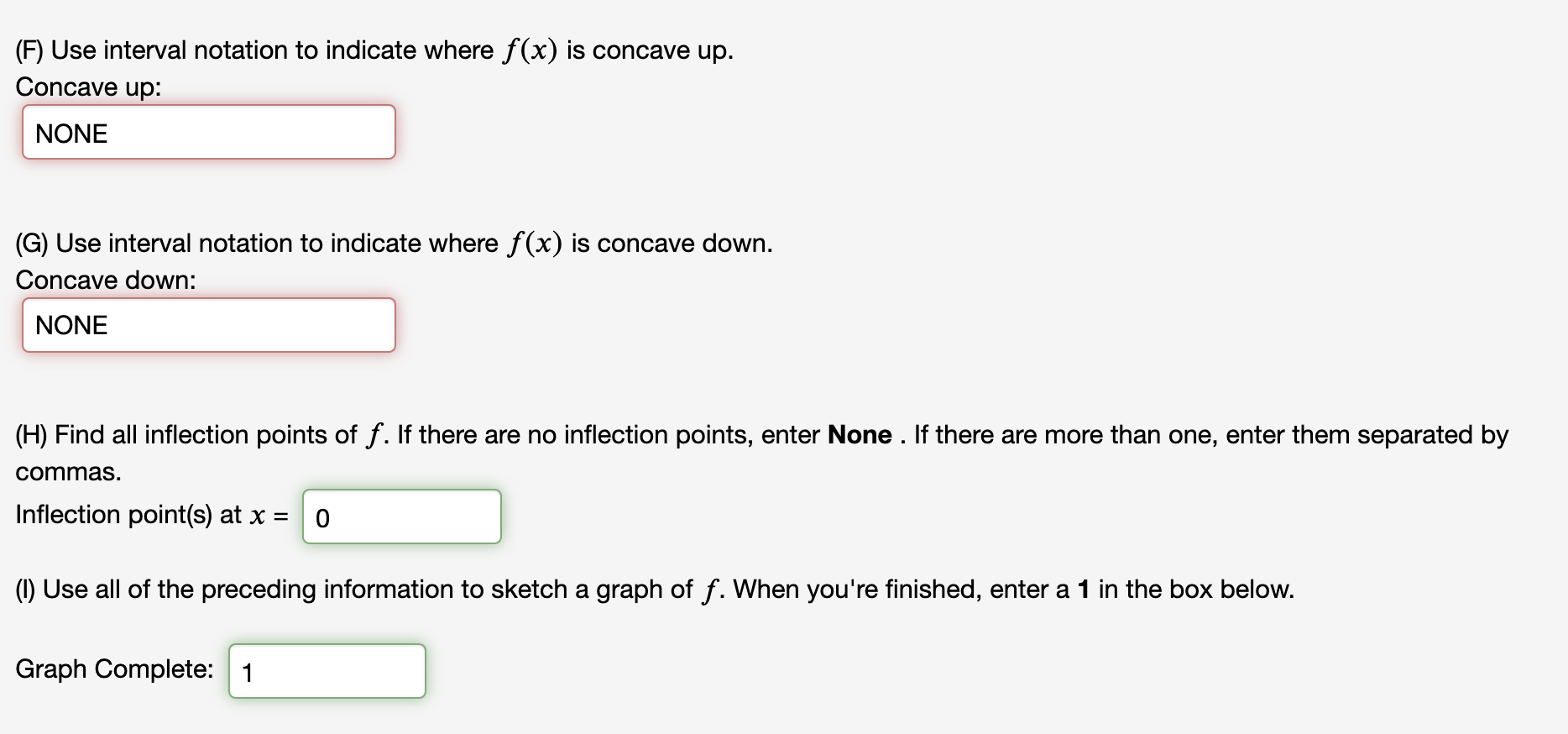
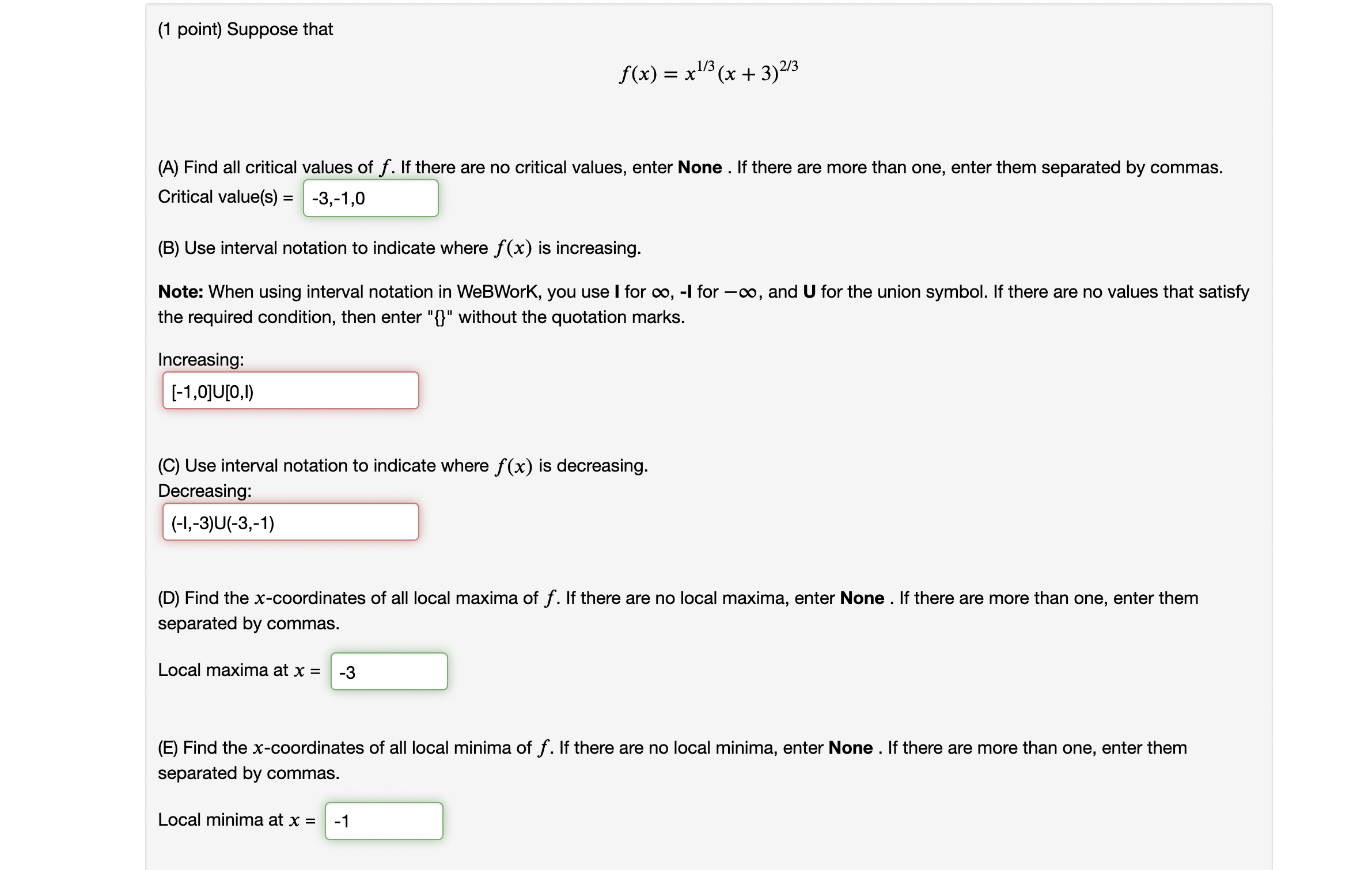
(F) Use interval notation to indicate where f (x) is concave up. Concave up: NONE (G) Use intenral notation to indicate where f (x) is concave down. Concave down: NONE (H) Find all inflection points of f. If there are no inflection points, enter None . If there are more than one, enter them separated by commas. Inflection point(s) at x = C] (I) Use all of the preceding information to sketch a graph of f. When you're finished, enter a 1 in the box below. Graph Complete: (1 point) Suppose that f(x) = x1/3 (x + 3)2/3 (A) Find all critical values of f. If there are no critical values, enter None . If there are more than one, enter them separated by commas. Critical value(s) = (B) Use interval notation to indicate where f (x) is increasing. Note: When using interval notation in WeBWorK, you use I for 00, -l for oo, and U for the union symbol. If there are no values that satisfy the required condition, then enter "{}" without the quotation marks. Increasing: [-1.0]U[0.|) (C) Use interval notation to indicate where f (x) is decreasing. Decreasing: (-|.-3)U(-3.-1) (D) Find the x-coordinates of all local maxima of f. If there are no local maxima, enter None . If there are more than one, enter them separated by commas. Local maxima at x = E (E) Find the x-coordinates of all local minima of f. If there are no local minima, enter None . If there are more than one, enter them separated by commas. Local minima at x =
Step by Step Solution
There are 3 Steps involved in it

Get step-by-step solutions from verified subject matter experts
 Study Help