Question: f1. INTRODUCTION TO PREPARING A WRITTEN CASE REPORT The method for a basic case analysis presented in Note 2 of the Case Guide SeriesPerforming a
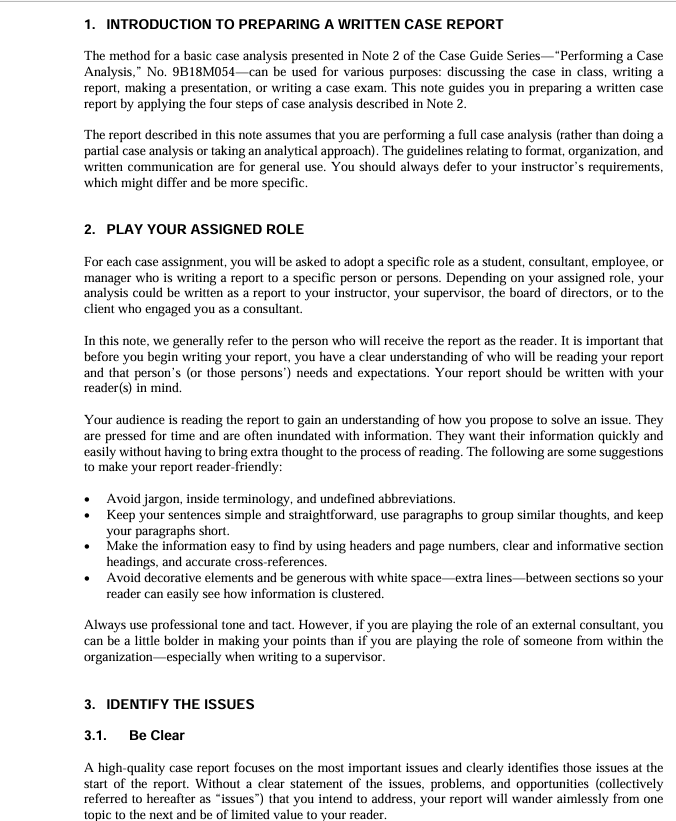
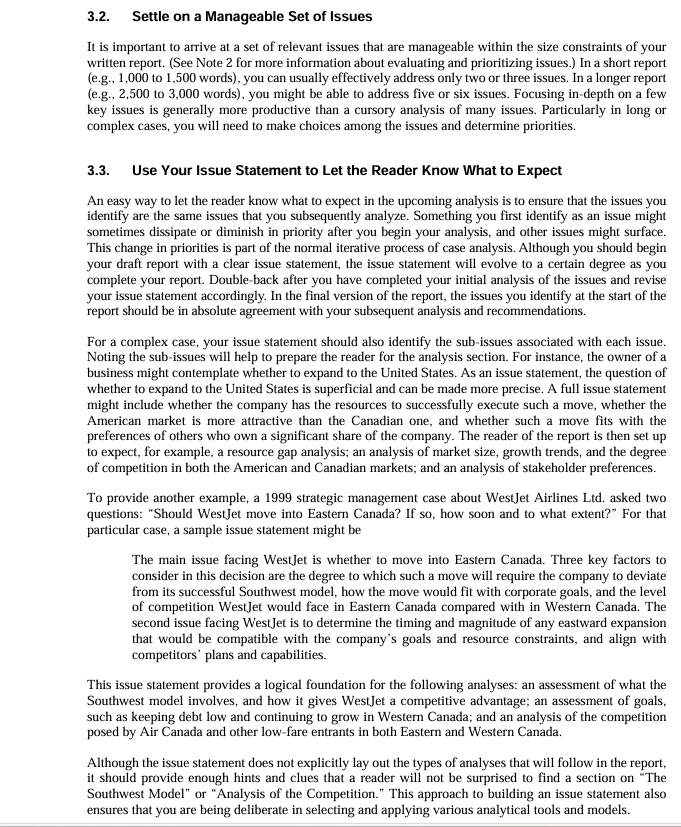
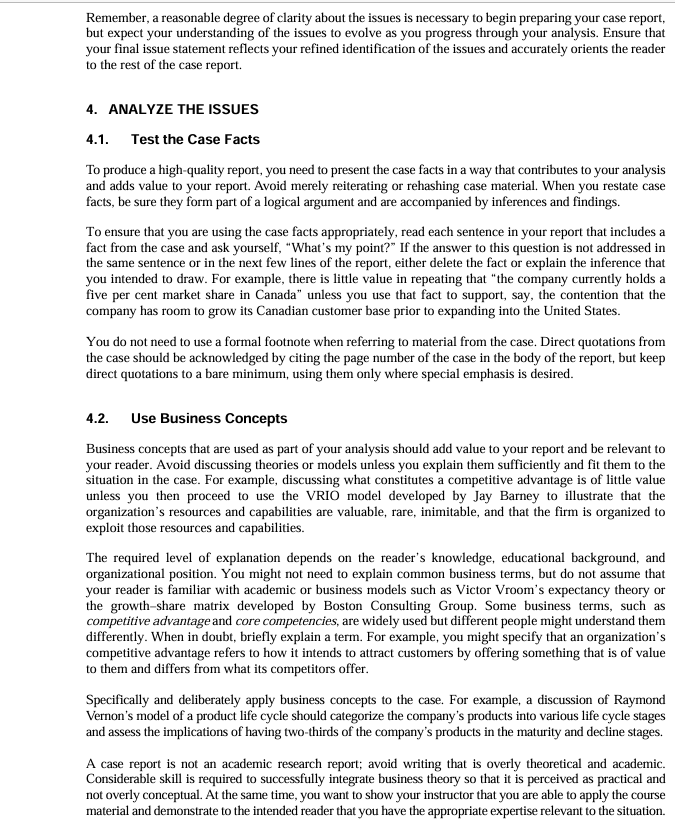
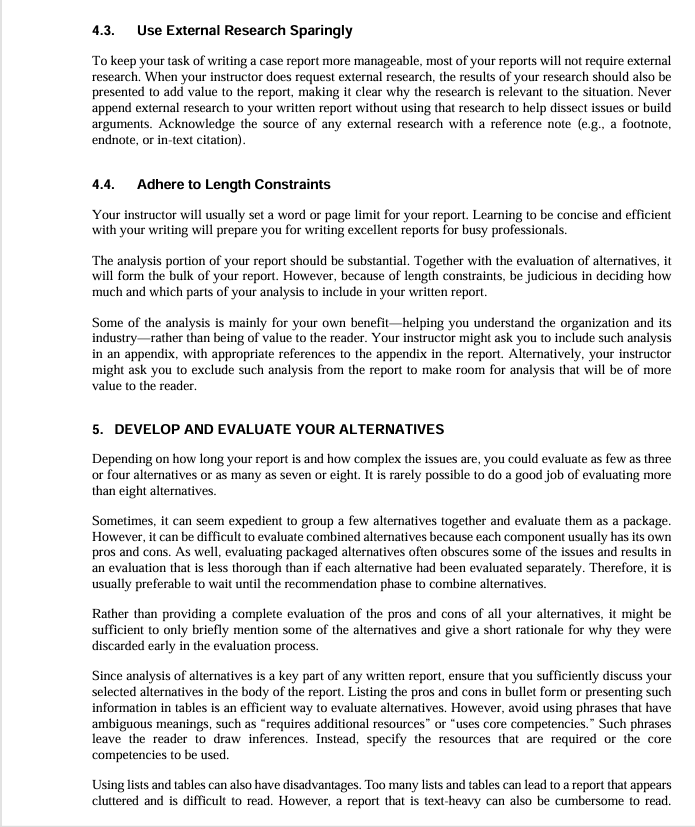
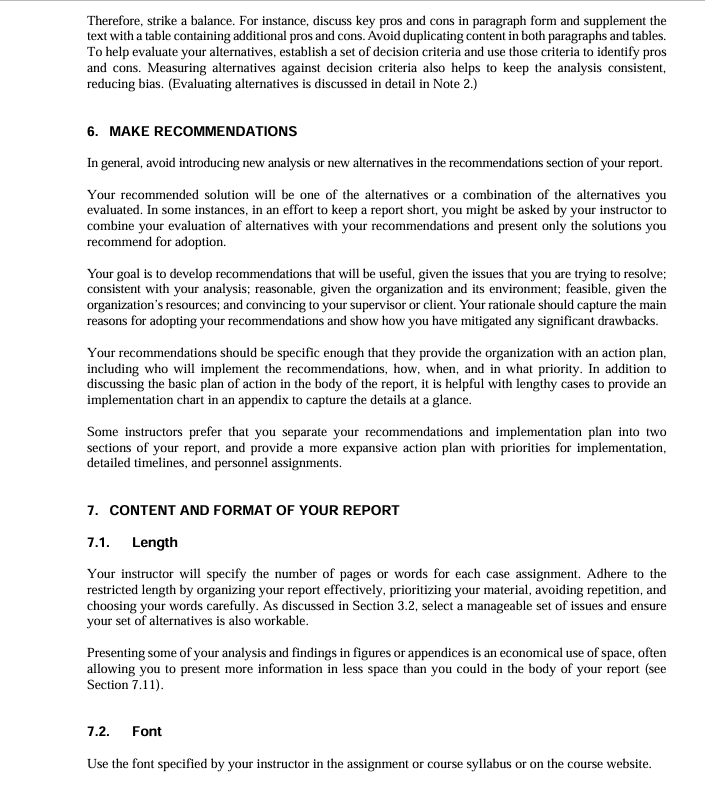
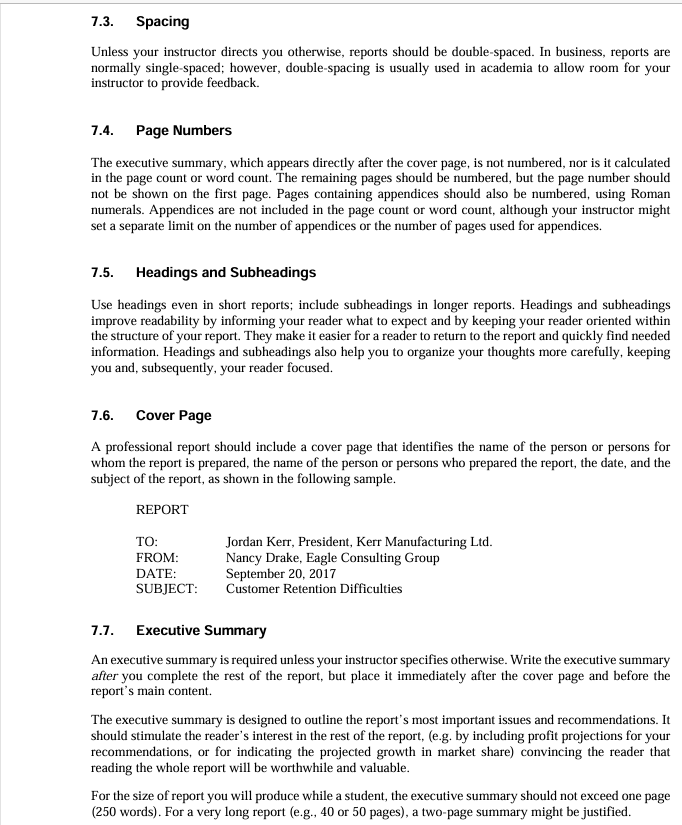
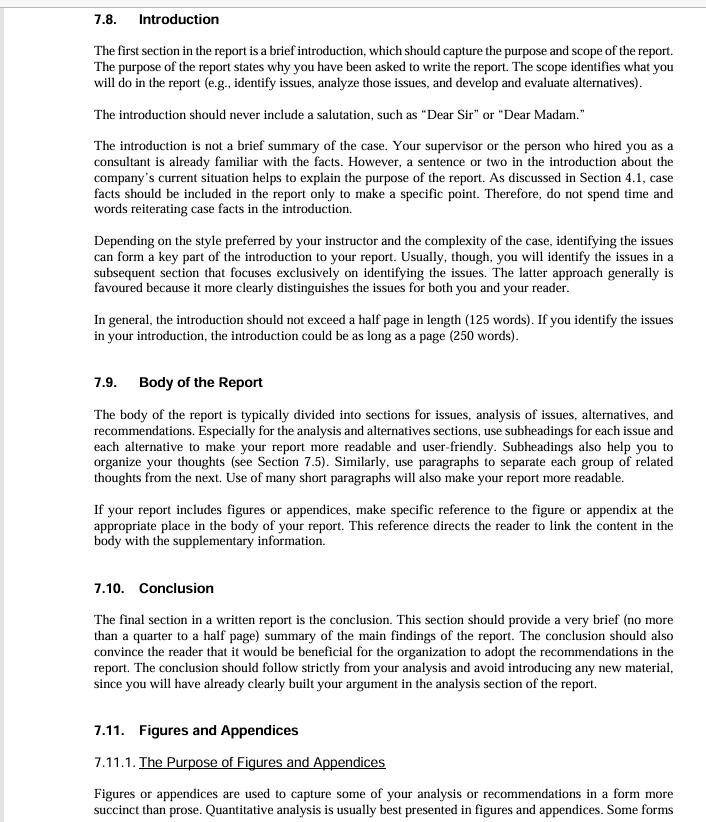
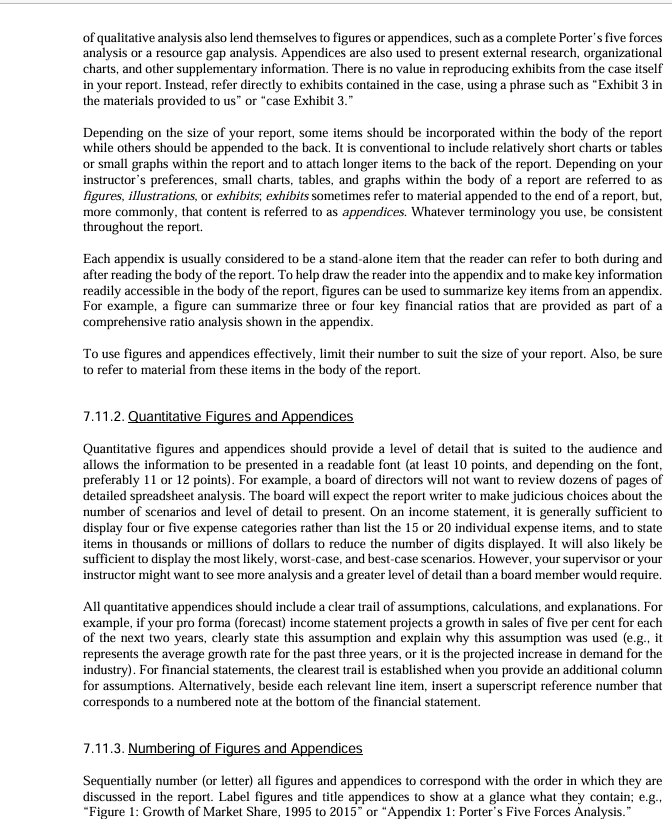
\f1. INTRODUCTION TO PREPARING A WRITTEN CASE REPORT The method for a basic case analysis presented in Note 2 of the Case Guide Series"Performing a Case Analysis,\" No. 9B18M054can be used for various purposes: discussing the case in class, wriling a report, making a presentation, or writing a case exam. This note guides you in preparing a written case report by applying the four steps of case analysis described in Note 2. The report described in this note assumes that you are performing a full case analysis (rather than doing a partial case analysis or taking an analytical approach). The guidelines relating to format, organization, and written communication are for general use. You should always defer to your instructor's requirements, which might differ and be more specific. 2. PLAY YOUR ASSIGNED ROLE For each case assignment, you will be asked 1o adopt a specific role as a student, consultant, employee, or manager who is writing a report to a specilic person or persons. Depending on your assigned role, your analysis could be wrilten as a report to your instructor, your supervisor, the board of directors, or to the client who engaged you as a consultant. In this note, we generally refer to the person who will receive the report as the reader. It is important that before you begin writing your report, you have a clear understanding of who will be reading yvour report and that person's (or those persons') needs and expectations. Your report should be written with your reader(s) in mind. Your audience is reading the report to gain an understanding of how you propose to solve an issue. They are pressed for time and are often inundated with information. They want their information quickly and easily without having to bring extra thought to the process of reading. The following are some suggestions to make your report reader-friendly: + Avoid jargon, inside terminology, and undefined abbreviations. + Keep your sentences simple and straightforward, use paragraphs to group similar thoughts, and keep your paragraphs short. Make the information easy to lind by using headers and page numbers, clear and informative section headings, and accurate cross-references. Avoid decorative elements and be generous with while spaceextra linesbelween sections so your reader can easily see how information is clustered. Always use professional tone and tact. However, il you are playing the role of an external consultant, you can be a little bolder in making your points than if you are playing the role of someone from within the organizationespecially when writing to a supervisor. 3. IDENTIFY THE ISSUES 3.1. Be Clear A high-quality case reporl focuses on the most important issues and clearly identifies those issues at the starl of the report. Without a clear statement of the issues, problems, and opportunities (collectively referred to hereafler as \"issues\") that you intend to address, your report will wander aimlessly from one topic to the next and be of limited value to vour reader. 3.2. Settle on a Manageable Set of Issues It is important to arrive at a set of relevant issues that are manageable within the size constraints of your written report. (See Note 2 for more information about evaluating and prioritizing issues.) In a short report {e.g., 1,000 to 1,500 words), you can usually effectively address only two or three issues. In a longer report (e.g., 2,500 to 3,000 words), you might be able to address five or six issues. Focusing in-depth on a few key issues is generally more productive than a cursory analysis of many issues. Particularly in long or complex cases, you will need to make choices among the issues and determine priorities. 3.3. Use Your Issue Statement to Let the Reader Know What to Expect An easy way to let the reader know what to expect in the upcoming analysis is to ensure that the issues you identily are the same issues that you subsequently analyze. Something you first identify as an issue might sometimes dissipate or diminish in priority after you begin your analysis, and other issues might surface. This change in priorities is part of the normal iterative process of case analysis. Although you should begin your draft report with a clear issue statement, the issue stalement will evolve to a certain degree as you complete your report. Double-back after you have completed your initial analysis of the issues and revise your issue staternent accordingly. In the final version of the report, the issues you identify at the start of the report should be in absolute agreement with your subsequent analysis and recommendations. For a complex case, your issue statement should also identily the sub-issues associated with each issue. Noting the sub-issues will help to prepare the reader for the analysis section. For instance, the owner of a business might contemplate whether to expand to the United States. As an issue statement, the question of whether to expand to the United States is superficial and can be made more precise. A full issue slatement might include whether the company has the resources to successfully execute such a move, whether the American markel is more attractive than the Canadian one, and whether such a move [its with the preferences of others who own a significant share of the company. The reader of the report is then set up to expect, for example, a resource gap analysis; an analysis of market size, growth trends, and the degree of competition in both the American and Canadian markets; and an analysis of stakeholder preferences. To provide another example, a 1999 strategic management case about WestJet Airlines Lid. asked two questions: "Should WestJet move into Eastern Canada? If so, how soon and to what extent?\" For that particular case, a sample issue statement might be The main issue facing WestJet is whether to move into Eastern Canada. Three key factors to consider in this decision are the degree to which such a move will require the company to deviate from its successful Southwest model, how the move would {it with corporate goals, and the level of competition WestJet would face in Eastern Canada compared with in Western Canada. The second issue facing WestJet is to determine the timing and magnitude of any eastward expansion that would be compatible with the company's goals and resource constraints, and align with competitors' plans and capabilities. This issue statement provides a logical foundation for the following analyses: an assessment ol what the Southwest model involves, and how it gives West]et a competitive advantage; an assessment of goals, such as keeping debt low and continuing to grow in Western Canada; and an analysis of the competition posed by Air Canada and other low-fare entrants in both Eastern and Western Canada. Although the issue stalement does not explicitly lay out the types of analyses that will follow in the report, it should provide enough hints and clues that a reader will not be surprised to find a section on \"The Southwest Model\" or "Analysis of the Competition.\" This approach to building an issue statement also ensures that you are being deliberate in selecting and applying various analytical tools and models. Remember, a reasonable degree of clarity about the issues is necessary to begin preparing your case report, but expect your understanding of the issues to evolve as you progress through your analysis. Ensure that your linal issue statement reflects your refined identification of the issues and accurately orients the reader to the rest of the case report. 4. ANALYZE THE ISSUES 4.1. Test the Case Facts To produce a high-quality report, you need to present the case facts in a way that contributes to your analysis and adds value to your report. Avoid merely reiterating or rehashing case material. When you restate case facts, be sure they form part of a logical argument and are accompanied by inferences and findings. To ensure that you are using the case facts appropriately, read each sentence in your report that includes a fact from the case and ask yourself, \"What's my point?\" If the answer to this question is not addressed in the same sentence or in the next few lines of the report, either delete the fact or explain the inference that you intended to draw. For example, there is little value in repeating that "the company currently holds a five per cent markel share in Canada\" unless you use that fact to support, say, the contention that the company has room to grow its Canadian customer base prior lo expanding into the United States. You do not need o use a formal footnote when referring to material from the case. Direct quotations [rom the case should be acknowledged by citing the page number of the case in the body of the report, but keep direct quotations to a bare minimum, using them only where special emphasis is desired. 4.2. Use Business Concepts Business concepts that are used as part of your analysis should add value 1o your report and be relevant to your reader. Avoid discussing theories or models unless you explain them sufficiently and fit them to the situation in the case. For example, discussing what constitutes a competitive advantage is of little value unless you then proceed to use the VRIO model developed by Jay Bamney to illustrate that the organization's resources and capabilities are valuable, rare, inimitable, and that the firm is organized to exploit those resources and capabilities. The required level of explanation depends on the reader's knowledge, educational background, and organizational position. You might not need to explain common business terms, but do not assume that your reader is familiar with academic or business models such as Victor Vroom's expectancy theory or the growth-share matrix developed by Boston Consulting Group. Some business terms, such as competitive advantage and core competencies, are widely used but different people might understand them differently. When in doubt, briefly explain a term. For example, you might specify thal an organization's compelitive advantage refers to how it intends to altract customers by olfering something that is of value to them and differs from what its competitors offer. Specifically and deliberately apply business concepts to the case. For example, a discussion of Raymond Vernon's model of a product life cycle should categorize the company's products into various life cycle stages and assess the implications of having two-thirds of the company's products in the maturity and decline stages. A case report is not an academic research report; avoid writing that is overly theoretical and academic. Considerable skill is required to successfully inlegrate business theory so that it is perceived as practical and not averly conceplual. Al the same time, you want to show your instructor that you are able to apply the course material and demonstrate to the intended reader that you have the appropriate expertise relevant to the situation. 4.3. Use External Research Sparingly To keep your task of writing a case report more manageable, most of your reports will not require external research, When your instructor does request external research, the results of your research should also be presented to add value to the reporl, making it clear why the research is relevant to the situation. Never append external research to your written report without using that research to help dissect issues or build arguments. Acknowledge the source of any external research with a reference note (e.g., a footnote, endnote, or in-text citation). 4.4. Adhere to Length Constraints Your instructor will usually set a word or page limit for your report. Learning to be concise and eflicient with your writing will prepare you for writing excellent reports for busy professionals. The analysis portion of your report should be substantial. Together with the evaluation of alternatives, il will form the bulk of your report. However, because of length constraints, be judicious in deciding how much and which parts of your analysis to include in your written report. Some of the analysis is mainly for your own benelithelping you understand the organization and its industryrather than being of value to the reader. Your instructor might ask you to include such analysis in an appendix, with appropriate references to the appendix in the reporl. Alternatively, your instructor might ask you to exclude such analysis from the report to make room for analysis that will be of more value to the reader. 5. DEVELOP AND EVALUATE YOUR ALTERNATIVES Depending on how long your report is and how complex the issues are, you could evaluate as few as three or four alternatives or as many as seven or eight. It is rarely possible to do a good job of evaluating more than eight alternatives. Sometimes, il can seem expedient 1o group a few alternatives together and evaluate them as a package. However, it can be difficult to evaluate combined alternatives because each component usually has its own pros and cons. As well, evaluating packaged alternatives often obscures some of the issues and resulls in an evaluation that is less thorough than if each alternative had been evaluated separately. Therefore, it is usually preferable to wait until the recommendation phase to combine alternatives. Rather than providing a complete evaluation of the pros and cons of all your alternatives, it might be sufficient to only briefly mention some of the alternatives and give a short rationale for why they were discarded early in the evaluation process. Since analysis of alternatives is a key part of any written report, ensure that you sufficiently discuss your selected alternatives in the body of the report. Listing the pros and cons in bullet form or presenting such information in tables is an efficient way to evaluate alternatives. However, avoid using phrases that have ambiguous meanings, such as \"requires additional resources\" or "uses core competencies.\" Such phrases leave the reader to draw inferences. Instead, specify the resources that are required or the core compelencies to be used. Using lists and tables can also have disadvantages. Too many lists and tables can lead to a report that appears cluttered and is difficult to read. However, a report that is text-heavy can also be cumbersome to read. Therefore, strike a balance. For instance, discuss key pros and cons in paragraph form and supplement the text with a table containing additional pros and cons. Avoid duplicating content in both paragraphs and tables. To help evaluate your alternatives, establish a set of decision criteria and use those criteria to identify pros and cons. Measuring alternatives against decision criteria also helps to keep the analysis consistent, reducing bias. (Evaluating alternatives is discussed in detail in Note 2.) 6. MAKE RECOMMENDATIONS In general, avoid introducing new analysis or new alternatives in the recommendations section of your report. Your recommended solution will be one of the alternatives or a combination of the alternatives you evaluated. In some instances, in an effort to keep a report short, you might be asked by your instructor to combine your evaluation of alternatives with your recommendations and present only the solutions you recommend for adoption. Your goal is to develop recommendations that will be useful, given the issues that you are tryving to resolve; consistent with your analysis; reasonable, given the organization and its environment; feasible, given the organization's resources; and convincing to your supervisor or client. Your rationale should capture the main reasons for adopting your recommendations and show how you have mitigated any significant drawbacks. Your recommendations should be specific enough that they provide the organization with an action plan, including who will implement the recommendations, how, when, and in what priority. In addition 1o discussing the basic plan of action in the body of the report, it is helpful with lengthy cases to provide an implementation chart in an appendix to capture the details al a glance. Some instructors prefer that you separate your recommendations and implementation plan into two sections of your report, and provide a more expansive action plan with priorities for implementation, detailed timelines, and personnel assignments. 7. CONTENT AND FORMAT OF YOUR REPORT 7.1. Length Your instructor will specify the number of pages or words for each case assignment. Adhere to the restricted length by organizing your report effectively, prioritizing your material, avoiding repetition, and choosing your words carefully. As discussed in Section 3.2, select a manageable set of issues and ensure your set of alternatives is also workable. Presenting some of your analysis and findings in figures or appendices is an economical use of space, often allowing you to present more information in less space than you could in the body of your report (see Section 7.11). 7.2. Font Use the font specified by your instructor in the assignment or course syllabus or on the course website. 7.3. Spacing Unless your instructor directs you atherwise, reports should be double-spaced. In business, reports are normally single-spaced; however, double-spacing is usually used in academia to allow room for your instructor to provide feedback. 7.4. Page Numbers The executive summary, which appears directly after the cover page, is not numbered, nor is it calculated in the page count or word count. The remaining pages should be numbered, but the page number should nol be shown on the first page. Pages containing appendices should also be numbered, using Roman numerals. Appendices are not included in the page count or word count, although your instructor might sel a separate limit on the number of appendices or the number of pages used lor appendices. 7.5. Headings and Subheadings Use headings even in short reports; include subheadings in longer reports. Headings and subheadings improve readability by informing your reader what to expect and by keeping your reader oriented within the structure of your report. They make it easier for a reader to return to the report and quickly find needed information. Headings and subheadings also help you to organize your thoughts more carefully, keeping vou and, subsequently, your reader focused. 7.6. Cover Page A professional report should include a cover page that identifies the name of the person or persons for whom the report is prepared, the name of the person or persons who prepared the report, the date, and the subject of the report, as shown in the following sample. REPORT TO: Jordan Kerr, President, Kerr Manufacturing Lid. FROM: MNancy Drake, Eagle Consulting Group DATE: September 20, 2017 SUBJECT: Customer Retention Difficulties 7.7. Executive Summary An executive summary is required unless your instructor specilies otherwise. Write the executive summary after you complete the rest of the report, but place it immediately after the cover page and before the report's main content. The executive summary is designed to outline the report's most important issues and recommendations. It should stimulate the reader's interest in the rest of the report, (e.g. by including profit projections for your recommendations, or for indicating the projected growth in market share) convincing the reader that reading the whole report will be worthwhile and valuable. For the size of report you will produce while a student, the executive summary should not exceed one page (250 words). For a very long report (e.g., 40 or 50 pages), a two-page summary might be justified. 71.8. Introduction The first section in the report is a briel introduction, which should capture the purpose and scope of the report. The purpose of the report states why you have been asked to write the report. The scope identifies what you will do in the report (e.g., identify issues, analyze those issues, and develop and evaluate alternatives). The introduction should never include a salutation, such as \"Dear Sir\" or \"Dear Madam.\" The introduction is not a brief summary of the case. Your supervisor or the person who hired you as a consultant is already familiar with the facts. However, a sentence or two in the introduction about the company's current situation helps to explain the purpose of the report. As discussed in Section 4.1, case facts should be included in the report only to make a specific point. Therefore, do not spend time and words reiterating case lacts in the introduction. Depending on the style preferred by your instructor and the complexity of the case, identifying the issues can form a key part of the introduction to your report. Usually, though, you will identify the issues in a subsequent section that focuses exclusively on identifying the issues. The latler approach generally is favoured because it more clearly distinguishes the issues for both you and your reader. In general, the introduction should not exceed a half page in length (125 words). If you identify the issues in your introduction, the introduction could be as long as a page (250 words). 7.9. Body of the Report The body of the report is typically divided into sections [or issues, analysis of issues, alternatives, and recommendations. Especially lor the analysis and alternatives sections, use subheadings for each issue and each allernative to make your report more readable and user-friendly. Subheadings also help you 1o organize your thoughts (see Section 7.5). Similarly, use paragraphs to separate each group of related thoughts from the next. Use of many short paragraphs will also make your report more readable. If your report includes figures or appendices, make specific reference to the figure or appendix at the appropriate place in the body of your report. This reference directs the reader to link the content in the body with the supplementary information. 7.10. Conclusion The final section in a written report is the conclusion. This section should provide a very briel (no more than a quarler to a hall page) summary of the main findings of the report. The conclusion should also convince the reader that it would be beneficial for the organization to adopt the recommendations in the report. The conclusion should follow strictly from your analysis and avoid introducing any new material, since you will have already clearly built your argument in the analysis section of the report. 7.11. Figures and Appendices 7.11.1. The PLII'QCIISE of Figures and AQQEHdiCES Figures or appendices are used to capture some of your analysis or recommendations in a form more succinct than prose. Quantitative analysis is usually best presented in figures and appendices. Some forms of qualitative analysis also lend themselves to figures or appendices, such as a complete Porter's five forces analysis or a resource gap analysis. Appendices are also used to present external research, organizational charts, and other supplementary information. There is no value in reproducing exhibits [rom the case itsell in your report. Instead, refer directly 1o exhibils contained in the case, using a phrase such as "Exhibit 3 in the materials provided to us or \"case Exhibit 3.7 Depending on the size of your report, some items should be incorporated within the body of the report while others should be appended to the back. It is conventional to include relatively short charts or tables or small graphs within the report and to attach longer items to the back of the report. Depending on your instructor's preferences, small charts, tables, and graphs within the body of a report are referred to as figures, illustrations, or exhibits, exhibits sometimes refer to material appended to the end of a report, but, more commonly, that content is referred (o as appendices. Whatever terminology you use, be consistent throughout the report. Each appendix is usually considered to be a stand-alone item that the reader can refer to both during and after reading the body of the report. To help draw the reader into the appendix and to make key information readily accessible in the body of the report, ligures can be used to summarize key items [rom an appendix. For example, a figure can summarize three or four key financial ratios that are provided as part of a comprehensive ratio analysis shown in the appendix. To use figures and appendices effectively, limit their number to suit the size of your report. Also, be sure to refer to material from these items in the body of the report. 7.11.2. Quantitative FigUFES and Appendices Quantitative figures and appendices should provide a level of detail that is suited to the audience and allows the information to be presented in a readable font (at least 10 points, and depending on the font, preferably 11 or 12 points). For example, a board of directors will not want to review dozens of pages of detailed spreadsheet analysis. The board will expect the report writer to make judicious choices about the number of scenarios and level of detail to present. On an income statement, it is generally sufficient to display four or five expense categories rather than list the 15 or 20 individual expense items, and (o state iterns in thousands or millions of dollars to reduce the number of digits displayed. It will also likely be sulficient to display the most likely, worst-case, and best-case scenarios. However, your supervisor or your instructor might want to see more analysis and a greater level of detail than a board member would require. All quantitative appendices should include a clear trail of assumptions, calculations, and explanations. For example, if vour pro forma (forecast) income statement projects a growth in sales of five per cent for each of the next two years, clearly state this assumption and explain why this assumption was used (e.g., it represents the average growth rate for the past three years, or it is the projected increase in demand for the industry). For financial statements, the clearest trail is established when you provide an additional column for assumptions. Alternatively, beside each relevant line item, insert a superscript reference number that corresponds to a numbered note at the bottom of the financial statement. 7.11.3. Numbering of Figures and Appendices Sequentially number (or letter) all figures and appendices to correspond with the order in which they are discussed in the report. Label figures and title appendices to show at a glance whal they contain; e.g., \"Figure 1: Growth of Market Share, 1995 to 20157 or \"Appendix 1: Porter's Five Forces Analysis.\" Figures and appendices should also be professional in appearance and format. Word processing software offers a wide range of colours and designs for charts, graphs, tables, and illustrations; however, unless you are providing the printed copy of the report (and thus have control over the final appearance), avoid the use of colour and keep illustrations simple. Also avoid the use of special efTects such as drop shadows and special, complex, or elaborate shapes. Use shading (i.e., fill) in tables and illustrations only when absolutely necessary. The width of borders should be between 0.5 and 1.0 points in size. When designing tables, use only the borders you need to separate rows and columns. Too many lines, vertical or horizontal, add clutter to content and often make a table more difficult rather than easier to read. Figures and appendices are typically not included as part of the prescribed word count: however, your instructor might prescribe a separate limit on the number of figures and appendices. B. WRITING STYLE, GRAMMAR, AND SPELLING 8.1. Basic Criteria of a Well-Written Report Your report should be well-organized and well-written. Careful attention to grammarincluding sentence structure, paragraph structure, word usage, and puncluationand spelling is essential. Your instructor might evaluate this aspect of your report separately or might show an explicit deduction from your overall grade in an effort 1o emphasize the cost of poor organization, faulty grammar, and misspellings. A poorly written report will have a negative impact on the reader that will adversely colour the reader's view of the entire report. For your work to be perceived as professional, competent, and credible, your report needs to be well written. While spell-checkers and other electronic tools are of some value, they do not detect all types of errors (e.g., using \"weather\" instead of "whether\"). It is also helplul to have someone else review your report for readability, clarity, spelling. and grammar. However, a review by another person does not replace the need to take the time and efTort to carefully review your own work. Plan your time to allow at least a day or two between finishing your first drall and editing your report; otherwise, you might simply see what you saw the last time. It can also be helpful to read your report aloud or to read the paragraphs in reverse order from the end to the beginning. Finally, vou should print and proofread your report. Your eyes and brain have the ability to notice things in a printed copy that are not seen on a screen. Prepare and proofread figures and appendices with the same care as applied to the body of the report. B.2. Use of "l Think" and "I Believe" Avoid the tendency to preface conclusions and recommendations with phrases such as [ think,\" "1 believe,\" or \"We are of the opinion that.\" The entire report represents your thoughis, beliefs, and opinions. It should be clear from the context whether you are citing facts or drawing a conclusion. While qualifying expressions can be used occasionally for special emphasis, their overuse leads to a report that appears tentative. 8.3. Formal versus Informal Reports When deciding on the tone of a report, consider the audience, the customary style within an organization, and the preferences of your supervisor or instructor. A report 1o a board of directors of a large corporation should use more formal language than a report to a small business owner. For example, it is more formal to write, \"The report recommends that the organization [do X|\" than to write, "I recommend that the organization [do Y].\" If your report is directed to your supervisor or a client who is the owner of a small business, use of \"I\" or \"we\" is generally acceptable. As well, when addressing the recipient of the report, it is generally acceplable to use "you.\" However, if the sentence refers to the recipient's department or organization as a whole, use \"the department\" or \"the company\" or a shortened version of the company name. Opinions differ on whether it is acceptable in a report to use the passive voice (e.g., \"It is recommended that"). In general, the active voice (e.g., "We recommend that") is more compelling than the passive voice, and it demonstrates more confidence in, and ownership of, the recommendations. The active voice is also easier to read and generally uses fewer words. 9. PROFESSIONAL LANGUAGE, TONE, AND TACT 9.1. Use Professional Language The report should use professional language that is both concise and clear. Say something well the first time, and you will eliminate repetition and make room lor new content. Keep your sentences short. Ensure that each word communicates the meaning you intend. Avoid flowery language. Remember thal you are writing a business report, not an English essay. Also avoid trite expressions, colloguialisms, and slang. For example, use the word \"receive\" instead of "get;\" use "will earn a profit\" instead of "will make money;\" use "high risk\" rather than "big gamble.\" Use words such as never, always, and very sparingly to avoid exaggeration and generalization. Such words are often unnecessarily inflammatory. As such, they might cause the reader to become defensive, and they might reduce your credibility. Awvoid the use of technical language that your reader will not understand unless you have explained such terms. This guideline also applies to use of theories and models. While you are required to use course concepts in an academic case report (in your role as a student), you are also required 1o apply them in a way that makes them understandable and relevant to the report recipient (in your assigned role as a subordinate or a consultant). For instance, in an organizational behaviour case, you might choose to apply expectancy theory to explain why employees are not motivated. It is sufficient to state (with appropriate support) that employees do not believe that behaviours being asked of them will lead to customer satisfaction, or they do not believe that their supervisors will reward improvements lo customer satisfaction, or they do not value the organization's rewards. Simple, clear conclusions are preferable to a theoretical outline of what expectancy theory is and what it says aboul motivation. Also avoid the use of jargon or "business speak.\" Jargon obscures your intended meaning and creates the potential for misunderstanding. Jargon also changes with generations: using jargon that might be understood by a young generation of business people might leave an older businessperson frustrated and feeling excluded. Similarly, jargon does not usually translate well or consistently across languages, and is potentially confusing, excluding, or even offending to an international reader. Instead of "reaching out\" or \"touching base,\" \"contact\" the person. Rather than pursuing "buy-in,\" "seek agreement\" on a course of action. Use big words only to the extent that you can do so effectively. In general, clarily and conciseness are more important than trying o impress your supervisor, client, or instructor. 9.2. Use Constructive Language Since a case report culminates in recommended alternatives for action, the goal is to be persuasive. Throughout the report, be positive, constructive, tactful, and considerate of the reader's feelings, so as not to alienate the reader. Although one important facet of the report is to identily issues, care should be taken to avoid overly negative language, especially when the report is addressed to your superiors. For example, rather than stating that \"management has failed o recognize that the current strategy is no longer effective,\" state that, \"due to significant changes in the external environment, the company has reached the stage where a new stralegy is required to ensure its ongoing success.\" Avoid accusatory statements such as \"poor management\" or "management has neglected to.\" It is more appropriate to state, for example, that \"there were insufficient controls in place\" rather than "there was a lack of internal controls\" or \"management failed to establish internal controls.\" Using appropriate language and tone will make the reader more receptive to what you say in the report about various issues. It will also make your analysis and recommendations more credible. 9.3. Use Must and Need Sparingly Also related to tone and tact is the use of the word must. In general, avoid telling the recipient of the report what the person must do. Overuse of that word reflects a lack of distinction between essential actions and suggested recommendations. As well, must has the connotation of ordering or commanding action. Your reader will react more positively, just as you would, to phrases such as "I recommend,\" \"It would be beneficial to,\" or \"The company should,\" rather than being told what the reader must do. It is also preferable to use wording such as *Your department should\" rather than " Your department needs t0.\" Reserve need o and needs fo for actions that are absolutely essential 1o emphasize their critical nature. Use \"I recommend\" [or actions that would be prudent or wise. 10. CASE REPORTS WRITTEN BY TEAMS 10.1. Team Meetings If you are assigned to complete your case as part of a team, plan to meet at least twice and perhaps three times to discuss the entire case. Set an agenda for each meeting and hold each other accountable for being prepared. For example, the goals of the [irst meeting might be to identify the issues and begin to analyze them. Prior to that meeting, each member of the team should read the case at least once, preferably twice, and make some preliminary notes. The goals of the second meeting might be to develop and evaluate alternative solutions and to drafl recommendations. Prior to that meeting, individual team members might be assigned the task of completing more in-depth analysis (e.g., calculating financial ratios, comparing the firm's product offering and value proposition to those of key competitors). Some team members might be assigned the role of capturing what was accomplished at the previous meeting by drafling one or more sections of the report. The agenda for the final meeting might be to review the draft for consistency, clarity, grammar, and so on, and to finalize the report. 10.2. Brainstorming One of the key benefits of working in teams is the ability to generate more ideas and to benefit from each another's ideas. For this advantage to be achieved, it is helpful to use a technique called \"brainstorming\" when identifying the issues and, especially, when generating alternative solutions. Brainstorming attempts to come up with as many ideas as possible by holding off on any evaluation or criticism of the ideas until a later time. 10.3. The Task of Writing the Report The duty of writing the report can be split or rotated among team members, but the [inal product should represent a team effort and not simply be a piecing together of several individually-crafted sections. The latter approach usually leads to inconsistencies such as analyzing issues that were not mentioned in the identification of issues, failing to solve issues that were analyzed, or not using much of the analysis contained in appendices. Some editing of a written dralt should occur at a subsequent meeting or by means of circulating the draft to all members of the team. The final report is the responsibility of the whole feam, not the individuals who are assigned all or part of the writing task. Your instructor might require all members of the team 1o sign off on the report to acknowledge this shared responsibility. 11. CASE ANALYSIS AND ACADEMIC INTEGRITY Because case analysis is complex, it may often seem helpful to discuss the case informally or formally with other students before participating in a class discussion, writing a report, or making a presentation. Managers and consultants often discuss problems with other people, within the constraints allowed by confidentiality. Therefore, your instructor may allow, encourage, or even require such discussion. However, to ensure academic integrity and to avoid plagiarism, unless your instructor has specifically indicated that some degree of discussion is permissible, you should consulf with your instructor before engaging in any collaboration. This restriction on outside discussion is especially necessary when preparing reports and presentations. It may also seem helpful to search the Internet for teaching notes for cases or for case reports or slide presentations prepared by other students. Academic integrity requires that you refrain from using such resources, in full or in part. Any attempt to use the work of others and to pass it off as your own is plagiarism. If the instructor is suspicious that plagiarism might be involved, you may be asked to upload a copy of your case report through Turnitin.com. While using the work of others may appear 1o provide a shoricut to a good grade, the quality of online sources and the work of other students is often suspect, at best. Most importantly, you deprive yoursell of the learning opportunities the case method offers. \f
Step by Step Solution
There are 3 Steps involved in it
1 Expert Approved Answer
Step: 1 Unlock
Question Has Been Solved by an Expert!
Get step-by-step solutions from verified subject matter experts
Step: 2 Unlock
Step: 3 Unlock
Students Have Also Explored These Related Business Writing Questions!










 Study Help