



Question: F5 1 . A long, thin steel wire is cut in half, and eachlialf is connected to a different terminal of a light bulb. An
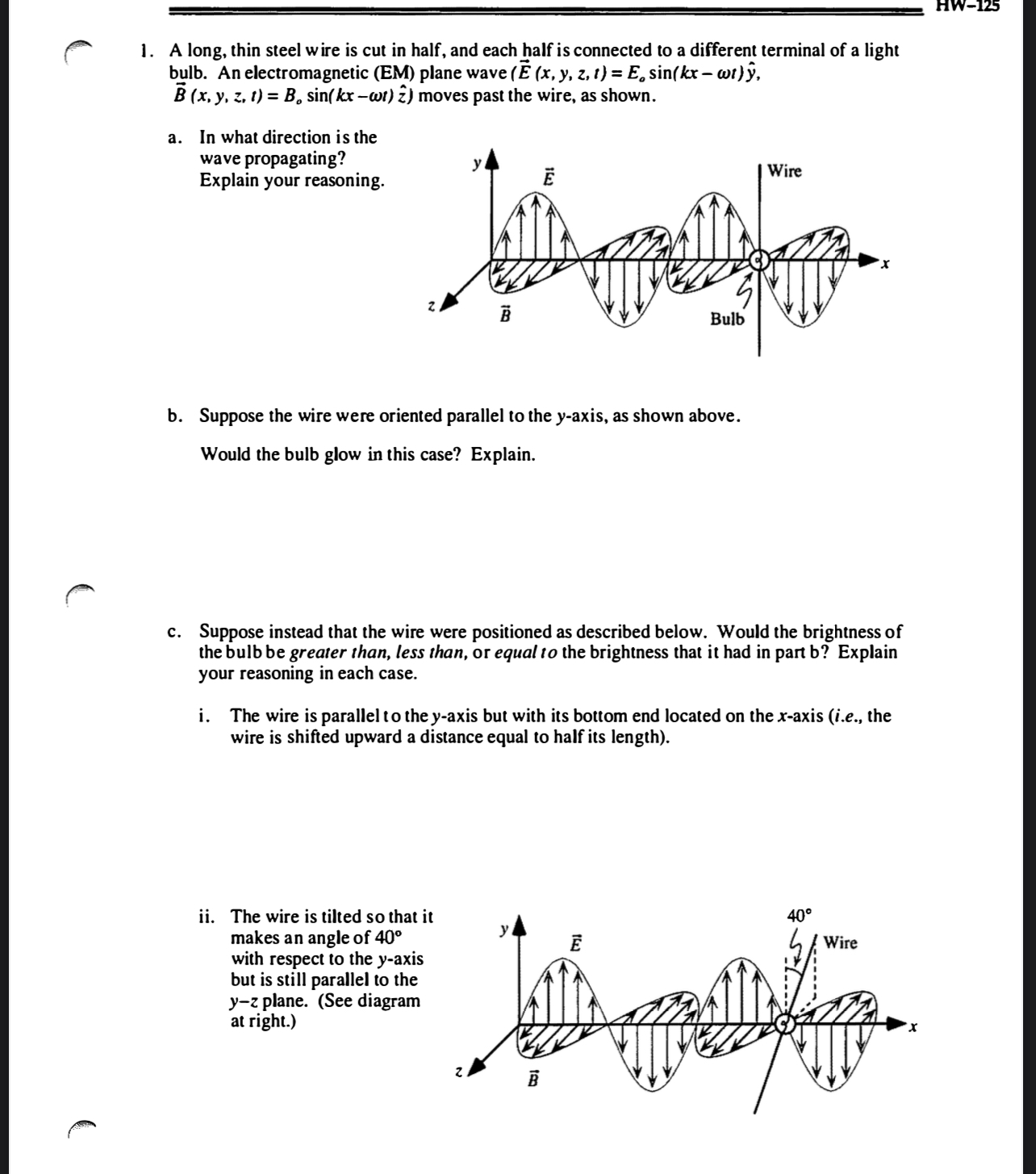
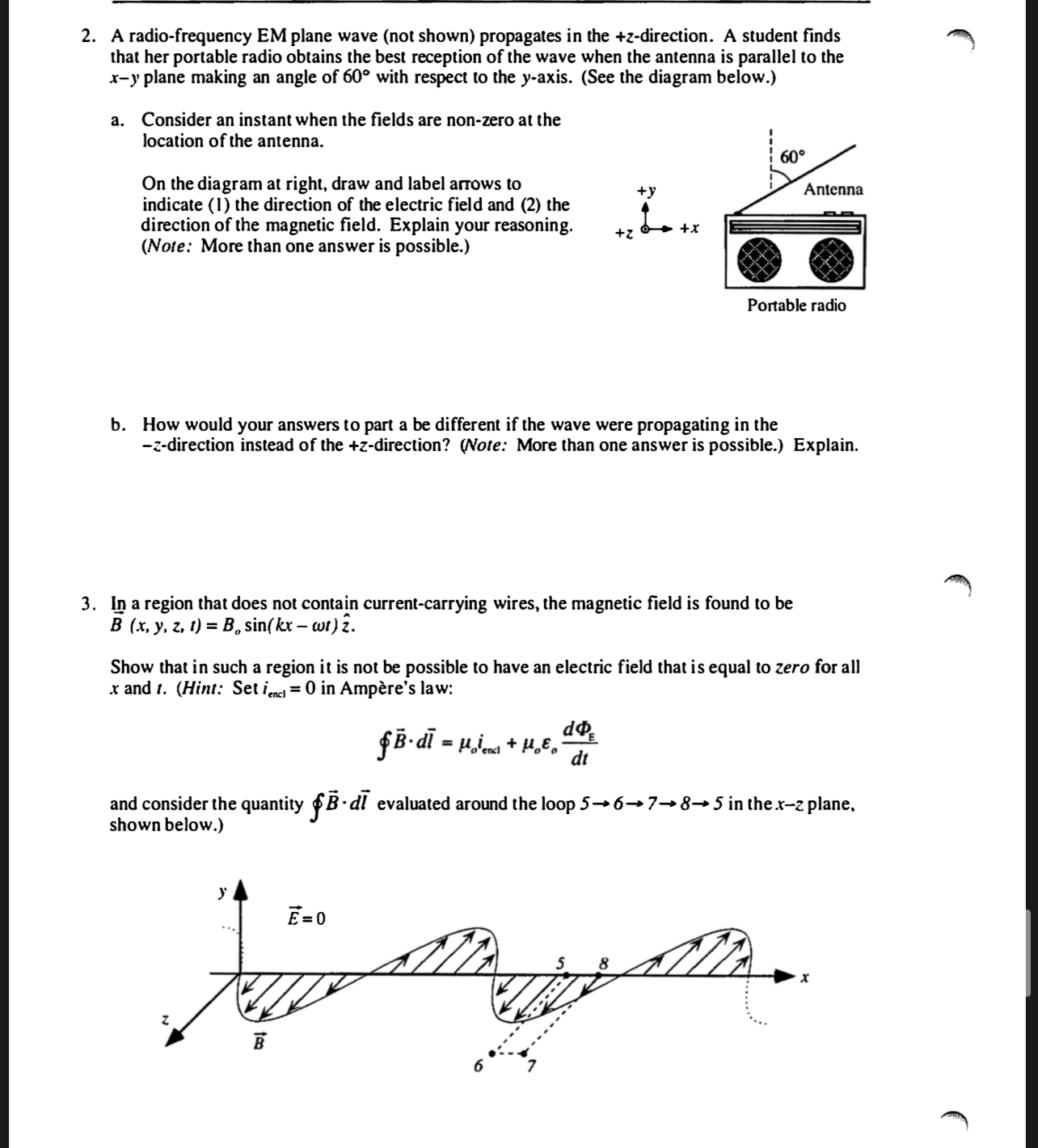
F5" 1 . A long, thin steel wire is cut in half, and eachlialf is connected to a different terminal of a light bulb. An electromagnetic (EM) plane wave { E (x. y. z. t} = E, sin (to: - curly. B (I. y. z. t) = B, sinka wt) 5) moves past the wire. as shown. a. In what direction is the wave propagating? Explain your reasoning. b. Suppose the wire were oriented parallel to the y-axis. as shown above. Would the bulb glow in this case? Explain. c. Suppose instead that the wire were positioned as described below. Would the brightness of the bulb be greater than, less than, or equal to the brightness that it had in part b? Explain your reasoning in each case. i. The wire is parallel to the y-axis but with its bottom end located on the .r-axis (i.e.. the wire is shifted upward a distance equal to half its length). ii. The wire is tilted so that it makes an angle of 40 with respect to the y-axis but is still parallel to the y-z plane. (See diagram at right.) HW-IZS 2. A radio-frequency EM plane wave (not shown) propagates in the +z-direction. A student nds that her portable radio obtains the best reception of the wave when the antenna is parallel to the xy plane making an angle of 60 with respect to the y-axis. (See the diagram below.) a. Consider an instant when the elds are non-zero at the location of the antenna. 0n the diagram at right. draw and label arrows to indicate (I) the direction of the electric field and (2) the direction of the magnetic field. Explain your reasoning. (Note: More than one answer is possible.) Portable radio b. How would your answers to part a be different if the wave were propagating in the -:.-direction instead of the +z-direction? (Note: More than one answer is possible.) Explain. 3. l_r_t a region that does not contain current-carrying wires, the magnetic field is found to be B (x. y. z. t) = B" sin(kr (002.. Show that in such a region it is not be possible to have an electric field that is equal to Zero for all x and t. (Him: Set in\". = O in Ampre's law: dd): dr f'di E \"aim-:14. #080 and consider the quantity ff)" - d? evaluated around the loop 5 _. 6 7. 8-- 5 in thexz plane, shown below.)
Step by Step Solution
There are 3 Steps involved in it

Get step-by-step solutions from verified subject matter experts