







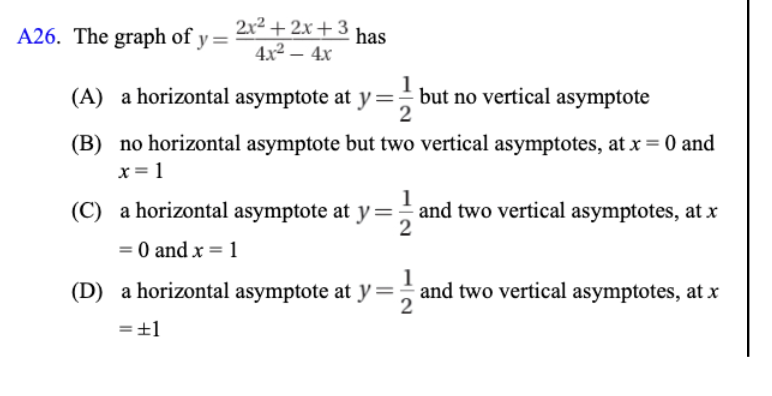
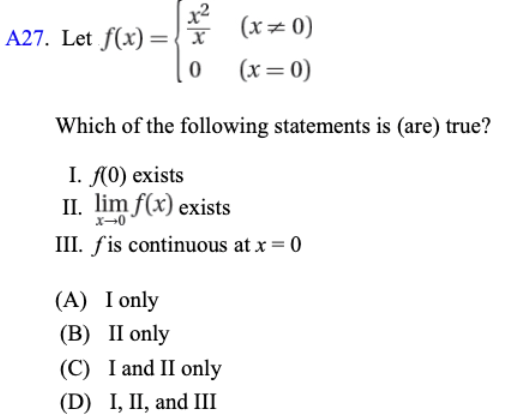
Question: fA27. Let f(x) = X (x* 0) 0 (x= 0) Which of the following statements is (are) true? I. A(O) exists II. lim f(x) exists
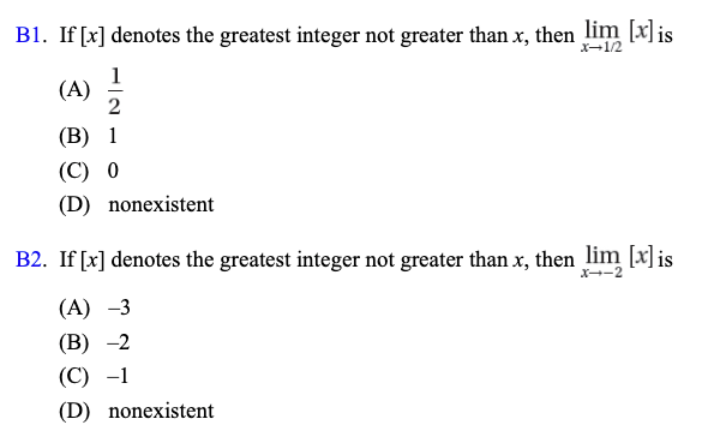
![and IIIB1. If [x] denotes the greatest integer not greater than x,](https://s3.amazonaws.com/si.experts.images/answers/2024/06/666561a430f13_164666561a41433b.jpg)
![then lim [x] is x-+1/2 (A) (B) 1 (C) 0 (D) nonexistent](https://s3.amazonaws.com/si.experts.images/answers/2024/06/666561a46fc73_164666561a45b9eb.jpg)
![B2. If [x] denotes the greatest integer not greater than x, then](https://s3.amazonaws.com/si.experts.images/answers/2024/06/666561a4c13ff_164666561a4afe25.jpg)
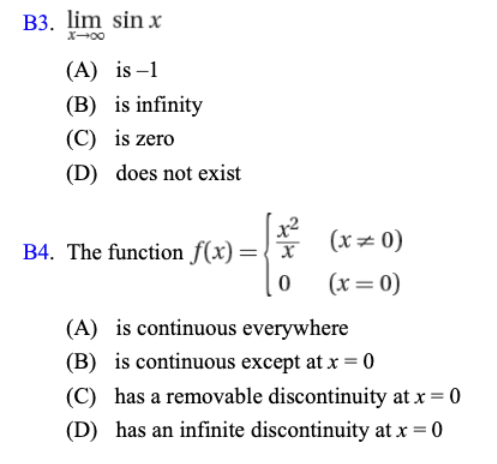
![lim [x] is (A) -3 (B) -2 (C) L (D) nonexistentB3. 13;](https://s3.amazonaws.com/si.experts.images/answers/2024/06/666561a510760_164666561a500182.jpg)
\fA27. Let f(x) = X (x* 0) 0 (x= 0) Which of the following statements is (are) true? I. A(O) exists II. lim f(x) exists x-+0 III. fis continuous at x = 0 (A) I only (B) II only (C) I and II only (D) I, II, and IIIB1. If [x] denotes the greatest integer not greater than x, then lim [x] is x-+1/2 (A) (B) 1 (C) 0 (D) nonexistent B2. If [x] denotes the greatest integer not greater than x, then lim [x] is (A) -3 (B) -2 (C) L (D) nonexistentB3. 13; sin I (A) is 1 (B) is infinity (C) is zero (D) does not exist J.52 B4. The function f(x) = T [x i 0) 0 (x = 0) (A) is continuous everywhere (B) is continuous except at x = 0 (C) has a removable discontinuity at x = 0 (D) has on int'mite discontinuity at x = 0
Step by Step Solution
There are 3 Steps involved in it

Get step-by-step solutions from verified subject matter experts
 Study Help