







Question: Facilities planning and material handling solve using excel with explantion of each step Flow Systems, Activity Relationships and Space requirements 1. For the machine-part matrix
Facilities planning and material handling 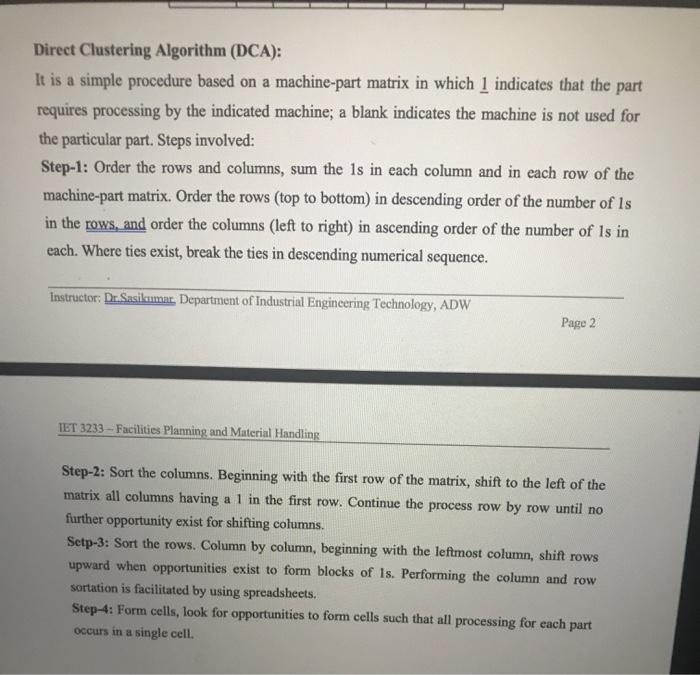
Flow Systems, Activity Relationships and Space requirements 1. For the machine-part matrix shown below, form cells using Direct Clustering Algorithm and, if conflicts exist, propose alternative approaches for resolving the conflicts. Solve the two problems in Microsoft Excel. Show the output of each step with explanation Machine # Part # 1 23 4 4 5 1 1 1 2 1 3 1 1 1 4 1 1 5 1 6 1 1 Machine # Part # 1 2 3 4 5 6 7 1 1 1 1 2 1 1 1 3 1 1 1 1 1 1 va 1 1 6 1 1 Direct Clustering Algorithm (DCA): It is a simple procedure based on a machine-part matrix in which 1 indicates that the part requires processing by the indicated machine; a blank indicates the machine is not used for the particular part. Steps involved: Step-1: Order the tows and columns, sum the Is in each column and in each row of the FOG Direct Clustering Algorithm (DCA): It is a simple procedure based on a machine-part matrix in which 1 indicates that the part requires processing by the indicated machine; a blank indicates the machine is not used for the particular part. Steps involved: Step-1: Order the rows and columns, sum the is in each column and in each row of the machine-part matrix. Order the rows (top to bottom) in descending order of the number of ls in the rows, and order the columns (left to right) in ascending order of the number of ls in each. Where ties exist, break the ties in descending numerical sequence. Instructor: Dr.Sasikumar. Department of Industrial Engineering Technology, ADW Page 2 TET 3233 - Facilities Planning and Material Handling Step-2: Sort the columns. Beginning with the first row of the matrix, shift to the left of the matrix all columns having a 1 in the first row. Continue the process row by row until no further opportunity exist for shifting columns Setp-3: Sort the rows. Column by column, beginning with the leftmost column, shift rows upward when opportunities exist to form blocks of Is. Performing the column and row sortation is facilitated by using spreadsheets. Step 4: Form cells, look for opportunities to form cells such that all processing for each part occurs in a single cell
solve using excel with explantion of each step 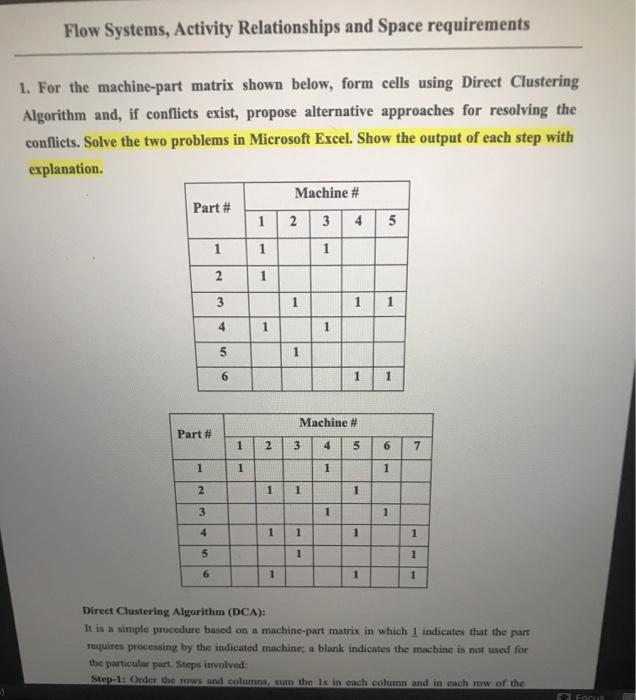
Step by Step Solution
There are 3 Steps involved in it
1 Expert Approved Answer
Step: 1 Unlock

Question Has Been Solved by an Expert!
Get step-by-step solutions from verified subject matter experts
Step: 2 Unlock
Step: 3 Unlock
 Study Help