







Question: Facility doctors determine whether a patient is competent to enter a study before obtaining informed consent for their participation. They are paid a fee for
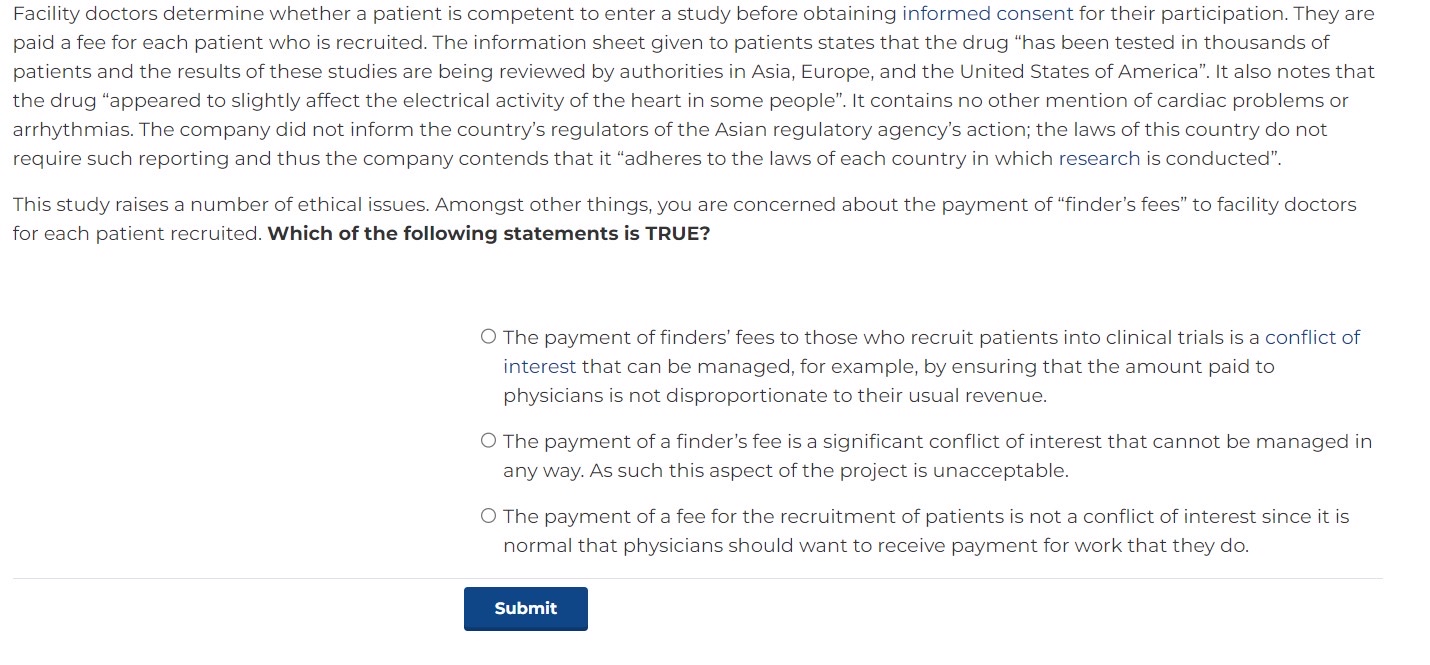
Facility doctors determine whether a patient is competent to enter a study before obtaining informed consent for their participation. They are paid a fee for each patient who is recruited. The information sheet given to patients states that the drug "has been tested in thousands of patients and the results of these studies are being reviewed by authorities in Asia, Europe, and the United States of America". It also notes that the drug "appeared to slightly affect the electrical activity of the heart in some people". It contains no other mention of cardiac problems or arrhythmias. The company did not inform the country's regulators of the Asian regulatory agency's action; the laws of this country do not require such reporting and thus the company contends that it "adheres to the laws of each country in which research is conducted".
This study raises a number of ethical issues. Amongst other things, you are concerned about the payment of "finder's fees" to facility doctors for each patient recruited. Which of the following statements is TRUE?
The payment of finders' fees to those who recruit patients into clinical trials is a conflict of interest that can be managed, for example, by ensuring that the amount paid to physicians is not disproportionate to their usual revenue.
The payment of a finder's fee is a significant conflict of interest that cannot be managed in any way. As such this aspect of the project is unacceptable.
The payment of a fee for the recruitment of patients is not a conflict of interest since it is normal that physicians should want to receive payment for work that they do
Step by Step Solution
There are 3 Steps involved in it
1 Expert Approved Answer
Step: 1 Unlock

Question Has Been Solved by an Expert!
Get step-by-step solutions from verified subject matter experts
Step: 2 Unlock
Step: 3 Unlock
 Study Help