







Question: Fact Pattern:Fact Pattern: You are currently working as a portfolio analyst with a local investment management firm. One of your functions is to prepare summaries
Fact Pattern:Fact Pattern:
You are currently working as a portfolio analyst with a local investment management firm. One of
your functions is to prepare summaries of portfolio performance for the firm's clients. This
performance analysis includes not only returns achieved, but comparisons with the market and
measures of risk exposure. One of the portfolios you are asked to analyze is called the Greshak
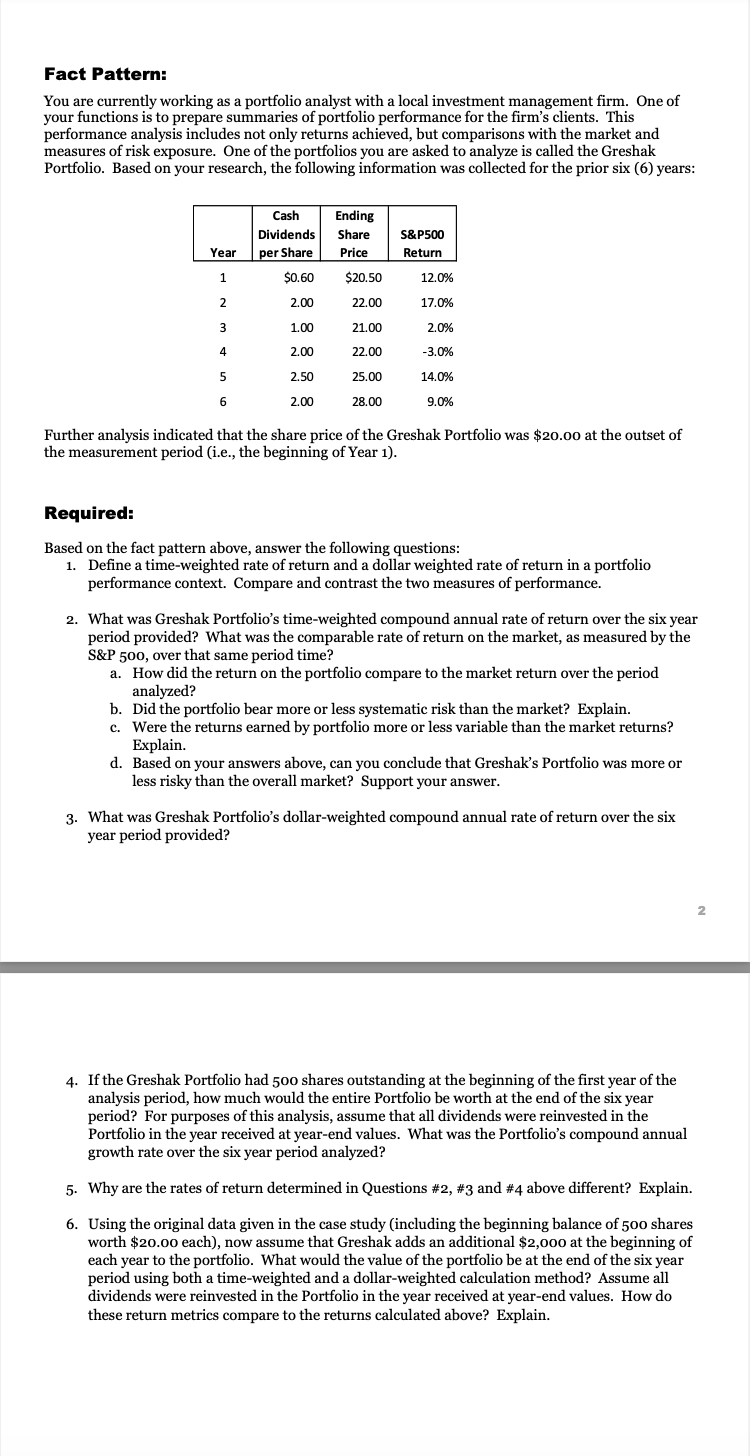
Portfolio. Based on your research, the following information was collected for the prior six years:
Further analysis indicated that the share price of the Greshak Portfolio was $ at the outset of
the measurement period ie the beginning of Year
Required:
Based on the fact pattern above, answer the following questions:
Define a timeweighted rate of return and a dollar weighted rate of return in a portfolio
performance context. Compare and contrast the two measures of performance.
What was Greshak Portfolio's timeweighted compound annual rate of return over the six year
period provided? What was the comparable rate of return on the market, as measured by the
S&P over that same period time?
a How did the return on the portfolio compare to the market return over the period
analyzed?
b Did the portfolio bear more or less systematic risk than the market? Explain.
c Were the returns earned by portfolio more or less variable than the market returns?
Explain.
d Based on your answers above, can you conclude that Greshak's Portfolio was more or
less risky than the overall market? Support your answer.
What was Greshak Portfolio's dollarweighted compound annual rate of return over the six
year period provided?
If the Greshak Portfolio had shares outstanding at the beginning of the first year of the
analysis period, how much would the entire Portfolio be worth at the end of the six year
period? For purposes of this analysis, assume that all dividends were reinvested in the
Portfolio in the year received at yearend values. What was the Portfolio's compound annual
growth rate over the six year period analyzed?
Why are the rates of return determined in Questions # # and # above different? Explain.
Using the original data given in the case study including the beginning balance of shares
worth $ each now assume that Greshak adds an additional $ at the beginning of
each year to the portfolio. What would the value of the portfolio be at the end of the six year
period using both a timeweighted and a dollarweighted calculation method? Assume all
dividends were reinvested in the Portfolio in the year received at yearend values. How do
these return metrics compare to the returns calculated above? Explain.
You are currently working as a portfolio analyst with a local investment management firm. One of
your functions is to prepare summaries of portfolio performance for the firm's clients. This
performance analysis includes not only returns achieved, but comparisons with the market and
measures of risk exposure. One of the portfolios you are asked to analyze is called the Greshak
Portfolio. Based on your research, the following information was collected for the prior six years:
Further analysis indicated that the share price of the Greshak Portfolio was $ at the outset of
the measurement period ie the beginning of Year Using the original data given in the case study including the beginning balance of shares
worth $ each now assume that Greshak adds an additional $ at the beginning of
each year to the portfolio. What would the value of the portfolio be at the end of the six year
period using both a timeweighted and a dollarweighted calculation method? Assume all
dividends were reinvested in the Portfolio in the year received at yearend values. How do
these return metrics compare to the returns calculated above? Explain.
Step by Step Solution
There are 3 Steps involved in it
1 Expert Approved Answer
Step: 1 Unlock

Question Has Been Solved by an Expert!
Get step-by-step solutions from verified subject matter experts
Step: 2 Unlock
Step: 3 Unlock
 Study Help