



Question: Falling Giant: A Case Study of AIG Why Could AIG Have Been Considered a Falling Giant? You may be surprised to learn that the
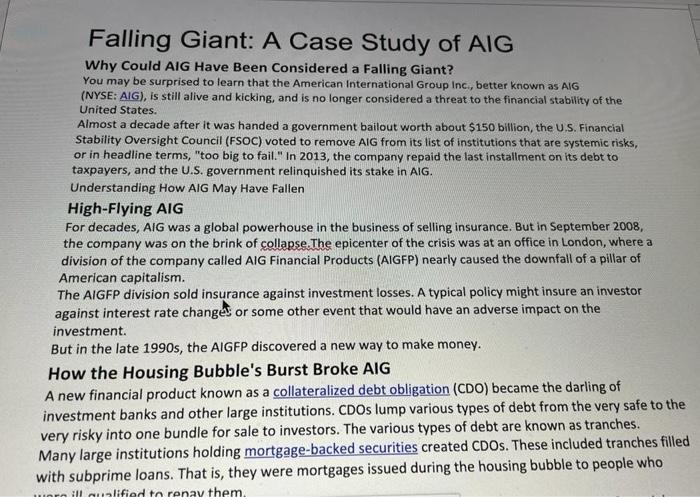
Falling Giant: A Case Study of AIG Why Could AIG Have Been Considered a Falling Giant? You may be surprised to learn that the American International Group Inc., better known as AIG (NYSE: AIG), is still alive and kicking, and is no longer considered a threat to the financial stability of the United States. Almost a decade after it was handed a government bailout worth about $150 billion, the U.S. Financial Stability Oversight Council (FSOC) voted to remove AIG from its list of institutions that are systemic risks, or in headline terms, "too big to fail." In 2013, the company repaid the last installment on its debt to taxpayers, and the U.S. government relinquished its stake in AIG. Understanding How AIG May Have Fallen High-Flying AIG For decades, AIG was a global powerhouse in the business of selling insurance. But in September 2008, the company was on the brink of collapse.The epicenter of the crisis was at an office in London, where a division of the company called AIG Financial Products (AIGFP) nearly caused the downfall of a pillar of American capitalism. The AIGFP division sold insurance against investment losses. A typical policy might insure an investor against interest rate changes or some other event that would have an adverse impact on the investment. But in the late 1990s, the AIGFP discovered a new way to make money. How the Housing Bubble's Burst Broke AIG A new financial product known as a collateralized debt obligation (CDO) became the darling of investment banks and other large institutions. CDOS lump various types of debt from the very safe to the very risky into one bundle for sale to investors. The various types of debt are known as tranches. Many large institutions holding mortgage-backed securities created CDOS. These included tranches filled with subprime loans. That is, they were mortgages issued during the housing bubble to people who worn ill qualified to repay them.
Step by Step Solution
There are 3 Steps involved in it

Get step-by-step solutions from verified subject matter experts