







Question: Falsc 1. () In full- duplex communication, a source and a destination cannot send signal at the same time. 2. () In simplex communication, a
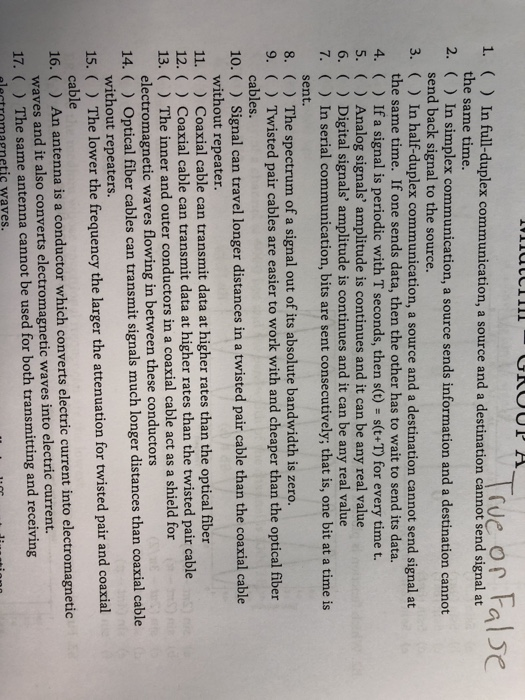
Falsc 1. () In full- duplex communication, a source and a destination cannot send signal at the same time. 2. () In simplex communication, a source sends information and a destination cannot send back signal to the source. 3. () In half-duplex communication, a source and a destination cannot send signal at the same time. If one sends data, then the other has to wait to send its data. 4. If a signal is periodic with T seconds, then s(t) s(t+T) for every time t. 5. ) Analog signals' amplitude is continues and it can be any real value 6. () Digital signals' amplitude is continues and it can be any real value 7. () In serial communication, bits are sent consecutively; that is, one bit at a time is sent. 8. () The spectrum of a signal out of its absolute bandwidth is zero. 9. ) Twisted pair cables are easier to work with and cheaper than the optical fiber cables. 10. Signal can travel longer distances in a twisted pair cable than the coaxial cable without repeater. 11. () Coaxial cable can transmit data at higher rates than the optical fiber 12. () Coaxial cable can transmit data at higher rates than the twisted pair cable 13. () The inner and outer conductors in a coaxial cable act as a shield for 14. Optical fiber cables can transmit signals much longer distances than coaxial cable 15. ) The lower the frequency the larger the attenuation for twisted pair and coaxial 16. () An 17. ( The same antenna cannot be used for both transmitting and receiving electromagnetic waves flowing in between these conductors without repeaters. cable waves and it also converts electromagnetic waves into electric current. antenna is a conductor which converts electric current into electromagnetic electromagnetic waves
Step by Step Solution
There are 3 Steps involved in it

Get step-by-step solutions from verified subject matter experts
 Study Help