







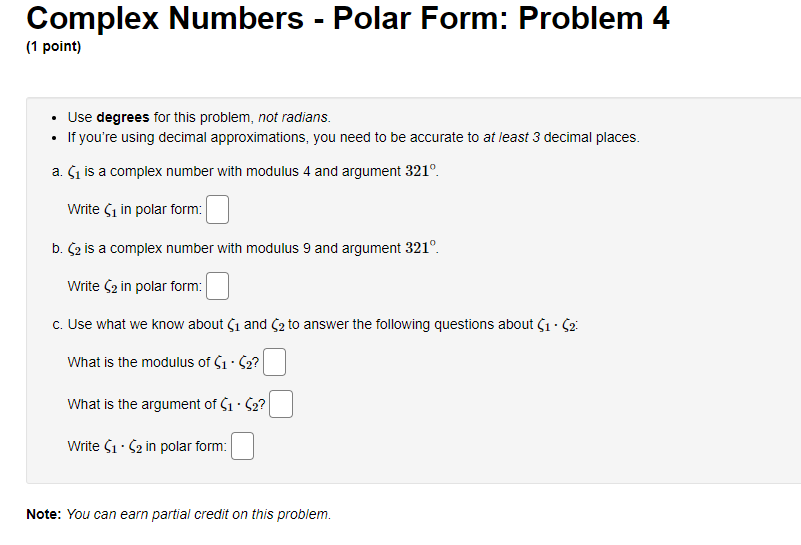
Question: fComplex Numbers - Polar Form: Problem 4 [1 point} - Use degrees for this problem, not radians. - If you're using decimal approximations, you need


![polar form: C] tn. (2 is a complex number 1with modulus E!](https://s3.amazonaws.com/si.experts.images/answers/2024/06/6680e6d883a0b_7366680e6d8702ea.jpg)
\fComplex Numbers - Polar Form: Problem 4 [1 point} - Use degrees for this problem, not radians. - If you're using decimal approximations, you need to be accurate to atleast 3 decimal places. a. C1 is a complex numberwith modulus 4 and argument 321\". Write C1 in polar form: C] tn. (2 is a complex number 1with modulus E! and argument 321\". Write C2 in polar form: [3 c. Use what we Know about C1 and C2 to answer the following questions about C1 - (2: What is the modulus of C1 - {2? D What is the argument of C1 - {2? [3 Write C1 - C2 in polarfonn: [3 Note: You can earn partial credit on this problem. Complex Numbers - Polar Form: Problem 5 [1 point]. - Use degrees forthis problem, no: radians. - If you're using decimal approximations, you need to be accurate to at least 3 decimal places. - Be careful, your device might autoconect \"r\" to a capital \"l". a. 1 is a complex number with modulus 40 and argument 141\". Write C1 in polar form: D h. C2 is a complex number with modulus 8 and argument 45\". Write C2 in polar form: I:] c. Use what we know about (1 and C2 to answer the following questions about (1 + C2: What is the modulus of C1 + (2? C] What is the argument of C1 + Q? I:] Write C1 + C2 in polar form: C]
Step by Step Solution
There are 3 Steps involved in it

Get step-by-step solutions from verified subject matter experts
 Study Help