







Question: fEg.3: If q = 3,1] find 4q ? A vector may not always lie with its tail on the origin. To find the coordinates of
![\fEg.3: If q = 3,1] find 4q ? A vector may](https://dsd5zvtm8ll6.cloudfront.net/si.experts.images/questions/2024/09/66e4715ec9309_26266e4715eaefcd.jpg)
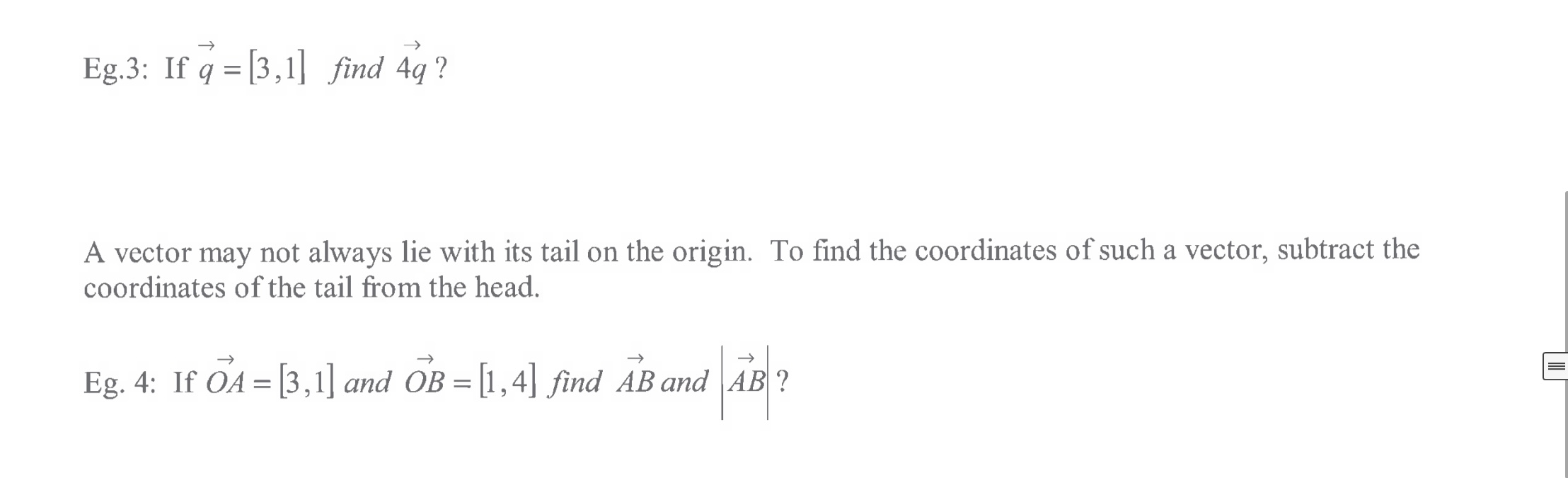
![the head. Eg. 4: If OA = [3,1] and OB = [1,](https://dsd5zvtm8ll6.cloudfront.net/si.experts.images/questions/2024/09/66e471659e0c3_26366e4715fdc1a8.jpg)
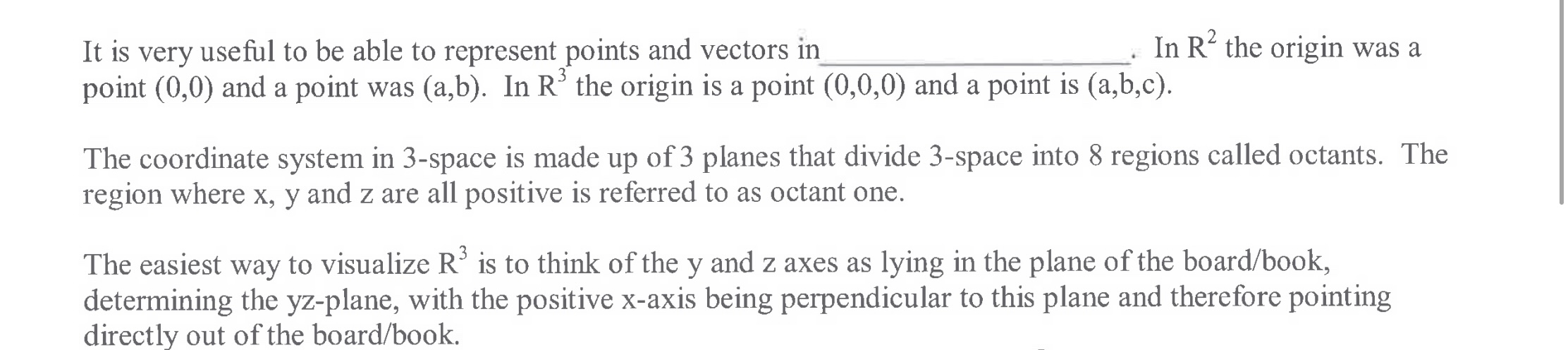
![4] find AB and AB ?It is very useal to be able](https://dsd5zvtm8ll6.cloudfront.net/si.experts.images/questions/2024/09/66e47165e6e63_26966e47165cf676.jpg)
\fEg.3: If q = 3,1] find 4q ? A vector may not always lie with its tail on the origin. To find the coordinates of such a vector, subtract the coordinates of the tail from the head. Eg. 4: If OA = [3,1] and OB = [1, 4] find AB and AB ?It is very useal to be able to represent points and vectors in . In R2 the origin was a point (0,0) and a point was (a,b). In R3 the origin is a point (0,0,0) and a point is (a,b,c). The coordinate system in 3-space is made up of 3 planes that divide 3-space into 8 regions called octants. The region where x, y and z are all positive is referred to as octant one. The easiest way to visualize R3 is to think of the y and z axes as lying in the plane of the board/book, determining the yz-plane, with the positive x-axis being perpendicular to this plane and therefore pointing directly out of the board/book. Eg.1: Write each of the vectors OP = [3, -1, 2], OO = [-5,3, -1], OR = [0, 0, 4]and OS = [-6, 0, 0] using the standard unit vectors. Eg.2: Express each of the following vectors in component form: OP = 2i-3 j-k , OS = 2 j , OM =6i-2k, ON = i+ j-4k .Eg.3: If OA=2i-3 j-k and OB = -4 i+7 j-5k , determine OA and OB as well as AB and AB
Step by Step Solution
There are 3 Steps involved in it

Get step-by-step solutions from verified subject matter experts
 Study Help