



Question: Feistel ciphers: (a) Consider the above Feistel cipher with r = 2 rounds. Describe an exhaustive key search attack. Is this Feistel cipher secure against
Feistel ciphers:
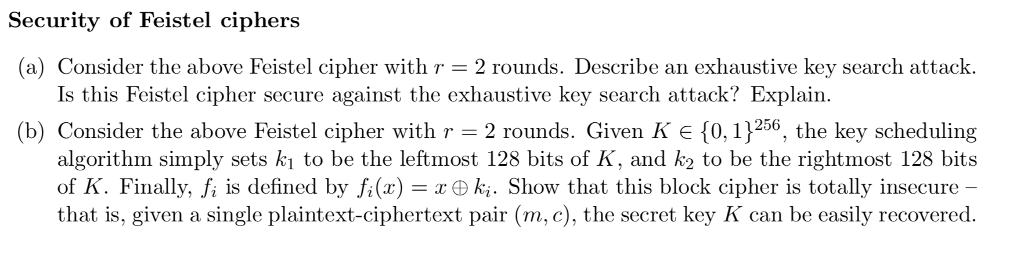
(a) Consider the above Feistel cipher with r = 2 rounds. Describe an exhaustive key search attack. Is this Feistel cipher secure against the exhaustive key search attack? Explain.
(b) Consider the above Feistel cipher with r = 2 rounds. Given K {0, 1}256, the key scheduling algorithm simply sets k1 to be the leftmost 128 bits of K, and k2 to be the rightmost 128 bits of K. Finally, fi is defined by fi(x) = x ki. Show that this block cipher is totally insecure that is, given a single plaintext-ciphertext pair (m, c), the secret key K can be easily recovered.
Security of Feistel ciphers (a) Consider the above Feistel cipher withr 2 rounds. Describe an exhaustive key search attack Is this Feistel cipher secure against the exhaustive key search attack? Explain (b) C = 2 rounds. Given K {0, 1}256, the key scheduling onsider the above Feistel cipher with 7 algorithm simply sets ki to be the leftmost 128 bits of K, and k2 to be the rightmost 128 bits of K. Finally, fi is defined by fi(x)-x ki. Show that this block cipher is totally insecure that is, given a single plaintext-ciphertext pair (m, c), the secret key K can be easily recovered Security of Feistel ciphers (a) Consider the above Feistel cipher withr 2 rounds. Describe an exhaustive key search attack Is this Feistel cipher secure against the exhaustive key search attack? Explain (b) C = 2 rounds. Given K {0, 1}256, the key scheduling onsider the above Feistel cipher with 7 algorithm simply sets ki to be the leftmost 128 bits of K, and k2 to be the rightmost 128 bits of K. Finally, fi is defined by fi(x)-x ki. Show that this block cipher is totally insecure that is, given a single plaintext-ciphertext pair (m, c), the secret key K can be easily recovered
Step by Step Solution
There are 3 Steps involved in it

Get step-by-step solutions from verified subject matter experts