







Question: fEP 4.13 Audit Scope LimitationsClient Imposed. .3 Required.- 5. What alternative procedures can an auditor perform to determine whether the accounts receivable balance is not
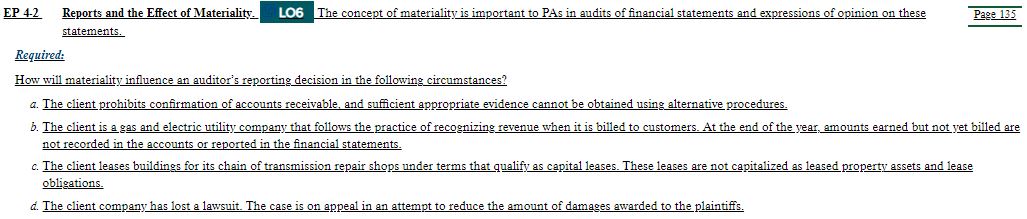



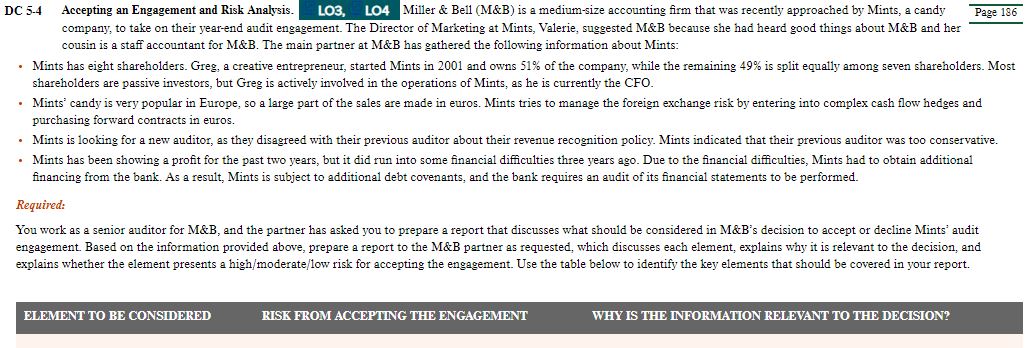
\fEP 4.13 Audit Scope LimitationsClient Imposed. .3\" Required.- 5. What alternative procedures can an auditor perform to determine whether the accounts receivable balance is not materially misstated when client management will not permit audit conrmations to be used? I}. What are the reporting implications if alternative procedures can be performed and provide sufcient audit evidence in situation (a)? c. What are the reporting implications ifalternative procedures cannot be used to satisfy audit eVidence requirements in situation {a}? EP 4-17 Going-Concern Issue. LOG PA is the auditor of TC Inc. TC's revenues and profitability have decreased in each of the past three years and, as of this year-end, 20X3, its retained earnings will fall into a deficit balance. TC's long-term debt comes due in 20X4, and its management is currently renegotiating the repayment date and terms with its Page 138 bondholders. According to PA's discussions with management, the renegotiation is not going well and there is a significant risk that the bondholders will put TC into receivership and liquidate its assets. TC's CFO has provided draft 20X3 financial statements to PA that are prepared in accordance with GAAP. Required: a. Discuss the audit reporting implications of the preceding situation. b. Assume that the long-term debt repayment date was not until 20X5. Would your response differ?EP 5.3 Auditing an Accounting Estimate. m Suppose that management estimated the lower of cost and net realizable value of some obsolete inventory at $99,000 and wrote it down from $120000. recognizing a loss of {521.000. The auditor: obtained the following information: The inventory in question could be sold for an amount between $78.000 and m 392.000. The costs of advertising and shipping could range from $5.000 to 31000. Required.- a. Would you propose an audit adjustment to the management estimate? Write the appropriate accounting entry. .5. If management's estimate of inventory market [lower than cost) had been 550.000. would you propose an audit adjustment? Write the appropriate at counting entry. DC 5-4 Accepting an Engagement and Risk Analysis. LO3, LO4 Miller & Bell (M&B) is a medium-size accounting firm that was recently approached by Mints, a candy Page 186 company, to take on their year-end audit engagement. The Director of Marketing at Mints, Valerie, suggested M&B because she had heard good things about M&B and her cousin is a staff accountant for M&B. The main partner at M&B has gathered the following information about Mints: . Mints has eight shareholders. Greg, a creative entrepreneur, started Mints in 2001 and owns 51% of the company, while the remaining 49% is split equally among seven shareholders. Most shareholders are passive investors, but Greg is actively involved in the operations of Mints, as he is currently the CFO. Mints' candy is very popular in Europe, so a large part of the sales are made in euros. Mints tries to manage the foreign exchange risk by entering into complex cash flow hedges and purchasing forward contracts in euros. Mints is looking for a new auditor, as they disagreed with their previous auditor about their revenue recognition policy. Mints indicated that their previous auditor was too conservative. Mints has been showing a profit for the past two years, but it did run into some financial difficulties three years ago. Due to the financial difficulties, Mints had to obtain additional financing from the bank. As a result, Mints is subject to additional debt covenants, and the bank requires an audit of its financial statements to be performed. Required: You work as a senior auditor for M&B, and the partner has asked you to prepare a report that discusses what should be considered in M&B's decision to accept or decline Mints' audit engagement. Based on the information provided above, prepare a report to the M&B partner as requested, which discusses each element, explains why it is relevant to the decision, and explains whether the element presents a high/moderate/low risk for accepting the engagement. Use the table below to identify the key elements that should be covered in your report. ELEMENT TO BE CONSIDERED RISK FROM ACCEPTING THE ENGAGEMENT WHY IS THE INFORMATION RELEVANT TO THE DECISION
Step by Step Solution
There are 3 Steps involved in it

Get step-by-step solutions from verified subject matter experts
 Study Help