







Question: Feynman argument for encoding bit in very tiny volumes using Si Question 1 Feynman said you could implement the 1015 bits of information contained in
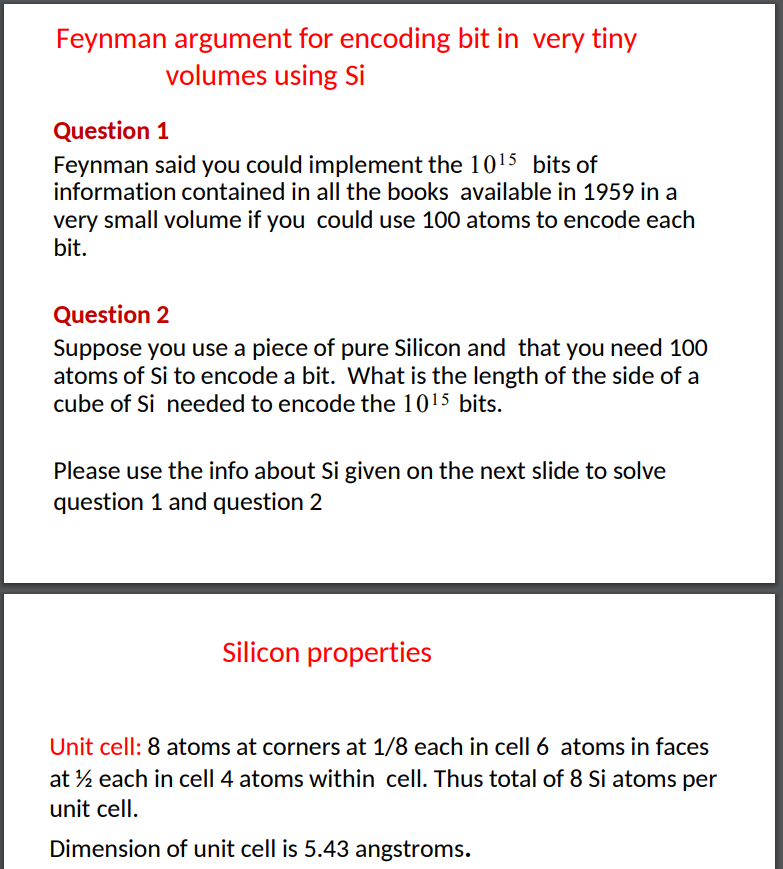
Feynman argument for encoding bit in very tiny volumes using Si Question 1 Feynman said you could implement the 1015 bits of information contained in all the books available in 1959 in a very small volume if you could use 100 atoms to encode each bit. Question 2 Suppose you use a piece of pure Silicon and that you need 100 atoms of Si to encode a bit. What is the length of the side of a cube of Si needed to encode the 1015 bits. Please use the info about Si given on the next slide to solve question 1 and question 2 Silicon properties Unit cell: 8 atoms at corners at 1/8 each in cell 6 atoms in faces : at % each in cell 4 atoms within cell. Thus total of 8 Si atoms per unit cell. Dimension of unit cell is 5.43 angstroms. Feynman argument for encoding bit in very tiny volumes using Si Question 1 Feynman said you could implement the 1015 bits of information contained in all the books available in 1959 in a very small volume if you could use 100 atoms to encode each bit. Question 2 Suppose you use a piece of pure Silicon and that you need 100 atoms of Si to encode a bit. What is the length of the side of a cube of Si needed to encode the 1015 bits. Please use the info about Si given on the next slide to solve question 1 and question 2 Silicon properties Unit cell: 8 atoms at corners at 1/8 each in cell 6 atoms in faces : at % each in cell 4 atoms within cell. Thus total of 8 Si atoms per unit cell. Dimension of unit cell is 5.43 angstroms
Step by Step Solution
There are 3 Steps involved in it

Get step-by-step solutions from verified subject matter experts
 Study Help