







Question: c. b. Suppose that in Year 1, K/L = 40 and Y/L=80, but in Year 2, K/L = 60 andY/L =110. How much has
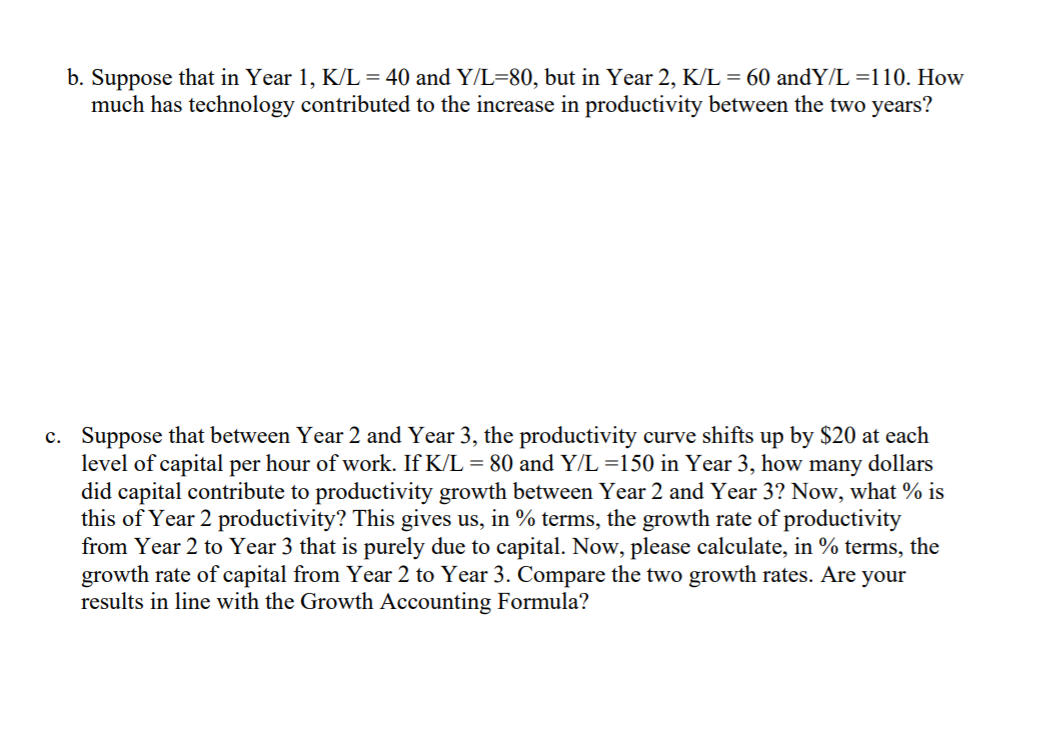
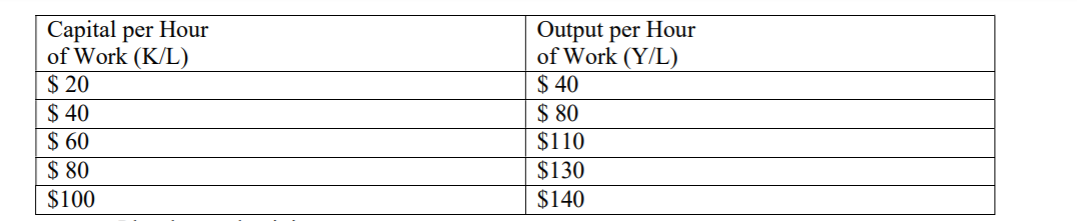
c. b. Suppose that in Year 1, K/L = 40 and Y/L=80, but in Year 2, K/L = 60 andY/L =110. How much has technology contributed to the increase in productivity between the two years? Suppose that between Year 2 and Year 3, the productivity curve shifts up by $20 at each level of capital per hour of work. If K/L = 80 and Y/L =150 in Year 3, how many dollars did capital contribute to productivity growth between Year 2 and Year 3? Now, what % is this of Year 2 productivity? This gives us, in % terms, the growth rate of productivity from Year 2 to Year 3 that is purely due to capital. Now, please calculate, in % terms, the growth rate of capital from Year 2 to Year 3. Compare the two growth rates. Are your results in line with the Growth Accounting Formula?
Step by Step Solution
There are 3 Steps involved in it

Get step-by-step solutions from verified subject matter experts
 Study Help