



Question: fieldwork in a timely manner. He began some further reading about gaining accest interviewees (Irvine & Gaffikin, 2006; Dundon & Ryan 2010; Berger 20 He

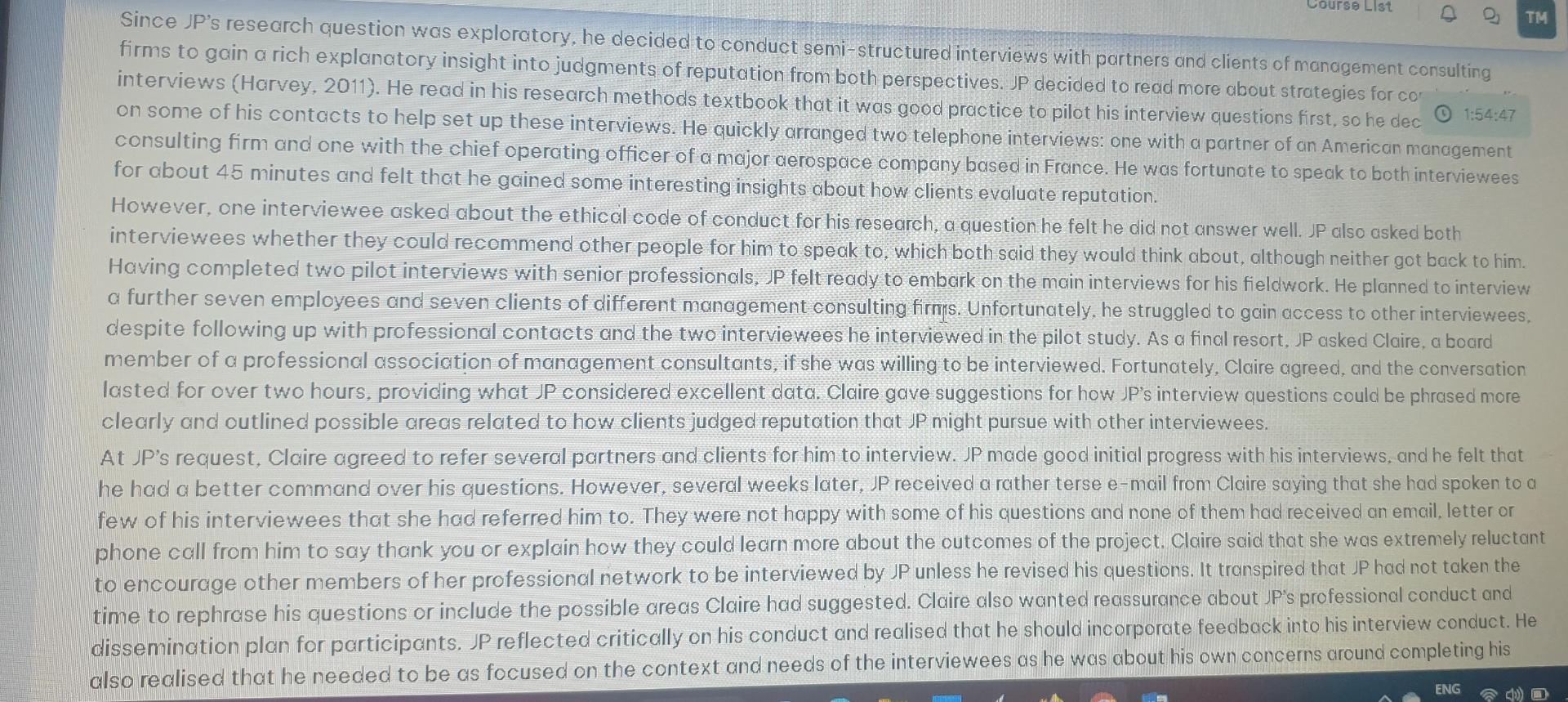
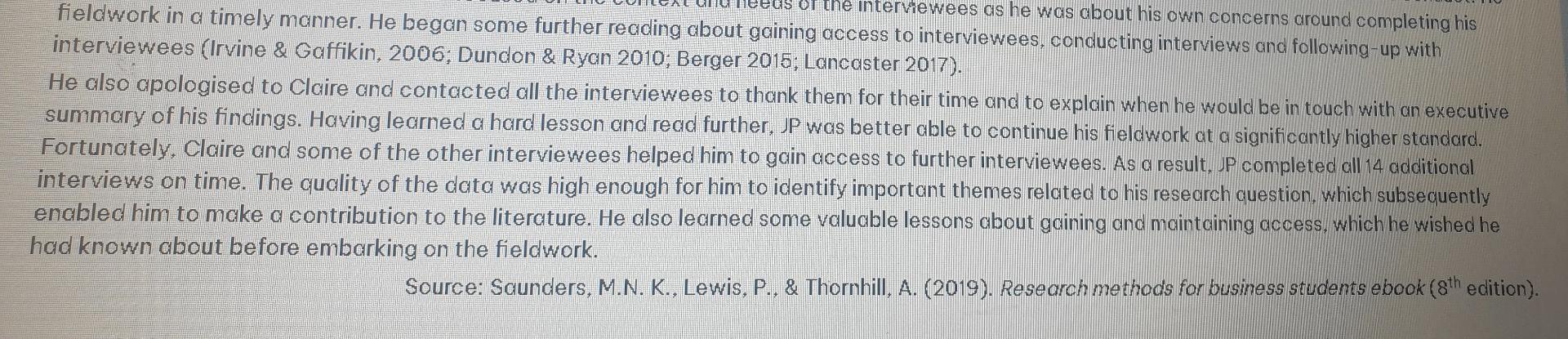



fieldwork in a timely manner. He began some further reading about gaining accest interviewees (Irvine \& Gaffikin, 2006; Dundon \& Ryan 2010; Berger 20 He also apologised to Claire and contacted oll th them for their time and to explain when he would be in touch with an executive er, JP was better able to continue his fieldwork at a significantly higher standaro access to further interviewees. As a result, JP completed all 14 additional had known about before embarking on the fieldwork. Source: Saunders, M.N. K., Lewis, P., \& Thornhill, A. (2019). Research methods for business students ebook (8th edition). Do you think JP properly identified the problem before commencing the research project? Substantiate your answer by explaining how identifying a research problem is a fundamental step that sets the tone for the research. (25 marks) Imagine you are a researcher to whom a company has outsourced a research project. Critically discuss what inputs you will give them regarding the structure of a research proposal based on the research problem, literature review, research design, and research appraach. Substantiate your answer with examples where possible. (25 marks) Task: Do you think JP properly identified the problem before commencing the research project? Substantiate your answer by explaining how identifying a research problem is a fundamental step that sets the tone for the research. (25 marks) Since JP's research question was exploratory, he decided to conduct semi-structured interviews with partners and clients of management consulting firms to gain a rich explanatory insight into judgments of reputation from both perspectives. JP decided to read more about strategies for cor interviews (Harvey, 2011). He read in his research methods textbook that it was good practice to pilot his interview questions first, so he dec on some of his contacts to help set up these interviews. He quickly arranged two telephone interviews: one with a partnero consulting firm and one with the chief operating officer of a major cerospace company based in France. He was fortunate to speak to bo management for about 45 minutes and felt that he gained some interesting insights about how clients evaluate reputation. However, one interviewee asked about the ethical code of conduct for his research, a question he felt he did not answer well. JP also asked both intervie wees whether they could recommend other people for him to speak to. which both said they would think about, although neither got back to him. Having completed two pilot interviews with senior professionals, JP felt ready to embark on the main interviews for his fieldwork. He planned to interview a further seven employees and seven clients of different management consulting firnis. Unfortunately, he struggled to gain access to other interviewees, despite following up with professional contacts and the two interviewees he interviewed in the pilot study. As a final resort, JP asked Claire, a board member of a professional association of management consultants, if she was willing to be interviewed. Fortunately, Claire agreed, and the conversation lasted for over two hours, providing what JP considered excellent data. Claire gave suggestions for how JP's interview questions could be phrased more clearly and outlined possible areas related to how clients judged reputation that JP might pursue with other interviewees. At JP's request, Claire agreed to refer several partners and clients for him to interview. JP made good initial progress with his interviews, and he felt that he had a better command over his questions. However, several weeks later. JP received a rather terse e-mail from claire saying that she had spoken to a few of his interviewees that she had referred him to. They were not happy with some of his questions and none of them had received an email, letter or phone call from him to say thank you or explain how they could learn more about the outcomes of the project. Claire said that she was extremely reluctant to encourage other members of her professional network to be interviewed by JP unless he revised his questions. It transpired that JP had not taken the time to rephrase his questions or include the possible areas Claire had suggested. Claire also wanted reassurance about JP's professional conduct and dissemination plan for participants. JP reflected critically on his conduct and realised that he should incorporate feedback into his interview conduct. He
Step by Step Solution
There are 3 Steps involved in it

Get step-by-step solutions from verified subject matter experts