







Question: Fig. 2 Cross - section view Use Equations 1 to 9 in the paper to calculate the elastic modulus in three directions ( E x
Fig. Crosssection view
Use Equations to in the paper to calculate the elastic modulus in three directions of the
sample in Fig.
All the elastic constants that will be used are summarized in the table below.
Hints:
According to the lecture notes, the volume fractions of solid, infill and carbon fibers in Equation
can be simplified as the area fractions of each part in Fig.
Since the directions of carbon fibers are all longitudinal direction Equation can be
simplified as Download the paper entitled "Tensile and Flexural Behaviors of Additively Manufactured
Continuous Carbon FiberReinforced Polymer Composites" from webcourses under
FilesHomeworkHW
Read the paper and learn how to estimate the elastic modulus of fiberreinforced polymer composites
using the stiffness averaging method.
Implement the stiffness averaging method using a programming language such as MATLAB or
MATHCAD.
Submit a report in word or PDF format on webcourses. In this report, please document how the elastic
modulus is estimated. The report should include:
a Code
b Stiffness and compliance matrices of
i Solid section
ii Infill section
iii. Carbon fiber section
iv Total composite structure based on the stiffness averaging method
c Volume fractions
i Solid section
ii Infill section
iii. Carbon fiber section
d Elastic moduli in directions
Problem description:
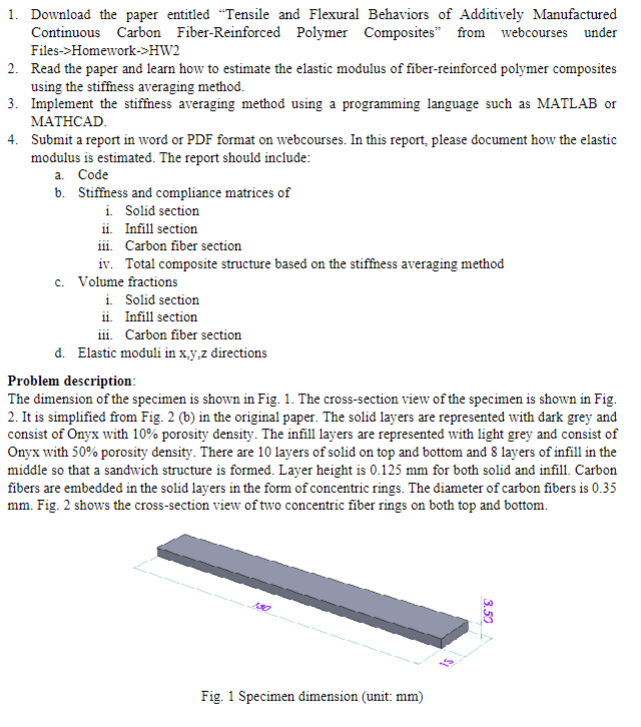
The dimension of the specimen is shown in Fig. The crosssection view of the specimen is shown in Fig.
It is simplified from Fig. b in the original paper. The solid layers are represented with dark grey and
consist of Onyx with porosity density. The infill layers are represented with light grey and consist of
Onyx with porosity density. There are layers of solid on top and bottom and layers of infill in the
middle so that a sandwich structure is formed. Layer height is mm for both solid and infill. Carbon
fibers are embedded in the solid layers in the form of concentric rings. The diameter of carbon fibers is
mm Fig. shows the crosssection view of two concentric fiber rings on both top and bottom.
Step by Step Solution
There are 3 Steps involved in it
1 Expert Approved Answer
Step: 1 Unlock

Question Has Been Solved by an Expert!
Get step-by-step solutions from verified subject matter experts
Step: 2 Unlock
Step: 3 Unlock
 Study Help