







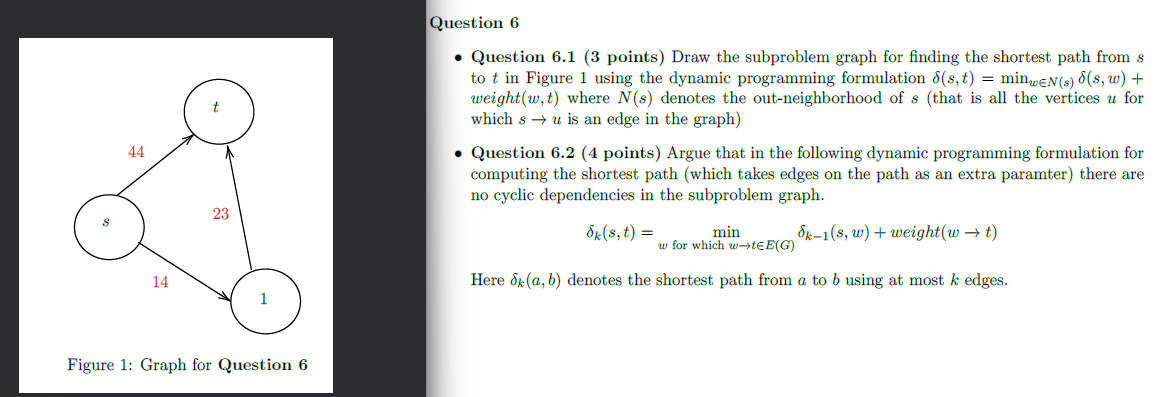
Question: Figure 1 : Graph for Question 6 6 . 1 ) Draw the subproblem graph for finding the shortest path from s to t in
Figure : Graph for Question
Draw the subproblem graph for finding the shortest path from s
to t in Figure using the dynamic programming formulation delta s t minw in Nsdelta swweightw t where Ns denotes the outneighborhood of s that is all the vertices u for which s u is an edge in the graph
Argue that in the following dynamic programming formulation for
computing the shortest path which takes edges on the path as an extra paramter there are no cyclic dependencies in the subproblem graph.
delta ks t min w for which wt in EGdelta ksw weightw t
Here delta ka b denotes the shortest path from a to b using at most k edges.Question
Question points Draw the subproblem graph for finding the shortest path from
to in Figure using the dynamic programming formulation
weight where denotes the outneighborhood of that is all the vertices for
which is an edge in the graph
Question points Argue that in the following dynamic programming formulation for
computing the shortest path which takes edges on the path as an extra paramter there are
no cyclic dependencies in the subproblem graph.
weight
Here denotes the shortest path from to using at most edges.
Step by Step Solution
There are 3 Steps involved in it
1 Expert Approved Answer
Step: 1 Unlock

Question Has Been Solved by an Expert!
Get step-by-step solutions from verified subject matter experts
Step: 2 Unlock
Step: 3 Unlock
 Study Help