







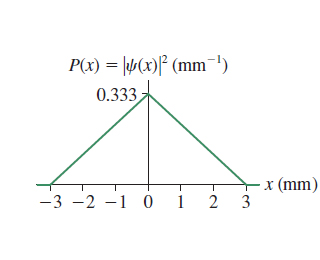
Question: (Figure 1) shows the probability density for an electron that has passed through an experimental apparatus. If 1.20106 electrons are used, what is the expected
(Figure 1) shows the probability density for an electron that has passed through an experimental apparatus. If 1.20106 electrons are used, what is the expected number that will land in a 0.0110-mm -wide strip at: Figure 1 of 1 The probability density is shown as a function of position. The position x is measured from negative 3 to positive 3 millimeters on the horizontal axis. The probability density equal to psi squared is measured from 0 to 0.333 reciprocal millimeters on the vertical axis. The probability density is zero at positions less than negative 3 millimeters, increases linearly to 0.333 reciprocal millimeters at zero position, decreases to 0 at positive 3 millimeters, and remains zero after that. Part A x =0.000mm? View Available Hint(s) for Part A Activate to select the appropriates template from the following choices. Operate up and down arrow for selection and press enter to choose the input value type Activate to select the appropriates symbol from the following choices. Operate up and down arrow for selection and press enter to choose the input value type Previous Answers Incorrect; Try Again; 4 attempts remaining Part B x =2.000mm? View Available Hint(s) for Part B Activate to select the appropriates template from the following choices. Operate up and down arrow for selection and press enter to choose the input value type Activate to select the appropriates symbol from the following choices. Operate up and down arrow for selection and press enter to choose
 \f
\f
Step by Step Solution
There are 3 Steps involved in it

Get step-by-step solutions from verified subject matter experts
 Study Help