







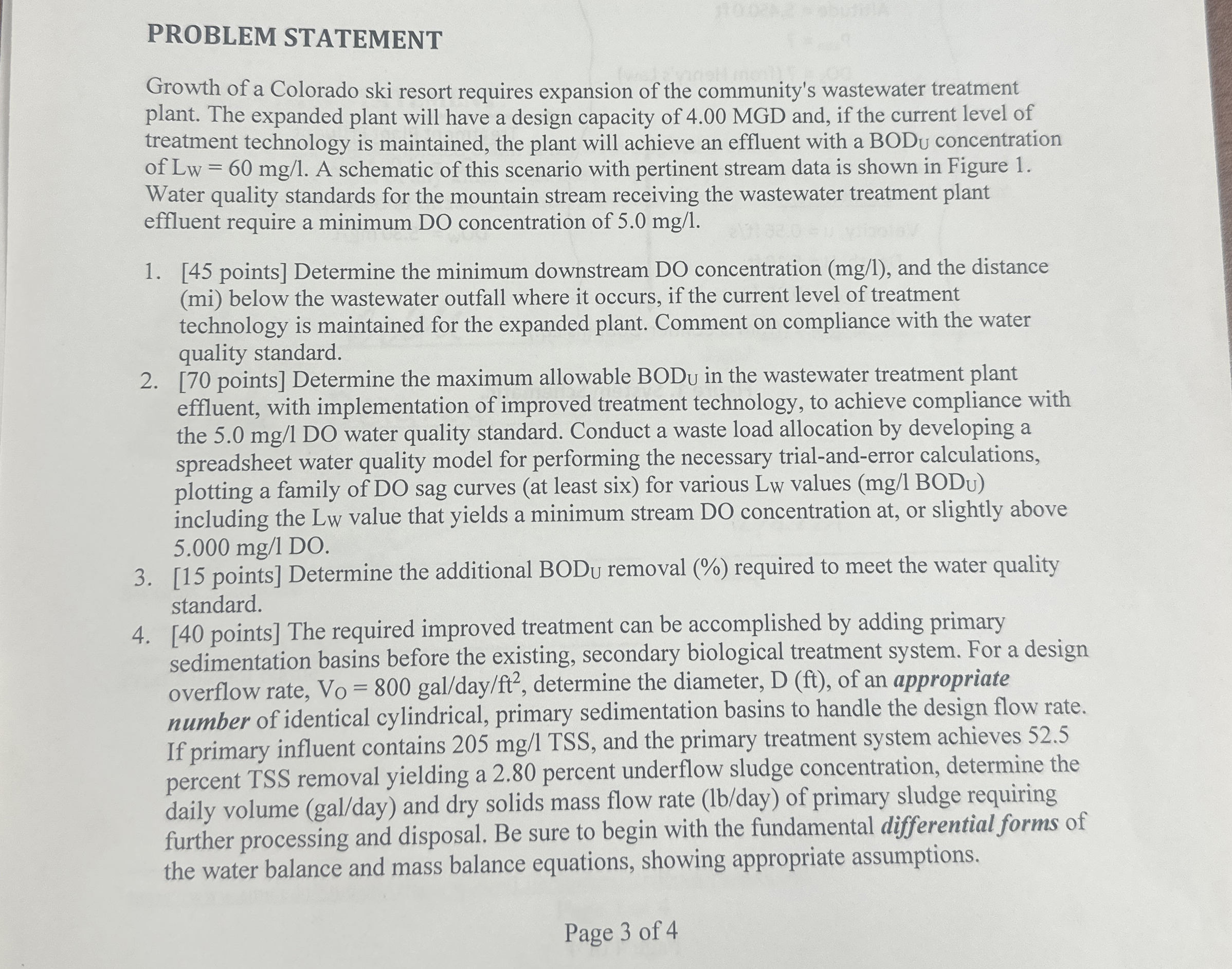
Question: Figure 1 . System Schematic. PROBLEM STATEMENT Growth of a Colorado ski resort requires expansion of the community's wastewater treatment plant. The expanded plant will
Figure System Schematic.
PROBLEM STATEMENT
Growth of a Colorado ski resort requires expansion of the community's wastewater treatment plant. The expanded plant will have a design capacity of MGD and, if the current level of treatment technology is maintained, the plant will achieve an effluent with a BODU concentration of A schematic of this scenario with pertinent stream data is shown in Figure Water quality standards for the mountain stream receiving the wastewater treatment plant effluent require a minimum DO concentration of
points Determine the minimum downstream DO concentration and the distance mi below the wastewater outfall where it occurs, if the current level of treatment technology is maintained for the expanded plant. Comment on compliance with the water quality standard.
points Determine the maximum allowable in the wastewater treatment plant effluent, with implementation of improved treatment technology, to achieve compliance with the water quality standard. Conduct a waste load allocation by developing a spreadsheet water quality model for performing the necessary trialanderror calculations, plotting a family of DO sag curves at least six for various values BODU including the value that yields a minimum stream DO concentration at or slightly above mg DO
points Determine the additional BODu removal required to meet the water quality standard.
points The required improved treatment can be accomplished by adding primary sedimentation basins before the existing, secondary biological treatment system. For a design overflow rate, day determine the diameter, of an appropriate number of identical cylindrical, primary sedimentation basins to handle the design flow rate. If primary influent contains and the primary treatment system achieves percent TSS removal yielding a percent underflow sludge concentration, determine the daily volume galday and dry solids mass flow rate lbday of primary sludge requiring further processing and disposal. Be sure to begin with the fundamental differential forms of the water balance and mass balance equations, showing appropriate assumptions.
Page of
Step by Step Solution
There are 3 Steps involved in it
1 Expert Approved Answer
Step: 1 Unlock

Question Has Been Solved by an Expert!
Get step-by-step solutions from verified subject matter experts
Step: 2 Unlock
Step: 3 Unlock
 Study Help