







Question: Figure 3. Regeneration. Realistic case vs the model problem. a) The differential equation and the boundary conditions. Develop a shell balance and derive a parabolic
Figure 3. Regeneration. Realistic case vs the model problem.\ a) The differential equation and the boundary conditions. Develop a shell balance and\ derive a parabolic PDE that describes unsteady-state mass transfer in an initially\ saturated silica bead. Assume thermal equilibrium inside.
Dis the effective diffusivity\ of water in the porous structure. At the outer surface of the bead, there is convective\ drying. Assume that the concentration of water vapor in the surrounding atmosphere is\ approximately zero. How would you write the boundary conditions? Are the PDE and\
BCslinear and homogeneous?\ b) Normalization. Make the PDE and boundary conditions dimensionless by normalizing\ your variables. How do you scale time? Use
\\\\theta =(C)/(C^(**))for the dimensionless\ concentration and
Bi_(m)=k_(m)(R)/(D)to make the convective boundary condition\ dimensionless.
k_(m)is the convective mass transfer coefficient and
C^(**)is the saturation\ moisture content.\ c) Separation of variables. Apply separation of variables and develop the general\ equations for
G(\\\\xi )and
F(\\\\tau ). What are the boundary conditions for the ODE for
G? How\ can you solve for
G? See Spiegel 24.23 and 24.24 to write the general solution in terms\ of trigonometric functions.
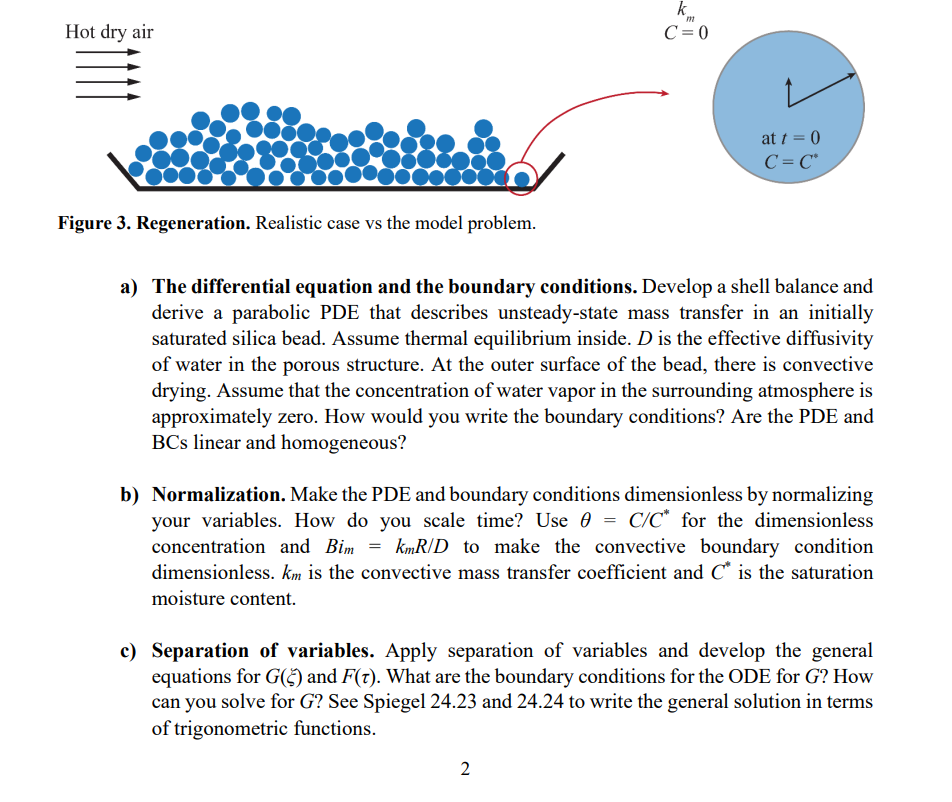
Figure 3. Regeneration. Realistic case vs the model problem. a) The differential equation and the boundary conditions. Develop a shell balance and derive a parabolic PDE that describes unsteady-state mass transfer in an initially saturated silica bead. Assume thermal equilibrium inside. D is the effective diffusivity of water in the porous structure. At the outer surface of the bead, there is convective drying. Assume that the concentration of water vapor in the surrounding atmosphere is approximately zero. How would you write the boundary conditions? Are the PDE and BCs linear and homogeneous? b) Normalization. Make the PDE and boundary conditions dimensionless by normalizing your variables. How do you scale time? Use =C/C for the dimensionless concentration and Bim=kmR/D to make the convective boundary condition dimensionless. km is the convective mass transfer coefficient and C is the saturation moisture content. c) Separation of variables. Apply separation of variables and develop the general equations for G() and F(). What are the boundary conditions for the ODE for G ? How can you solve for G ? See Spiegel 24.23 and 24.24 to write the general solution in terms of trigonometric functions. 2
Step by Step Solution
There are 3 Steps involved in it

Get step-by-step solutions from verified subject matter experts
 Study Help