







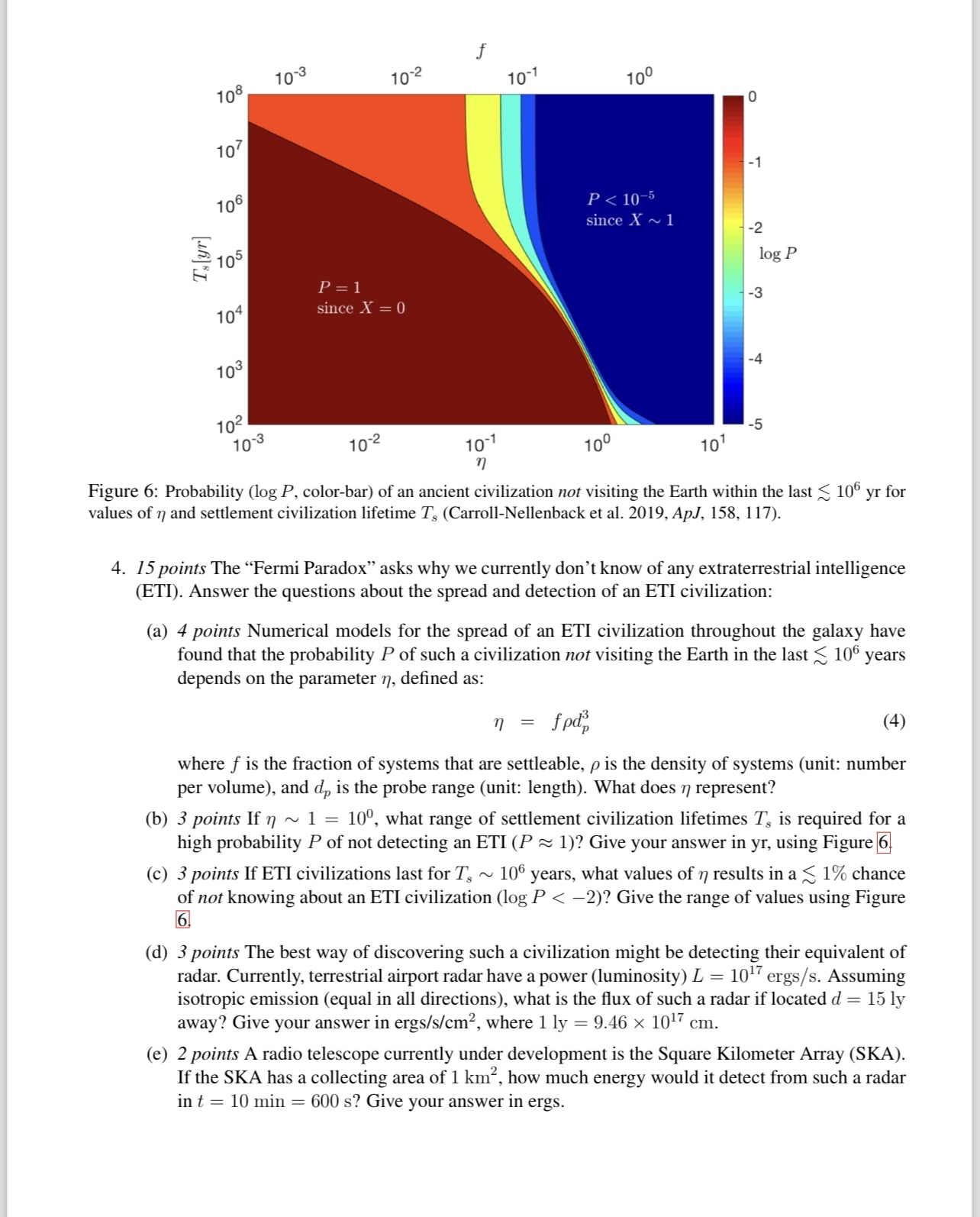
Question: Figure 6 : Probability ( l o g P , color - bar ) of an ancient civilization not visiting the Earth within the last
Figure : Probability colorbar of an ancient civilization not visiting the Earth within the last for values of and settlement civilization lifetime CarrollNellenback et al ApJ,
points The "Fermi Paradox" asks why we currently don't know of any extraterrestrial intelligence ETI Answer the questions about the spread and detection of an ETI civilization:
a points Numerical models for the spread of an ETI civilization throughout the galaxy have found that the probability of such a civilization not visiting the Earth in the last years depends on the parameter defined as:
where is the fraction of systems that are settleable, is the density of systems unit: number per volume and is the probe range unit: length What does represent?
b points If what range of settlement civilization lifetimes is required for a high probability of not detecting an ETI ~~ Give your answer in yr using Figure
c points If ETI civilizations last for years, what values of results in a chance of not knowing about an ETI civilization Give the range of values using Figure
d points The best way of discovering such a civilization might be detecting their equivalent of radar. Currently, terrestrial airport radar have a power luminosityerg Assuming isotropic emission equal in all directions what is the flux of such a radar if located ly away? Give your answer in ergs where
e points A radio telescope currently under development is the Square Kilometer Array SKA If the SKA has a collecting area of how much energy would it detect from such a radar in min Give your answer in ergs.
Step by Step Solution
There are 3 Steps involved in it
1 Expert Approved Answer
Step: 1 Unlock

Question Has Been Solved by an Expert!
Get step-by-step solutions from verified subject matter experts
Step: 2 Unlock
Step: 3 Unlock
 Study Help