







Question: Figure ( a ) shows the basic structure of a human eye. Light refracts into the eye through the cornea and is then further redirected
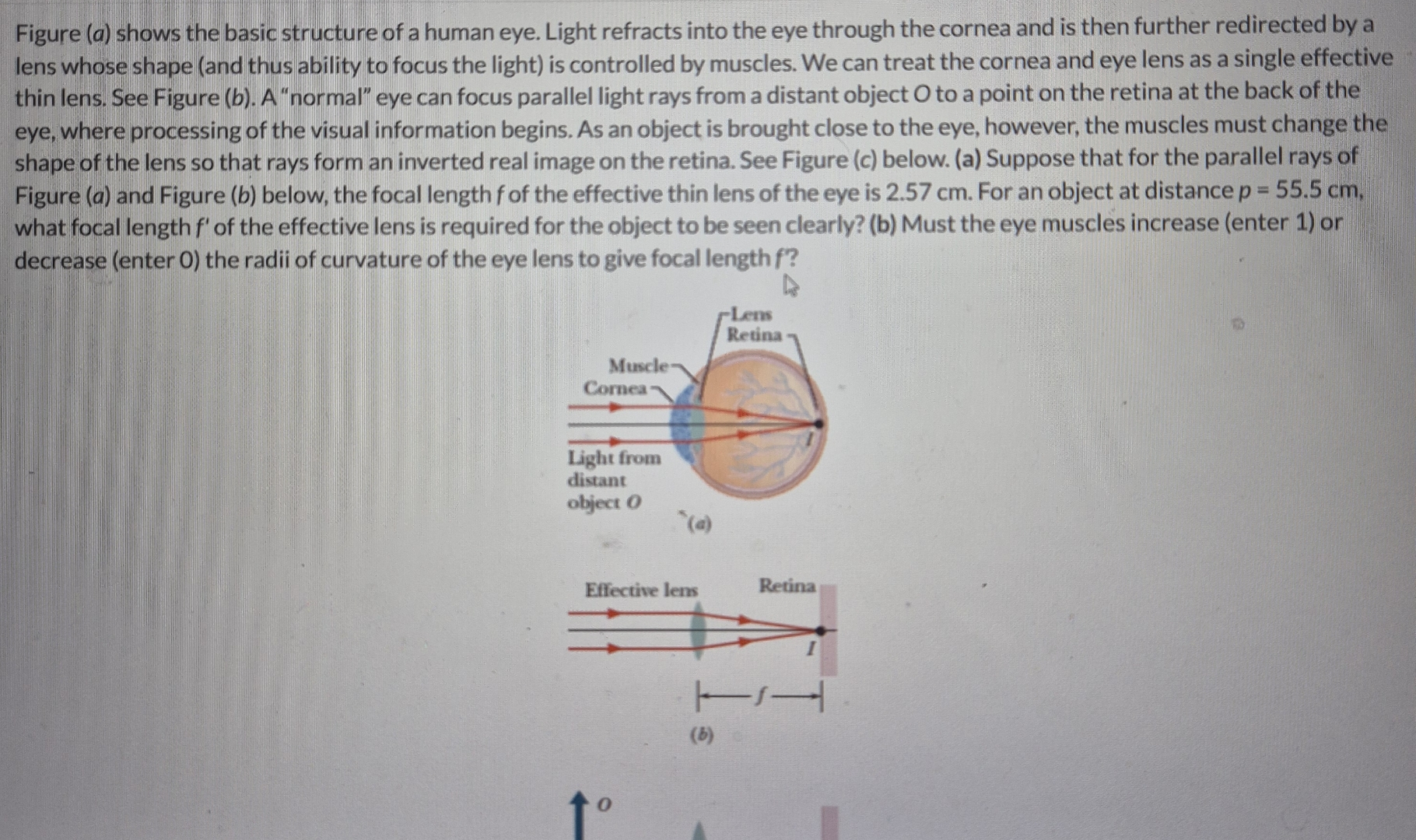
Figure a shows the basic structure of a human eye. Light refracts into the eye through the cornea and is then further redirected by a lens whose shape and thus ability to focus the light is controlled by muscles. We can treat the cornea and eye lens as a single effective thin lens. See Figure b A "normal" eye can focus parallel light rays from a distant object to a point on the retina at the back of the eye, where processing of the visual information begins. As an object is brought close to the eye, however, the muscles must change the shape of the lens so that rays form an inverted real image on the retina. See Figure c below. a Suppose that for the parallel rays of Figure and Figure below, the focal length of the effective thin lens of the eye is cm For an object at distance what focal length of the effective lens is required for the object to be seen clearly? b Must the eye muscles increase enter or decrease enter the radii of curvature of the eye lens to give focal length
Step by Step Solution
There are 3 Steps involved in it
1 Expert Approved Answer
Step: 1 Unlock

Question Has Been Solved by an Expert!
Get step-by-step solutions from verified subject matter experts
Step: 2 Unlock
Step: 3 Unlock
 Study Help