



Question: Figure Q2 shows a damped spring-mass system that contains a disk C with radius of R = 20 mm, mass of M = 8 kg,
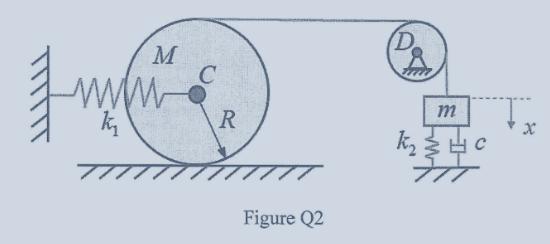
Figure Q2 shows a damped spring-mass system that contains a disk C with radius of R = 20 mm, mass of M = 8 kg, and moment of inertia about its center, I= A1R.2 I 2 , a weightless pulley D, a mass m = 3 kg, one damper with damping coefficient c, and two springs with force constant k1 = 8 N/mm and k2 = 4 N/mm . The two springs remain unstretched, when mass m is at the position x = o . At time t = o , the mass m is released from rest at the position x = O, then it vibrates in the vertical direction. Note that the cable does not slip on the disk and pulley, no slippery while the disk C is rolling on the ground, and air resistance against the motion can be neglected. The general solutions of ordinary differentiation equation (ODE) in Table 1 may be found useful.
(a) Draw two free-body diagrams for mass m and disk C. (5 marks)
(b) Formulate the ODE of this vibration system in terms of x. (7 marks)
(C) What is the requirement of damping coefficient c so that the system is subcritical damped? (4 marks)
(d) When the damping coefficient c=3N•s/mm, (i) Find the equilibrium position, x,, of the mass m. (4 marks)
(ii) Determine the displacement of mass m as a function of time. (5 marks)
M R Figure Q2
Step by Step Solution
3.48 Rating (151 Votes )
There are 3 Steps involved in it
To solve this problem lets go through each part step by step a Draw two freebody diagrams for mass m ... View full answer

Get step-by-step solutions from verified subject matter experts