





Question: Fill up blanks Lesson 3: Earth & Space Unit Lesson 3 - What has space exploration taught us about our solar system? *The definition of

Fill up blanks
Fill up blanks Lesson 3: Earth & Space Unit
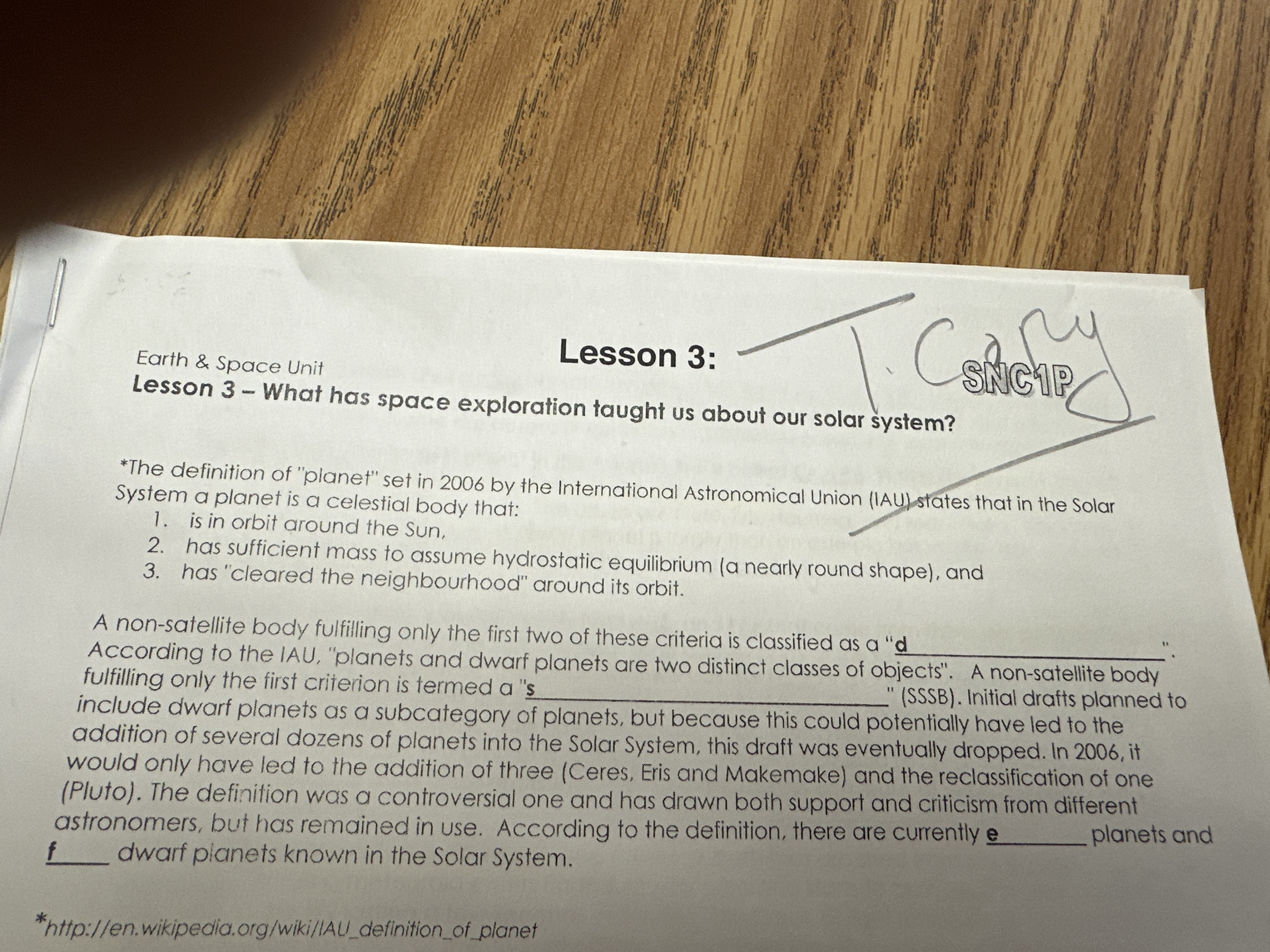
Lesson 3: Earth & Space Unit Lesson 3 - What has space exploration taught us about our solar system? *The definition of "planet" set in 2006 by the International Astronomical Union (IAU) states that in the Solar System a planet is a celestial body that: 1. is in orbit around the Sun, 2. has sufficient mass to assume hydrostatic equilibrium (a nearly round shape), and 3. has "cleared the neighbourhood" around its orbit. A non-satellite body fulfilling only the first two of these criteria is classified as a "d According to the IAU, "planets and dwarf planets are two distinct classes of objects". A non-satellite body fulfilling only the first criterion is termed a 's "(SSSB). Initial drafts planned to include dwarf planets as a subcategory of planets, but because this could potentially have led to the addition of several dozens of planets into the Solar System, this draft was eventually dropped. In 2006, it would only have led to the addition of three (Ceres, Eris and Makemake) and the reclassification of one (Pluto). The definition was a controversial one and has drawn both support and criticism from different astronomers, but has remained in use. According to the definition, there are currently e planets and dwarf planets known in the Solar System. *http://en. wikipedia.org/wiki/IAU_definition_of_planet

Step by Step Solution

There are 3 Steps involved in it

1 Expert Approved Answer
Step: 1 Unlock blur-text-image

Question Has Been Solved by an Expert!

Get step-by-step solutions from verified subject matter experts

Step: 2 Unlock
Step: 3 Unlock

Students Have Also Explored These Related Business Writing Questions!