







Question: Final Case Study: UBS Seeks an Appropriate Global Warming Policy For your final assessment, you will apply and integrate the concepts of Hopkins CSR model
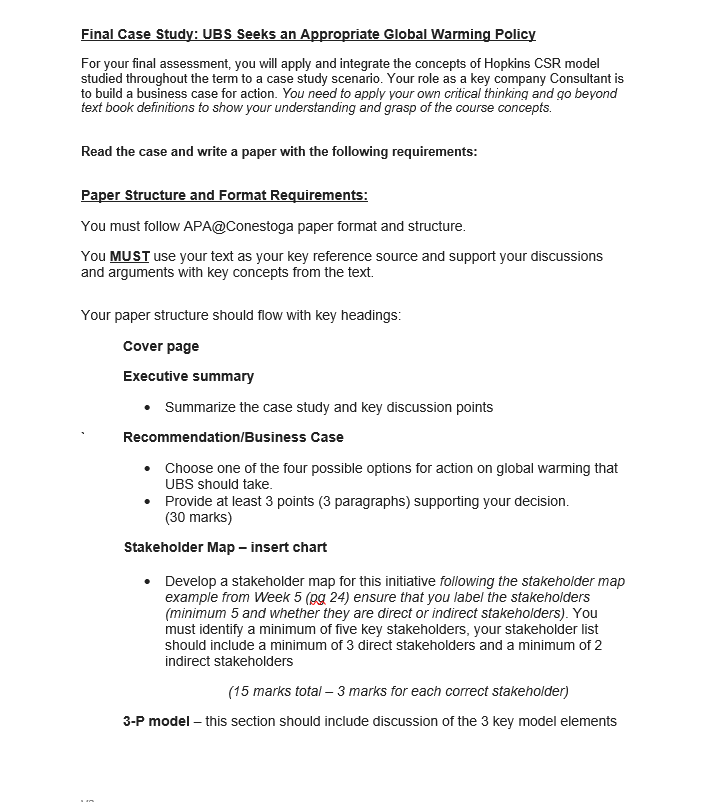
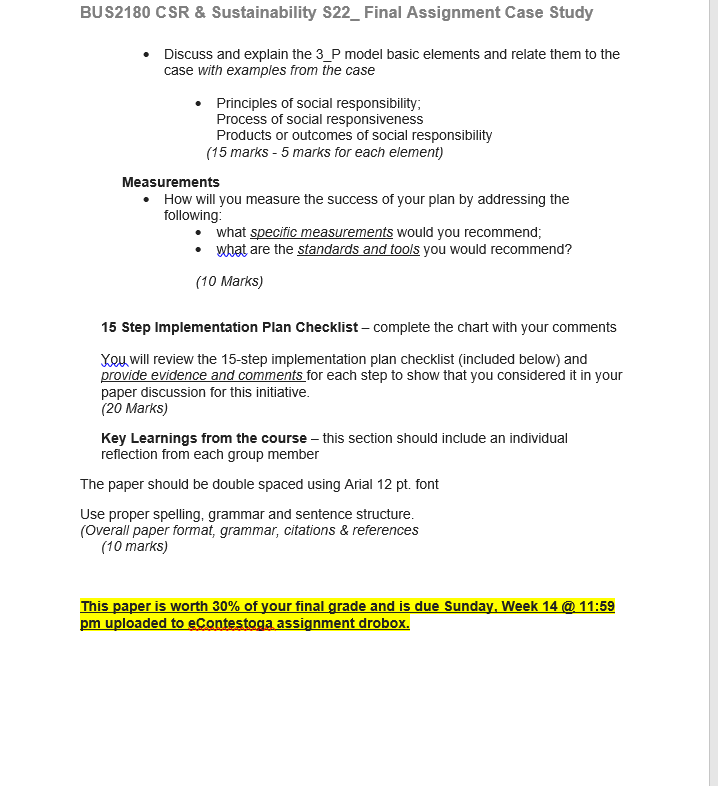
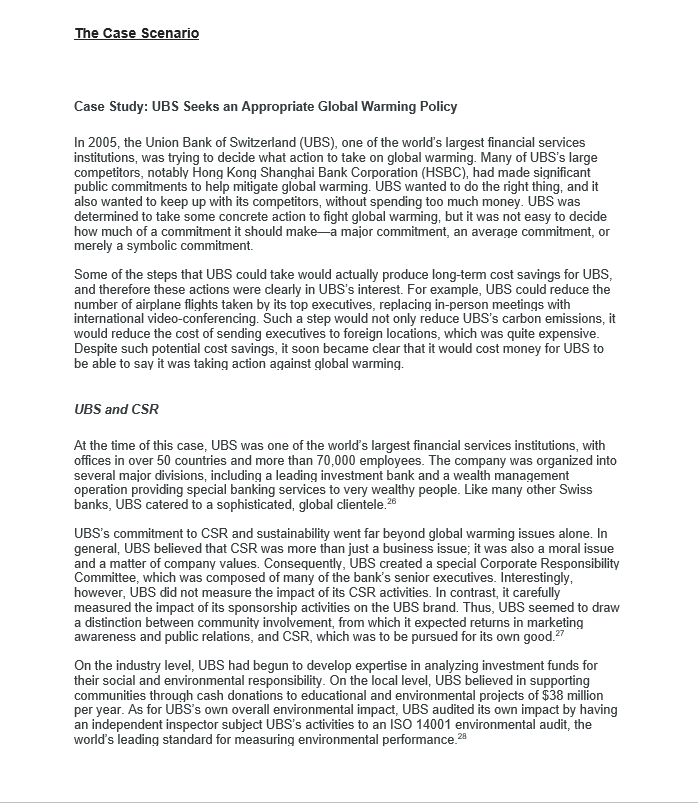
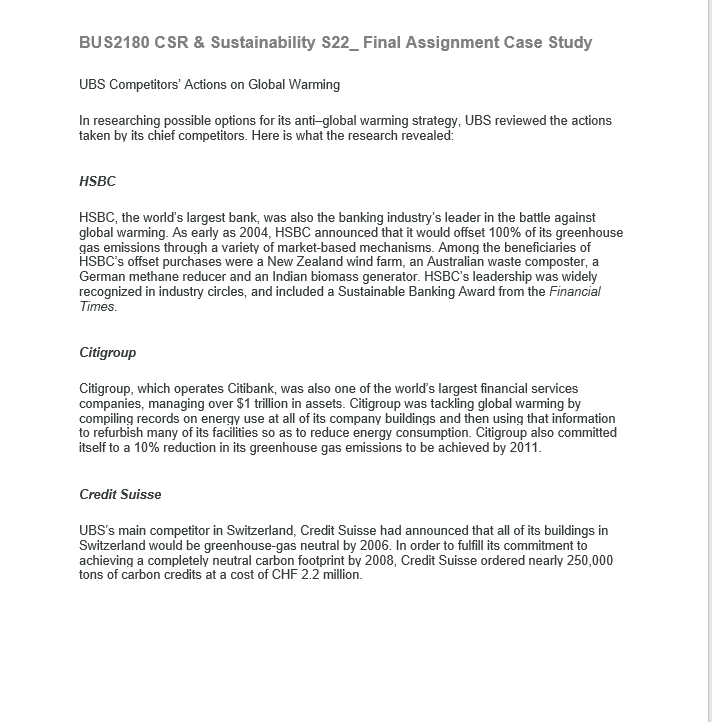
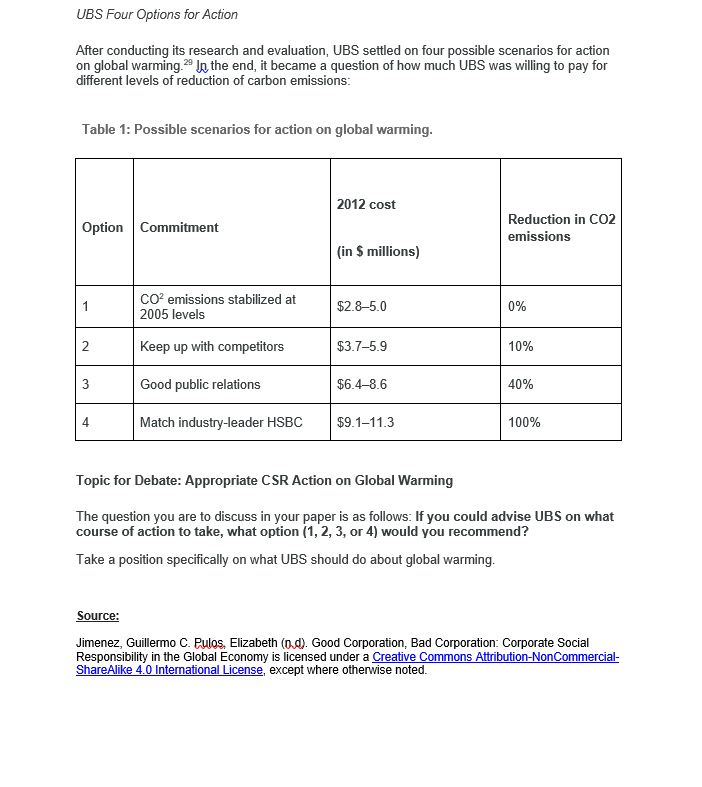
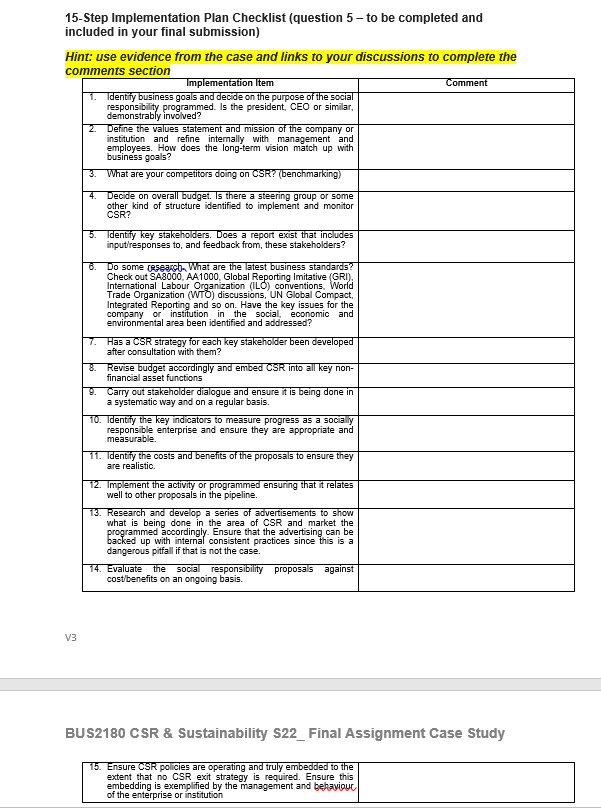
Final Case Study: UBS Seeks an Appropriate Global Warming Policy For your final assessment, you will apply and integrate the concepts of Hopkins CSR model studied throughout the term to a case study scenario. Your role as a key company Consultant is to build a business case for action. You need to apply your own critical thinking and go beyond text book definitions to show your understanding and grasp of the course concepts. Read the case and write a paper with the following requirements: Paper Structure and Format Requirements: You must follow APA@Conestoga paper format and structure. You MUST use your text as your key reference source and support your discussions and arguments with key concepts from the text. Your paper structure should flow with key headings: Cover page Executive summary . Summarize the case study and key discussion points Recommendation/Business Case Choose one of the four possible options for action on global warming that UBS should take Provide at least 3 points (3 paragraphs) supporting your decision. (30 marks) Stakeholder Map - insert chart . Develop a stakeholder map for this initiative following the stakeholder map example from Week 5 (pg 24) ensure that you label the stakeholders (minimum 5 and whether they are direct or indirect stakeholders). You must identify a minimum of five key stakeholders, your stakeholder list should include a minimum of 3 direct stakeholders and a minimum of 2 indirect stakeholders (15 marks total - 3 marks for each correct stakeholder) 3-P model - this section should include discussion of the 3 key model elementsBUS2180 CSR & Sustainability $22_Final Assignment Case Study Discuss and explain the 3_P model basic elements and relate them to the case with examples from the case Principles of social responsibility; Process of social responsiveness Products or outcomes of social responsibility (15 marks - 5 marks for each element) Measurements How will you measure the success of your plan by addressing the following: . what specific measurements would you recommend; what are the standards and tools you would recommend? (10 Marks) 15 Step Implementation Plan Checklist - complete the chart with your comments You will review the 15-step implementation plan checklist (included below) and provide evidence and comments for each step to show that you considered it in your paper discussion for this initiative. (20 Marks) Key Learnings from the course - this section should include an individual reflection from each group member The paper should be double spaced using Arial 12 pt. font Use proper spelling, grammar and sentence structure. (Overall paper format, grammar, citations & references (10 marks) This paper is worth 30% of your final grade and is due Sunday, Week 14 @ 11:59 pm uploaded to eContestoga assignment drobox.The Case Scenario Case Study: UBS Seeks an Appropriate Global Warming Policy In 2005, the Union Bank of Switzerland (UBS), one of the world's largest financial services institutions, was trying to decide what action to take on global warming. Many of UBS's large competitors, notably Hong Kong Shanghai Bank Corporation (HSBC), had made significant public commitments to help mitigate global warming. UBS wanted to do the right thing, and it also wanted to keep up with its competitors, without spending too much money. UBS was determined to take some concrete action to fight global warming, but it was not easy to decide how much of a commitment it should make-a major commitment, an average commitment, or merely a symbolic commitment. Some of the steps that UBS could take would actually produce long-term cost savings for UBS, and therefore these actions were clearly in UBS's interest. For example, UBS could reduce the number of airplane flights taken by its top executives, replacing in-person meetings with international video-conferencing. Such a step would not only reduce UBS's carbon emissions, it would reduce the cost of sending executives to foreign locations, which was quite expensive. Despite such potential cost savings, it soon became clear that it would cost money for UBS to be able to say it was taking action against global warming. UBS and CSR At the time of this case, UBS was one of the world's largest financial services institutions, with offices in over 50 countries and more than 70,000 employees. The company was organized into several major divisions, including a leading investment bank and a wealth management operation providing special banking services to very wealthy people. Like many other Swiss banks, UBS catered to a sophisticated, global clientele.2 UBS's commitment to CSR and sustainability went far beyond global warming issues alone. In general, UBS believed that CSR was more than just a business issue; it was also a moral issue and a matter of company values. Consequently, UBS created a special Corporate Responsibility Committee, which was composed of many of the bank's senior executives. Interestingly, however, UBS did not measure the impact of its CSR activities. In contrast, it carefully measured the impact of its sponsorship activities on the UBS brand. Thus, UBS seemed to draw a distinction between community involvement, from which it expected returns in marketing awareness and public relations, and CSR, which was to be pursued for its own good. On the industry level, UBS had begun to develop expertise in analyzing investment funds for their social and environmental responsibility. On the local level, UBS believed in supporting communities through cash donations to educational and environmental projects of $38 million per year. As for UBS's own overall environmental impact, UBS audited its own impact by having an independent inspector subject UBS's activities to an ISO 14001 environmental audit, the world's leading standard for measuring environmental performance.BUS2180 CSR & Sustainability $22_ Final Assignment Case Study UBS Competitors' Actions on Global Warming In researching possible options for its anti-global warming strategy, UBS reviewed the actions taken by its chief competitors. Here is what the research revealed: HSBC HSBC, the world's largest bank, was also the banking industry's leader in the battle against global warming. As early as 2004, HSBC announced that it would offset 100% of its greenhouse gas emissions through a variety of market-based mechanisms. Among the beneficiaries of HSBC's offset purchases were a New Zealand wind farm, an Australian waste composter, a German methane reducer and an Indian biomass generator. HSBC's leadership was widely recognized in industry circles, and included a Sustainable Banking Award from the Financial Times. Citigroup Citigroup, which operates Citibank, was also one of the world's largest financial services companies, managing over $1 trillion in assets. Citigroup was tackling global warming by compiling records on energy use at all of its company buildings and then using that information to refurbish many of its facilities so as to reduce energy consumption. Citigroup also committed itself to a 10% reduction in its greenhouse gas emissions to be achieved by 2011. Credit Suisse UBS's main competitor in Switzerland, Credit Suisse had announced that all of its buildings in Switzerland would be greenhouse-gas neutral by 2006. In order to fulfill its commitment to achieving a completely neutral carbon footprint by 2008, Credit Suisse ordered nearly 250,000 tons of carbon credits at a cost of CHF 2.2 million.UBS Four Options for Action After conducting its research and evaluation, UBS settled on four possible scenarios for action on global warming." In the end, it became a question of how much UBS was willing to pay for different levels of reduction of carbon emissions: Table 1: Possible scenarios for action on global warming. 2012 cost Option Commitment Reduction in CO2 emissions (in $ millions) 7 CO emissions stabilized at 2005 levels $2.8-5.0 0% 2 Keep up with competitors $3.7-5.9 10% 3 Good public relations $6.4-8.6 40% 4 Match industry-leader HSBC $9.1-11.3 100% Topic for Debate: Appropriate CSR Action on Global Warming The question you are to discuss in your paper is as follows: If you could advise UBS on what course of action to take, what option (1, 2, 3, or 4) would you recommend? Take a position specifically on what UBS should do about global warming. Source: Jimenez, Guillermo C. Pulos. Elizabeth (0.d). Good Corporation, Bad Corporation: Corporate Social Responsibility in the Global Economy is licensed under a Creative Commons Attribution-NonCommercial- ShareAlike 4.0 International License, except where otherwise noted.15-Step Implementation Plan Checklist (question 5 - to be completed and included in your final submission Hint: use evidence from the case and links to your discussions to complete the comments section Implementation Item Comment Identify business goals and decide on the purpose of the social responsibility programmed. Is the president, CEO or similar, demonstrably involved? 2. Define the values statement and mission of the company or institution and refine internally with management and employees. How does the long-term vision match up with business goals? What are your competitors doing on CSR? (benchmarking) Decide on overall budget. Is there a steering group or some other kind of structure identified to implement and monitor CSR? 5. Identify key stakeholders. Does a report exist that includes inputresponses to, and feedback from, these stakeholders? Do some (search. What are the latest business standards? Check out SA8000, AA1000, Global Reporting Imitative (GRI), International Labour Organization (LO) conventions. V Trade Organization (WTO) discussions, UN Global Compact, Integrated Reporting and so on. Have the key issues for the company or" institution in the social, economic and environmental area been identified and addressed? Has a CSR strategy for each key stakeholder been developed after consultation with them? Revise budget accordingly and embed CSR into all key non- financial asset functions 9. Carry out stakeholder dialogue and ensure it is being done in 3 systematic way and on a regular basis. To. Identify the key indicators to measure progress as a socially responsible enterprise and ensure they are appropriate and measurable. 1. Identify the costs and benefits of the proposals to ensure they are realistic 12. Implement the activity or programmed ensuring that it relates well to other proposals in the pipeline 13. Research and develop a series of advertisements to show what is being done in the area of CSR and market the programmed accordingly. Ensure that the advertising can be backed up with internal consistent practices since this is a dangerous pitfall if that is not the case. 14. Evaluate the Social responsibility proposals against cost benefits on an ongoing basis. V3 BUS2180 CSR & Sustainability $22_Final Assignment Case Study 15. Ensure CSR policies are operating and truly embedded to the extent that no CSR exit strategy is required. Ensure this embedding is exemplified by the management and behaviour of the enterprise or institution
Step by Step Solution
There are 3 Steps involved in it

Get step-by-step solutions from verified subject matter experts
 Study Help