







Question: final If we anticipate a decrease of the interest rate in the next 6 months, we should purchase bonds of which: The coupon rate is
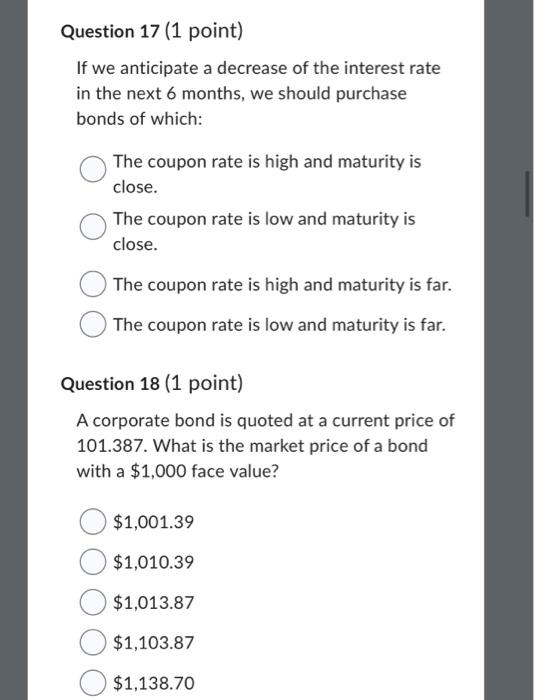
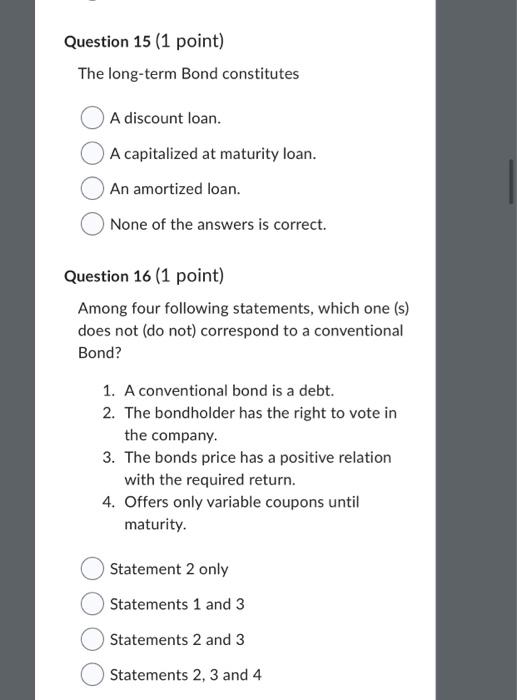
If we anticipate a decrease of the interest rate in the next 6 months, we should purchase bonds of which: The coupon rate is high and maturity is close. The coupon rate is low and maturity is close. The coupon rate is high and maturity is far. The coupon rate is low and maturity is far. Question 18 (1 point) A corporate bond is quoted at a current price of 101.387. What is the market price of a bond with a $1,000 face value? $1,001.39 $1,010.39 $1,013.87 $1,103.87 $1,138.70 The long-term Bond constitutes A discount loan. A capitalized at maturity loan. An amortized loan. None of the answers is correct. Question 16 (1 point) Among four following statements, which one (s) does not (do not) correspond to a conventional Bond? 1. A conventional bond is a debt. 2. The bondholder has the right to vote in the company. 3. The bonds price has a positive relation with the required return. 4. Offers only variable coupons until maturity. Statement 2 only Statements 1 and 3 Statements 2 and 3 Statements 2, 3 and 4 If we anticipate a decrease of the interest rate in the next 6 months, we should purchase bonds of which: The coupon rate is high and maturity is close. The coupon rate is low and maturity is close. The coupon rate is high and maturity is far. The coupon rate is low and maturity is far. Question 18 (1 point) A corporate bond is quoted at a current price of 101.387. What is the market price of a bond with a $1,000 face value? $1,001.39 $1,010.39 $1,013.87 $1,103.87 $1,138.70 The long-term Bond constitutes A discount loan. A capitalized at maturity loan. An amortized loan. None of the answers is correct. Question 16 (1 point) Among four following statements, which one (s) does not (do not) correspond to a conventional Bond? 1. A conventional bond is a debt. 2. The bondholder has the right to vote in the company. 3. The bonds price has a positive relation with the required return. 4. Offers only variable coupons until maturity. Statement 2 only Statements 1 and 3 Statements 2 and 3 Statements 2, 3 and 4
Step by Step Solution
There are 3 Steps involved in it

Get step-by-step solutions from verified subject matter experts
 Study Help