







Question: Finally, you should estimate two Machine Learning models and evaluate the predictive performance of these models. The first model will try to predict the dividend
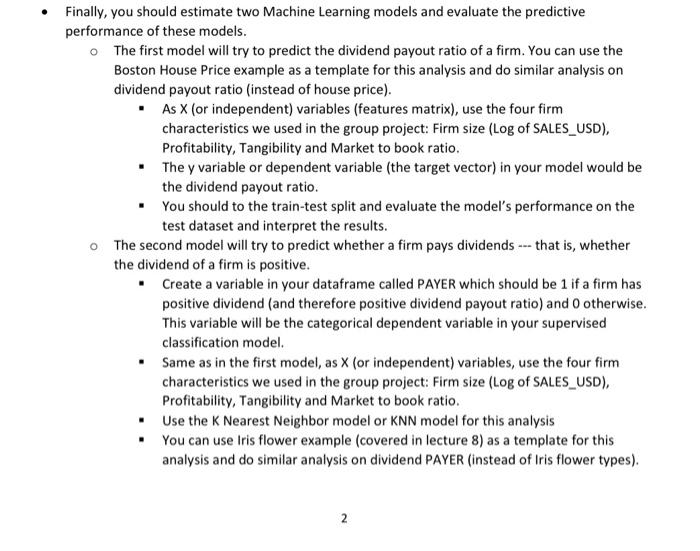
Finally, you should estimate two Machine Learning models and evaluate the predictive performance of these models. The first model will try to predict the dividend payout ratio of a firm. You can use the Boston House Price example as a template for this analysis and do similar analysis on dividend payout ratio (instead of house price). As X (or independent) variables (features matrix), use the four firm characteristics we used in the group project: Firm size (Log of SALES_USD), Profitability, Tangibility and Market to book ratio. . The y variable or dependent variable (the target vector) in your model would be the dividend payout ratio. . You should to the train-test split and evaluate the model's performance on the test dataset and interpret the results. The second model will try to predict whether a firm pays dividends --- that is, whether the dividend of a firm is positive. . Create a variable in your dataframe called PAYER which should be 1 if a firm has positive dividend (and therefore positive dividend payout ratio) and otherwise. This variable will be the categorical dependent variable in your supervised classification model. Same as in the first model, as X (or independent) variables, use the four firm characteristics we used in the group project: Firm size (Log of SALES_USD), Profitability, Tangibility and Market to book ratio. . Use the K Nearest Neighbor model or KNN model for this analysis You can use Iris flower example (covered in lecture 8) as a template for this analysis and do similar analysis on dividend PAYER (instead of Iris flower types). 2 Finally, you should estimate two Machine Learning models and evaluate the predictive performance of these models. The first model will try to predict the dividend payout ratio of a firm. You can use the Boston House Price example as a template for this analysis and do similar analysis on dividend payout ratio (instead of house price). As X (or independent) variables (features matrix), use the four firm characteristics we used in the group project: Firm size (Log of SALES_USD), Profitability, Tangibility and Market to book ratio. . The y variable or dependent variable (the target vector) in your model would be the dividend payout ratio. . You should to the train-test split and evaluate the model's performance on the test dataset and interpret the results. The second model will try to predict whether a firm pays dividends --- that is, whether the dividend of a firm is positive. . Create a variable in your dataframe called PAYER which should be 1 if a firm has positive dividend (and therefore positive dividend payout ratio) and otherwise. This variable will be the categorical dependent variable in your supervised classification model. Same as in the first model, as X (or independent) variables, use the four firm characteristics we used in the group project: Firm size (Log of SALES_USD), Profitability, Tangibility and Market to book ratio. . Use the K Nearest Neighbor model or KNN model for this analysis You can use Iris flower example (covered in lecture 8) as a template for this analysis and do similar analysis on dividend PAYER (instead of Iris flower types). 2
Step by Step Solution
There are 3 Steps involved in it

Get step-by-step solutions from verified subject matter experts
 Study Help