







Question: finance help please ! thumbs up for all correct answers 7-4. (Bond valuation) Calculate the value of a bond that will mature in 14 years
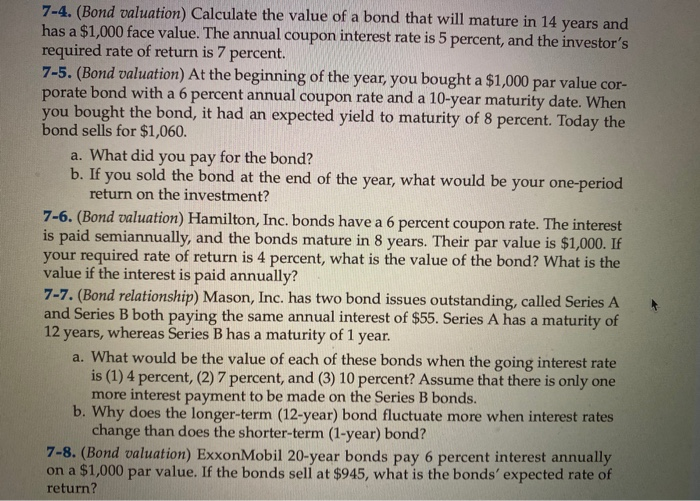
7-4. (Bond valuation) Calculate the value of a bond that will mature in 14 years and has a $1,000 face value. The annual coupon interest rate is 5 percent, and the investor's required rate of return is 7 percent. 7-5. (Bond valuation) At the beginning of the year, you bought a $1,000 par value cor- porate bond with a 6 percent annual coupon rate and a 10-year maturity date. When you bought the bond, it had an expected yield to maturity of 8 percent. Today the bond sells for $1,060. a. What did you pay for the bond? b. If you sold the bond at the end of the year, what would be your one-period return on the investment? 7-6. (Bond valuation) Hamilton, Inc. bonds have a 6 percent coupon rate. The interest is paid semiannually, and the bonds mature in 8 years. Their par value is $1,000. If your required rate of return is 4 percent, what is the value of the bond? What is the value if the interest is paid annually? 7-7. (Bond relationship) Mason, Inc. has two bond issues outstanding, called Series A and Series B both paying the same annual interest of $55. Series A has a maturity of 12 years, whereas Series B has a maturity of 1 year. a. What would be the value of each of these bonds when the going interest rate is (1) 4 percent, (2) 7 percent, and (3) 10 percent? Assume that there is only one more interest payment to be made on the Series B bonds. b. Why does the longer-term (12-year) bond fluctuate more when interest rates change than does the shorter-term (1-year) bond? 7-8. (Bond valuation) ExxonMobil 20-year bonds pay 6 percent interest annually on a $1,000 par value. If the bonds sell at $945, what is the bonds' expected rate of return
Step by Step Solution
There are 3 Steps involved in it

Get step-by-step solutions from verified subject matter experts
 Study Help