







Question: Financial Management I need the answer for (( ALL THE QUESTIONS)) please! please do not answer if you are not sure. Scenario 1: You would
Financial Management
I need the answer for (( ALL THE QUESTIONS)) please!
please do not answer if you are not sure.
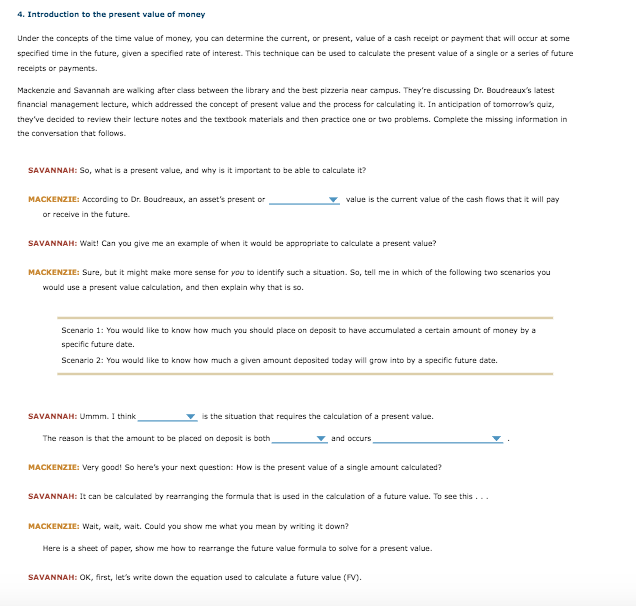
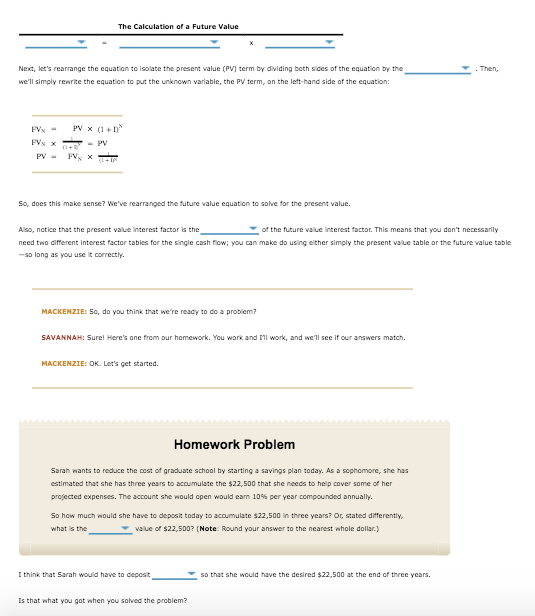
Scenario 1: You would like to knew how much you should place on deposit to have accumulated a certain amount of money by a specific future date. Scenario 2: You would like to knew how much a given amount deposited today will grow into by a specific future date. SAVANNAH: Ummm. I think is the situation that requires the calculation of a present value. The reason is that the amount to be placed on deposit is both and occurs MACKENZZE: Very gond! So here's your next questien: How is the present value of a single amount calculated? SAVANNAH: It can be calculated by rearranging the formula that is used in the colculation of a future value. To see this ... MACKENZIE: Wait, wat, wait. Could you shaw me what you mean by writing it down? Here is a sheet of paper, show me haw ta rearrange the future value formula to solve for a present value. SAVANNAH: OK, first, let's write down the equation used to calculate a future value (PV). Next, let's rearrange the equation to isolate the present walue (PV) term by dividing both sices of the equation by the Then, well simply rearite the equation to pus the unknown variable, the PV term, on the left-hand side of the equation: FS=PV(1+1)x FVs 1+D2= PV PV=WS1+11 So, does this make sense? We've rearranged the future value equation to solve for the present value. Also, notice that the present value interest factor is the of the future value interest factor. This means that you don't necessarily need two cifferent interest factor tables for the single cash fiow; you an make do using either simply the present value table or the future value table -so long as you use it correctly. MACKENZIE! 50, do you think that we're ready to do a probiem? SAVANNAH: Surel Here's ane from our hamework. You wark and thl work, and we'l see if our answers match. MACKENZIE: OK. Let's get started. Homework Problem Sarah wants to reduce the cest of graduate school by starting a savings plan today. As a sophomore, she has estimated that she has three years to acoumulate the $22,500 that she neecs to heip cover some of her projected expenses. The account she would cpen would eam 10% per year compounded annually. So how much aould she have to deposit today to acoumulate $22,500 in three years? Or, stated differently. what is the valee of $22,500 ? (Note: Round your answer to the nearest whole dollar.) I think that Sarah would have to ceposit so that she would have the desired $22,500 at the end of three years. Is that what you got when you solved the problem? Scenario 1: You would like to knew how much you should place on deposit to have accumulated a certain amount of money by a specific future date. Scenario 2: You would like to knew how much a given amount deposited today will grow into by a specific future date. SAVANNAH: Ummm. I think is the situation that requires the calculation of a present value. The reason is that the amount to be placed on deposit is both and occurs MACKENZZE: Very gond! So here's your next questien: How is the present value of a single amount calculated? SAVANNAH: It can be calculated by rearranging the formula that is used in the colculation of a future value. To see this ... MACKENZIE: Wait, wat, wait. Could you shaw me what you mean by writing it down? Here is a sheet of paper, show me haw ta rearrange the future value formula to solve for a present value. SAVANNAH: OK, first, let's write down the equation used to calculate a future value (PV). Next, let's rearrange the equation to isolate the present walue (PV) term by dividing both sices of the equation by the Then, well simply rearite the equation to pus the unknown variable, the PV term, on the left-hand side of the equation: FS=PV(1+1)x FVs 1+D2= PV PV=WS1+11 So, does this make sense? We've rearranged the future value equation to solve for the present value. Also, notice that the present value interest factor is the of the future value interest factor. This means that you don't necessarily need two cifferent interest factor tables for the single cash fiow; you an make do using either simply the present value table or the future value table -so long as you use it correctly. MACKENZIE! 50, do you think that we're ready to do a probiem? SAVANNAH: Surel Here's ane from our hamework. You wark and thl work, and we'l see if our answers match. MACKENZIE: OK. Let's get started. Homework Problem Sarah wants to reduce the cest of graduate school by starting a savings plan today. As a sophomore, she has estimated that she has three years to acoumulate the $22,500 that she neecs to heip cover some of her projected expenses. The account she would cpen would eam 10% per year compounded annually. So how much aould she have to deposit today to acoumulate $22,500 in three years? Or, stated differently. what is the valee of $22,500 ? (Note: Round your answer to the nearest whole dollar.) I think that Sarah would have to ceposit so that she would have the desired $22,500 at the end of three years. Is that what you got when you solved the
Step by Step Solution
There are 3 Steps involved in it

Get step-by-step solutions from verified subject matter experts
 Study Help