







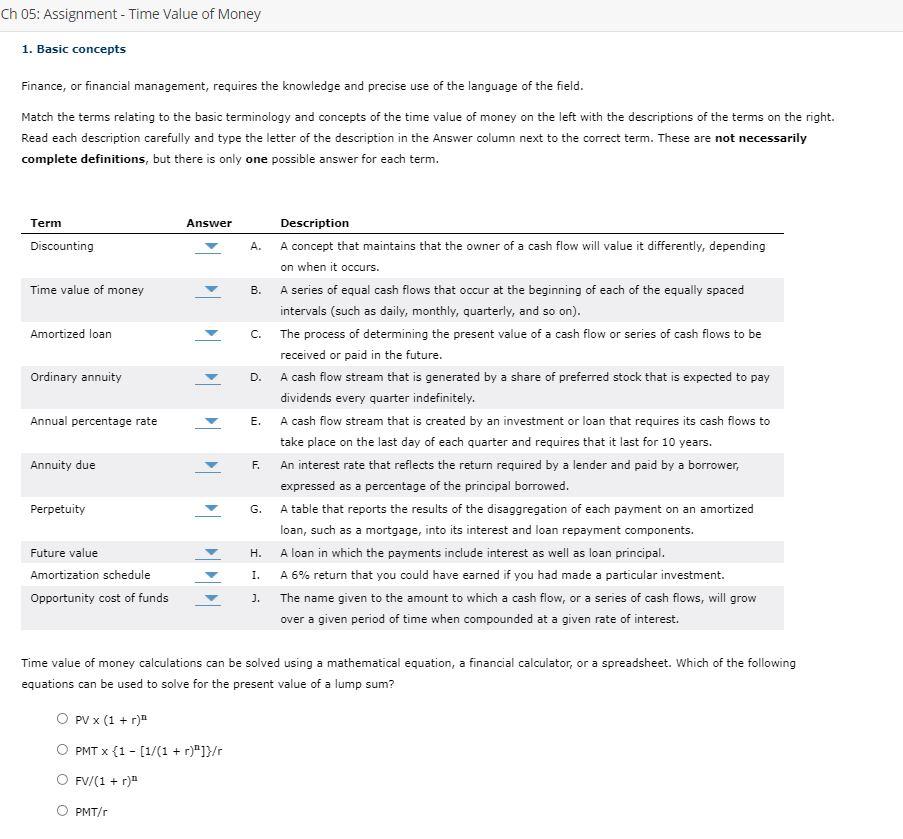
Question: FINANCIAL MANAGEMENT Q2) PLEASE NUMBER EACH ANSWER Ch 05: Assignment - Time Value of Money 1. Basic concepts Finance, or financial management, requires the knowledge
FINANCIAL MANAGEMENT
Q2) PLEASE NUMBER EACH ANSWER
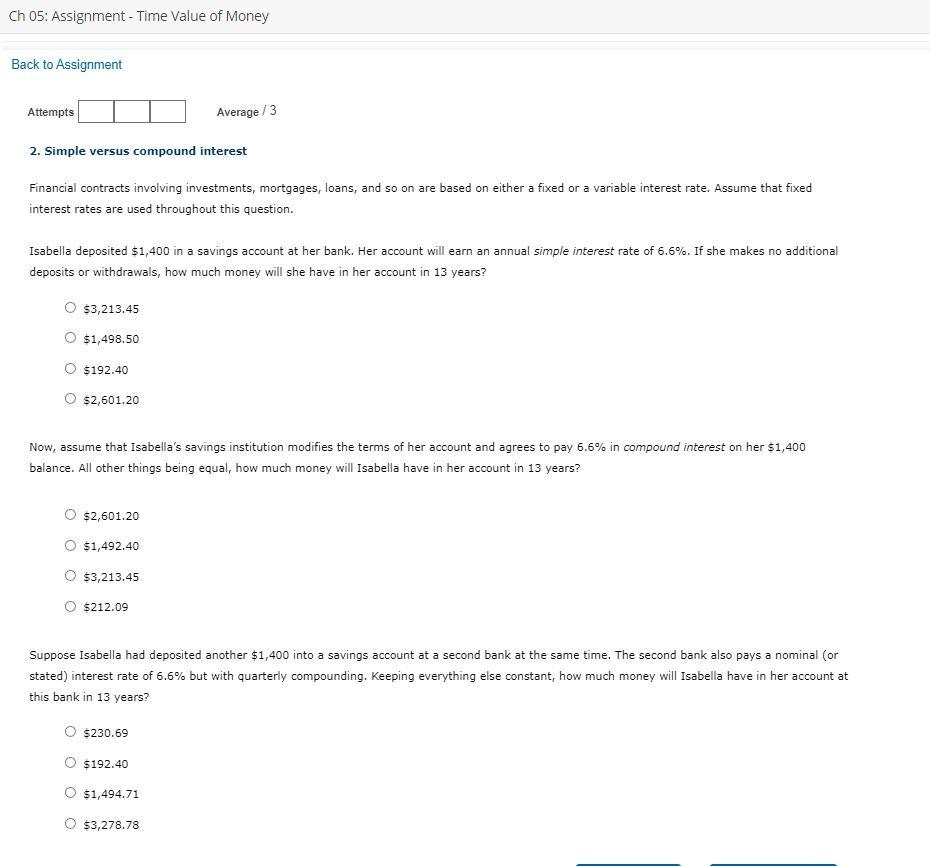
Ch 05: Assignment - Time Value of Money 1. Basic concepts Finance, or financial management, requires the knowledge and precise use of the language of the field. Match the terms relating to the basic terminology and concepts of the time value of money on the left with the descriptions of the terms on the right. Read each description carefully and type the letter of the description in the Answer column next to the correct term. These are not necessarily complete definitions, but there is only one possible answer for each term. Term Answer Discounting A. Time value of money B. Amortized loan c. Ordinary annuity D. Annual percentage rate E. Description A concept that maintains that the owner of a cash flow will value it differently, depending on when it occurs. A series of equal cash flows that occur at the beginning of each of the equally spaced intervals (such as daily, monthly, quarterly, and so on). The process of determining the present value of a cash flow or series of cash flows to be received or paid in the future. A cash flow stream that is generated by a share of preferred stock that is expected to pay dividends every quarter indefinitely. A cash flow stream that is created by an investment or loan that requires its cash flows to take place on the last day of each quarter and requires that it last for 10 years. An interest rate that reflects the return required by a lender and paid by a borrower, expressed as a percentage of the principal borrowed. A table that reports the results of the disaggregation of each payment on an amortized loan, such as a mortgage, into its interest and loan repayment components. A loan in which the payments include interest as well as loan principal. A 6% return that you could have earned if you had made a particular investment. The name given to the amount to which a cash flow, or a series of cash flows, will grow over a given period of time when compounded at a given rate of interest. Annuity due F. Perpetuity G. H. Future value Amortization schedule Opportunity cost of funds I. J. Time value of money calculations can be solved using a mathematical equation, a financial calculator, or a spreadsheet. Which of the following equations can be used to solve for the present value of a lump sum? PV x (1 + r) PMT x {1 - [1/(1 + r)"]}/ OFV/(1 + r)" PMT/r Ch 05: Assignment - Time Value of Money Back to Assignment Attempts Average/3 2. Simple versus compound interest Financial contracts involving investments, mortgages, loans, and so on are based on either a fixed or a variable interest rate. Assume that fixed interest rates are used throughout this question. Isabella deposited $1,400 in a savings account at her bank. Her account will earn an annual simple interest rate of 6.6%. If she makes no additional deposits or withdrawals, how much money will she have in her account in 13 years? $3,213.45 O $1,498.50 O $192.40 $2,601.20 Now, assume that Isabella's savings institution modifies the terms of her account and agrees to pay 6.6% in compound interest on her $1,400 balance. All other things being equal, how much money will Isabella have in her account in 13 years? O $2,601.20 O $1,492.40 $3,213.45 $212.09 Suppose Isabella had deposited another $1,400 into a savings account at a second bank at the same time. The second bank also pays a nominal (or stated) interest rate of 6.6% but with quarterly compounding. Keeping everything else constant, how much money will Isabella have in her account at this bank in 13 years? $230.69 $192.40 $1,494.71 O $3,278.78
Step by Step Solution
There are 3 Steps involved in it

Get step-by-step solutions from verified subject matter experts
 Study Help