







Question: Find a binomial acceptance testing plan to demonstrate a reliability of 0.98. An unacceptable reliability is 0.90. The risk of incorrectly accepting or incorrectly rejecting
Find a binomial acceptance testing plan to demonstrate a reliability of 0.98. An
unacceptable reliability is 0.90. The risk of incorrectly accepting or incorrectly rejecting
should be less than 10 percent. What is the minimum sampling size for which both risks are less than 5 percent. Hint: Binomial probabilities can be computed recursively
using
1-Rn-i
Pr{X = i + I} = R i + l Pr{X = i}
where X is the number of failures, I - R is the probability of a failure and n is the
number on test. Numerical problems encountered with large factorials can therefore
be avoided. You are encouraged to prove the foregoing relationship before using it.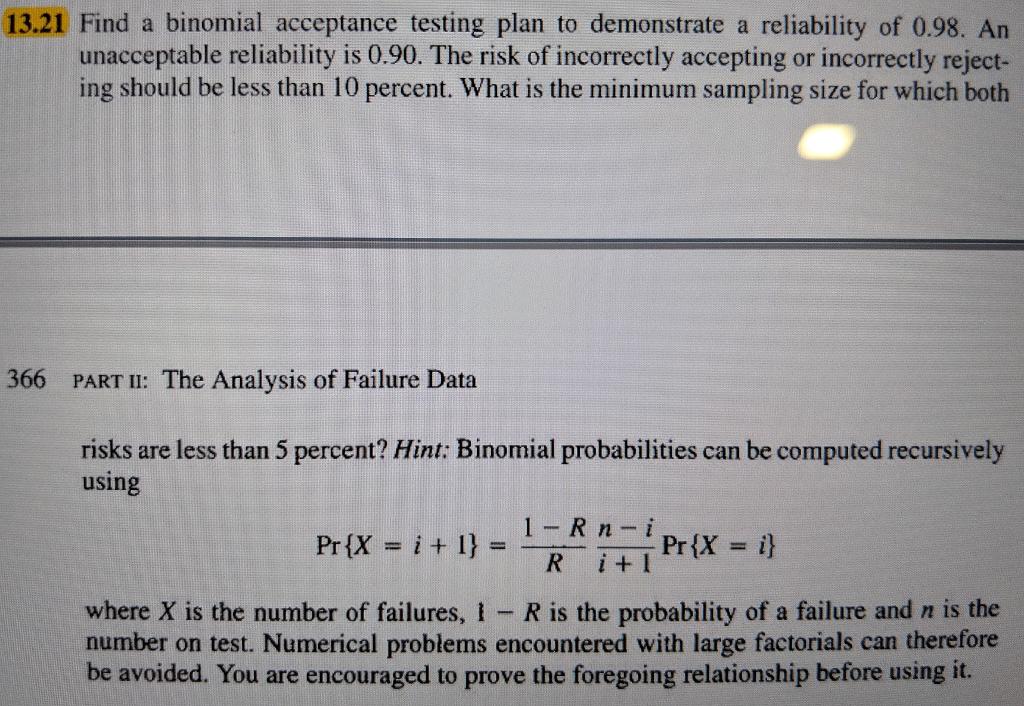
13.21 Find a binomial acceptance testing plan to demonstrate a reliability of 0.98. An unacceptable reliability is 0.90. The risk of incorrectly accepting or incorrectly reject- ing should be less than 10 percent. What is the minimum sampling size for which both 366 PART II: The Analysis of Failure Data risks are less than 5 percent? Hint: Binomial probabilities can be computed recursively using Pr{X = i + 1} = 1- R n-i R i+l Pr{X = i} where X is the number of failures, I- R is the probability of a failure and n is the number on test. Numerical problems encountered with large factorials can therefore be avoided. You are encouraged to prove the foregoing relationship before using it.
Step by Step Solution
3.33 Rating (153 Votes )
There are 3 Steps involved in it
Sole Find a Binomial acceptance testing plan to demonstrate geliability of ... View full answer

Get step-by-step solutions from verified subject matter experts
 Study Help