





Question: Find an article that relates to Chapter 10 (Global Strategy: Competing Around the World). The article must explain any concept discussed in the Chapter. Do
Find an article that relates to Chapter 10 (Global Strategy: Competing Around the World). The article must explain any concept discussed in the Chapter. Do the following:
1. Provide a detailed introduction
2. What are the key concepts of the article
3. Would you recommend this article to other business students - Explain why or why not.
4. Provide a brief summary. Give your opinion of the article.
*Please provide the name of the author, title, and year of publication. You do not have to submit a copy of the article, just your critique.
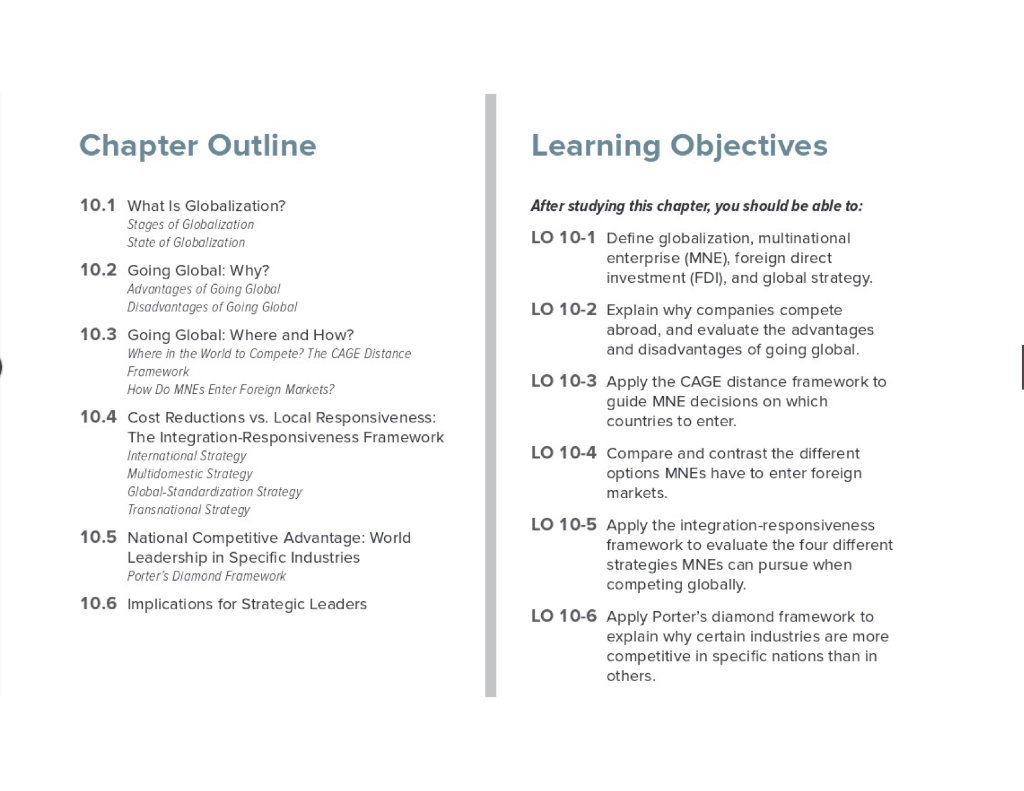
Chapter Outline Learning Objectives 10.1 What Is Globalization? Stages of Globalization State of Globalization After studying this chapter, you should be able to: LO 10-1 Define globalization, multinational enterprise (MNE), foreign direct investment (FDI), and global strategy. LO 10-2 Explain why companies compete abroad, and evaluate the advantages and disadvantages of going global. LO 10-3 Apply the CAGE distance framework to guide MNE decisions on which countries to enter. 10.2 Going Global: Why? Advantages of Going Global Disadvantages of Going Global 10.3 Going Global: Where and How? Where in the World to Compete? The CAGE Distance Framework How Do MNES Enter Foreign Markets? 10.4 Cost Reductions vs. Local Responsiveness: The Integration-Responsiveness Framework International Strategy Multidomestic Strategy Global-Standardization Strategy Transnational Strategy 10.5 National Competitive Advantage: World Leadership in Specific Industries Porter's Diamond Framework 10.6 Implications for Strategic Leaders LO 10-4 Compare and contrast the different options MNEs have to enter foreign markets. LO 10-5 Apply the integration-responsiveness framework to evaluate the four different strategies MNEs can pursue when competing globally. LO 10-6 Apply Porter's diamond framework to explain why certain industries are more competitive in specific nations than in others

