







Question: Find its fectors 3. Given the survival function: S(t) = exp(-t?) derive the probability density function and the hazard function. 4. Derive X(t) = f(t)
Find its fectors
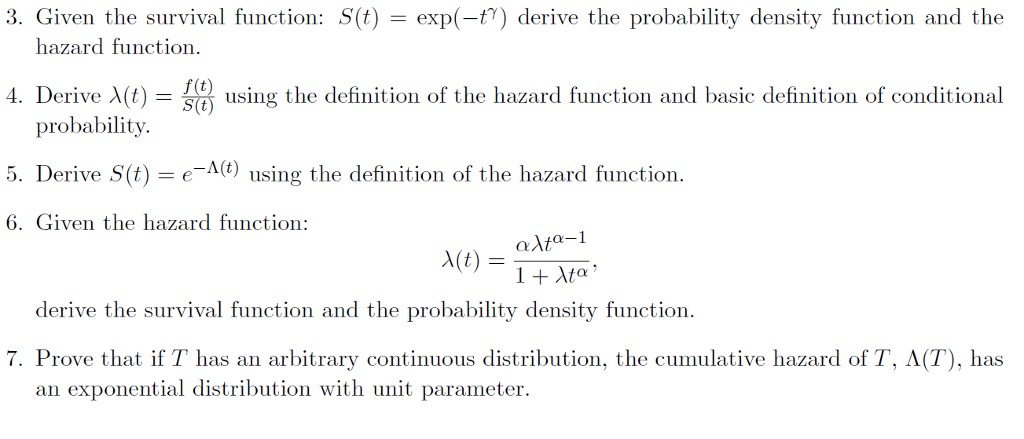
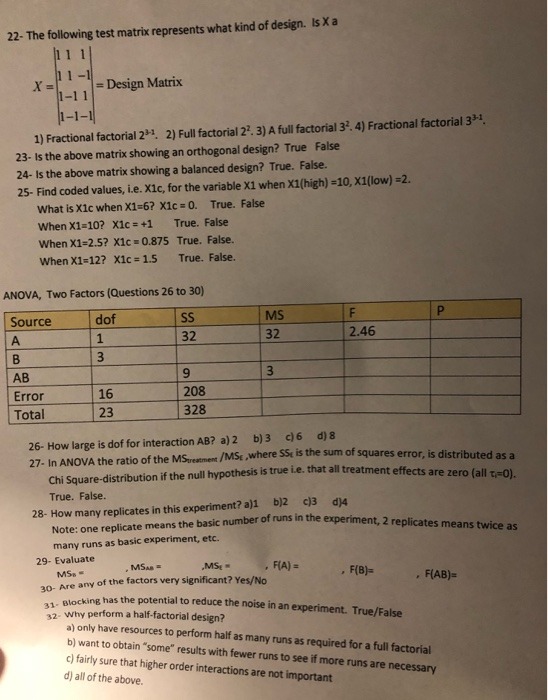
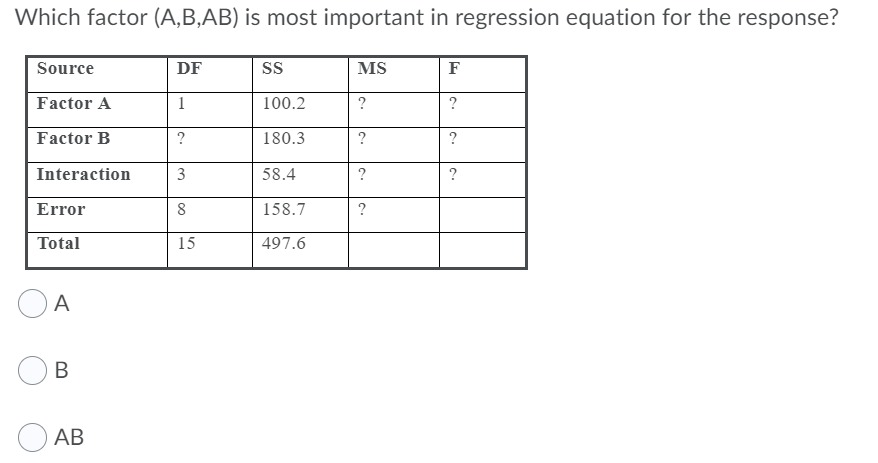
3. Given the survival function: S(t) = exp(-t?) derive the probability density function and the hazard function. 4. Derive X(t) = f(t) S(t) using the definition of the hazard function and basic definition of conditional probability. 5. Derive S(t) = e-A(t) using the definition of the hazard function. 6. Given the hazard function: adta-1 A (t ) = 1 + Ata' derive the survival function and the probability density function. 7. Prove that if T has an arbitrary continuous distribution, the cumulative hazard of T, A(T), has an exponential distribution with unit parameter.22- The following test matrix represents what kind of design. Is X a 1 1 1 1 1 -1 X = = Design Matrix 1-11 1-1-1 1) Fractional factorial 231. 2) Full factorial 2?. 3) A full factorial 33. 4) Fractional factorial 33-1. 23- Is the above matrix showing an orthogonal design? True False 24- Is the above matrix showing a balanced design? True. False. 25- Find coded values, i.e. X1c, for the variable X1 when X1(high) =10, X1(low) =2. What is X1c when X1=6? X1c = 0. True. False When X1=10? Xic = +1 True. False When X1=2.57 X1c = 0.875 True. False. When X1=127 X1c = 1.5 True. False. ANOVA, Two Factors (Questions 26 to 30) Source dof SS MS F P A 1 32 32 2.46 B 3 AB 9 3 Error 16 208 Total 23 328 26- How large is dof for interaction AB? a) 2 b) 3 c)6 d) 8 27- In ANOVA the ratio of the MStreatment /MS , where $5 is the sum of squares error, is distributed as a Chi Square-distribution if the null hypothesis is true ie. that all treatment effects are zero (all t=0). True. False. 28- How many replicates in this experiment? all bj2 c)3 dj4 Note: one replicate means the basic number of runs in the experiment, 2 replicates means twice as many runs as basic experiment, etc. 29- Evaluate . F(A) = 30- Are any of the factors very significant? Yes/No . F(B]= , FIAB)= 31- Blocking has the potential to reduce the noise in an experiment. True/False 32- why perform a half-factorial design? a) only have resources to perform half as many runs as required for a full factorial b) want to obtain "some" results with fewer runs to see if more runs are necessary c) fairly sure that higher order interactions are not important d) all of the above.Which factor (A,B,AB) is most important in regression equation for the response? Factor B Interaction
Step by Step Solution
There are 3 Steps involved in it

Get step-by-step solutions from verified subject matter experts
 Study Help