







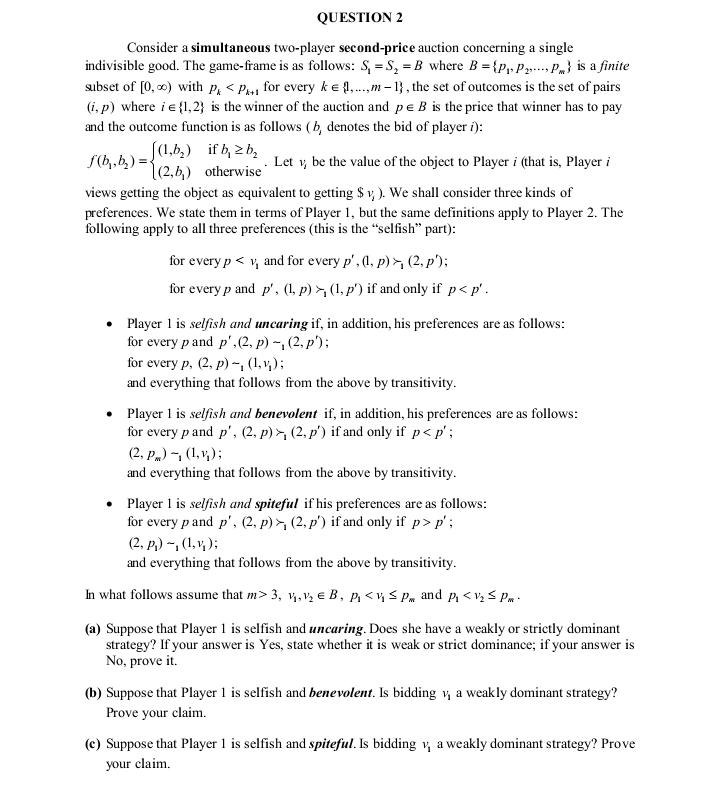
Question: Find the attachments below.. QUESTION 2 Consider a simultaneous two-player second-price auction concerning a single indivisible good. The game-frame is as follows: S, = S,
Find the attachments below..
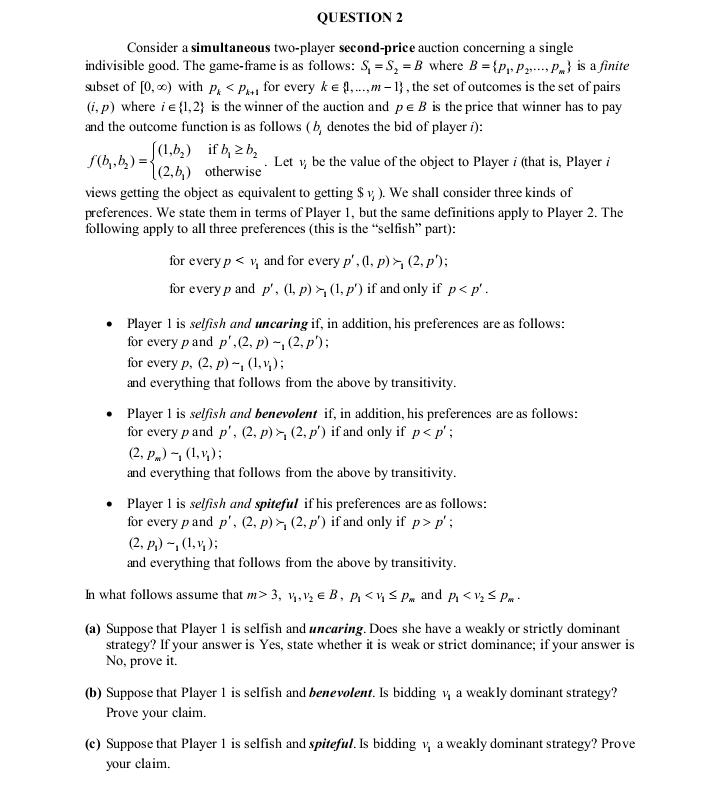
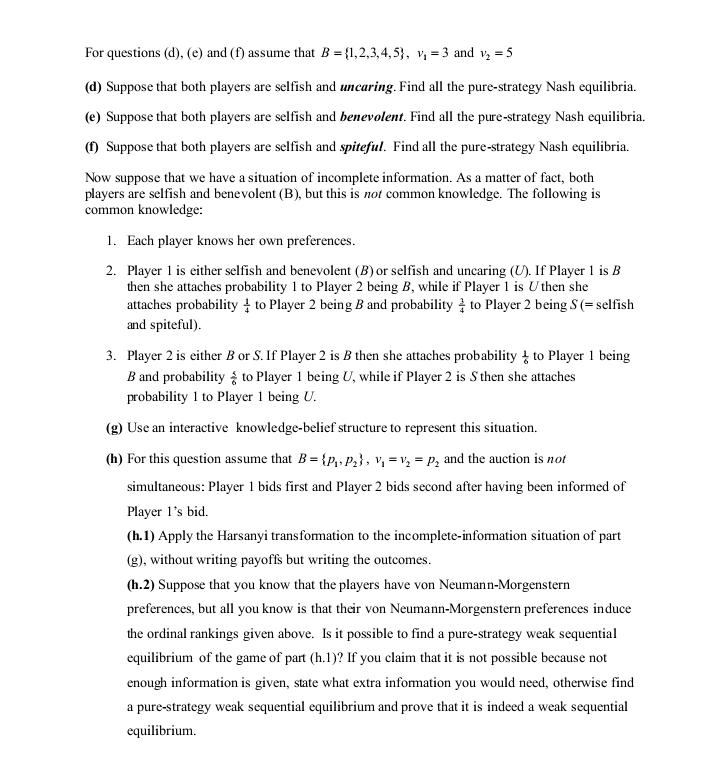
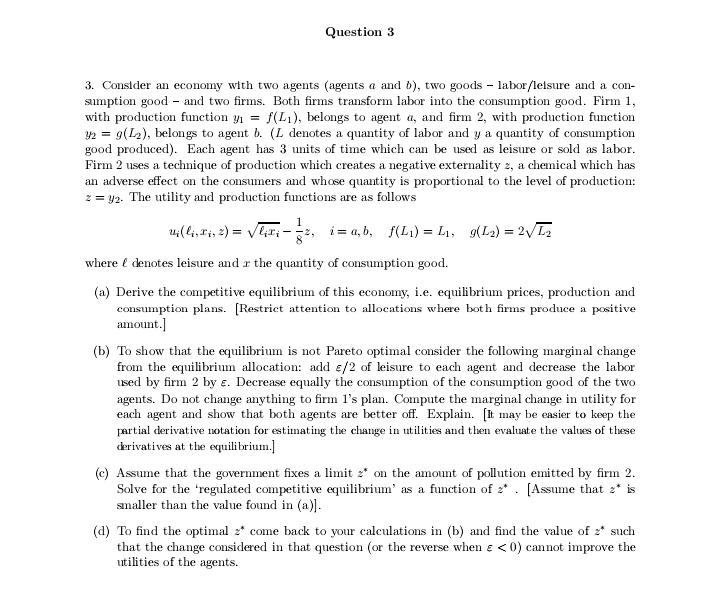
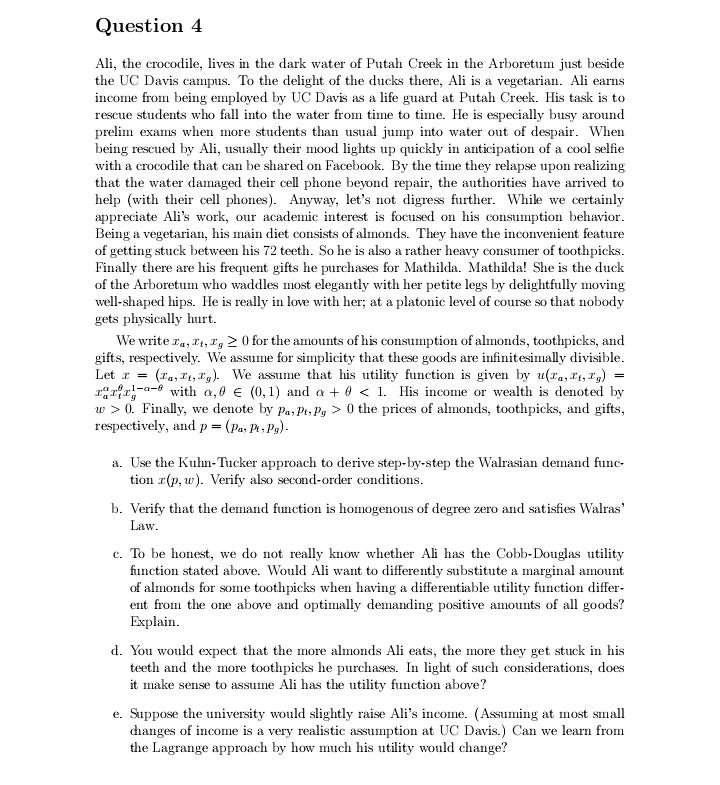
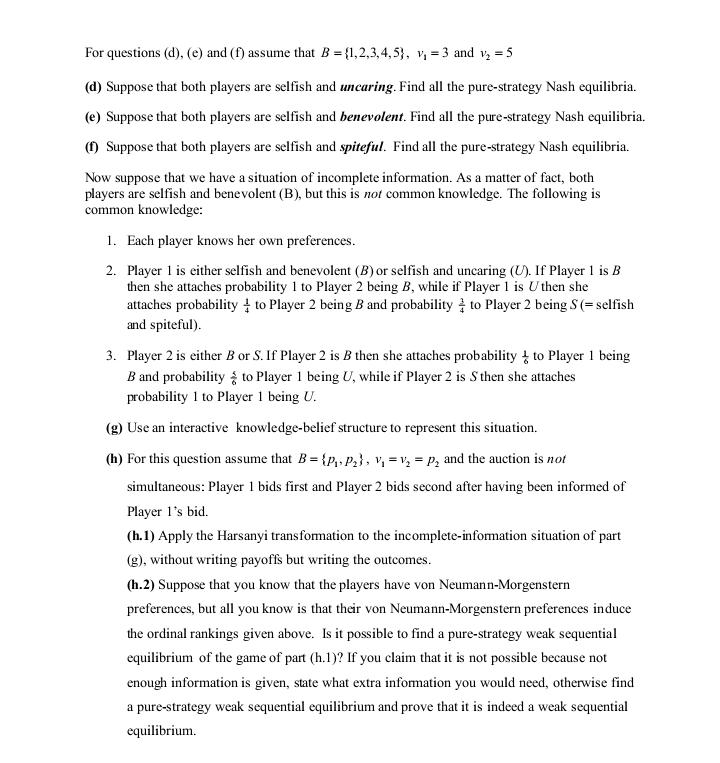
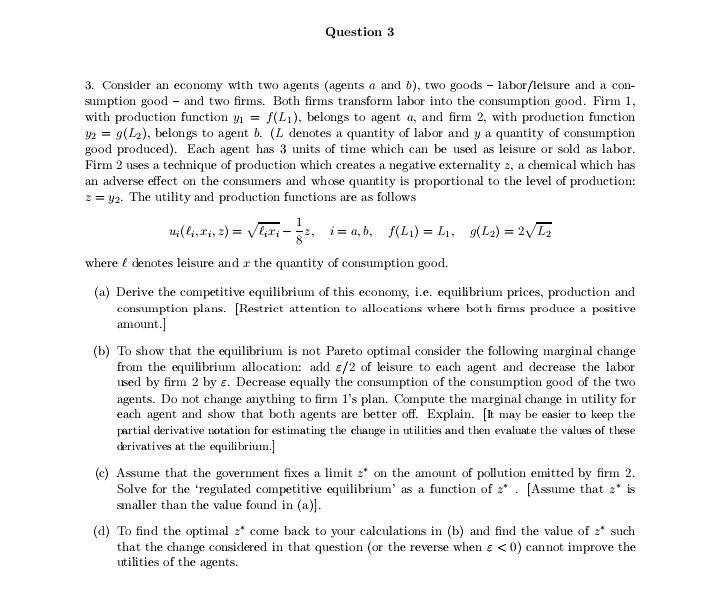
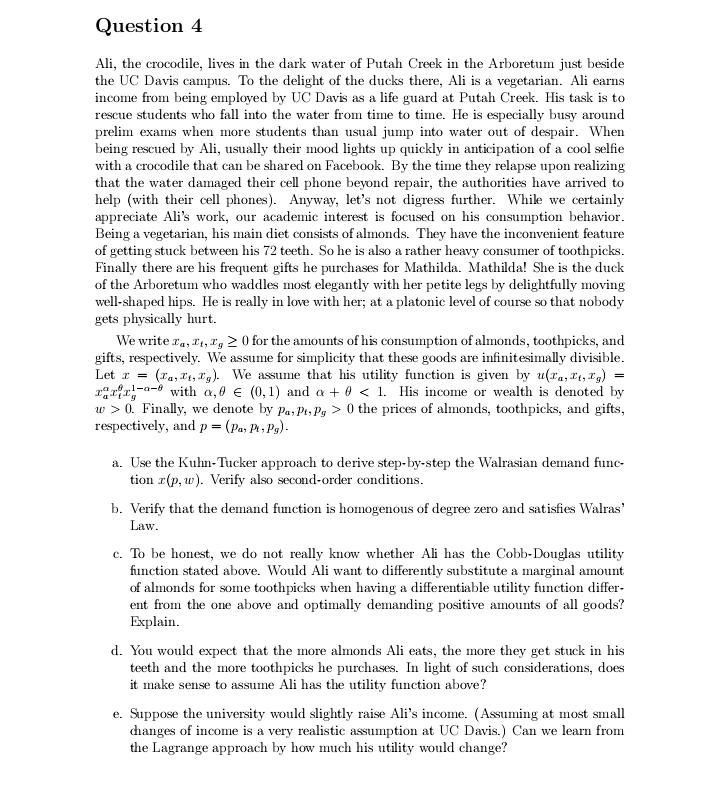
QUESTION 2 Consider a simultaneous two-player second-price auction concerning a single indivisible good. The game-frame is as follows: S, = S, = B where B= (p,, pp..., P.) is a finite subset of [0, 0) with P. , (2, p'); for everyp and p', (1, p) >, (1, p') if and only if p , (2, p') if and only if p, (2, p') if and only if p> p' ; (2, p.) -, (1,"); and everything that follows from the above by transitivity. In what follows assume that m> 3, w,ne B, p 0. Finally, we denote by Pa, pr, p, > 0 the prices of almonds, toothpicks, and gifts, respectively, and p = (Pa; P , Pg)- a. Use the Kuhn-Tucker approach to derive step-by-step the Walrasian demand func- tion r(p, w). Verify also second-order conditions. b. Verify that the demand function is homogenous of degree zero and satisfies Walras' Law. c. To be honest, we do not really know whether Ali has the Cobb-Douglas utility function stated above. Would Ali want to differently substitute a marginal amount of almonds for some toothpicks when having a differentiable utility function differ- ent from the one above and optimally demanding positive amounts of all goods? Explain. d. You would expect that the more almonds Ali eats, the more they get stuck in his teeth and the more toothpicks he purchases. In light of such considerations, does it make sense to assume Ali has the utility function above? e. Suppose the university would slightly raise Ali's income. (Assuming at most small changes of income is a very realistic assumption at UC Davis.) Can we learn from the Lagrange approach by how much his utility would change
Step by Step Solution
There are 3 Steps involved in it

Get step-by-step solutions from verified subject matter experts
 Study Help