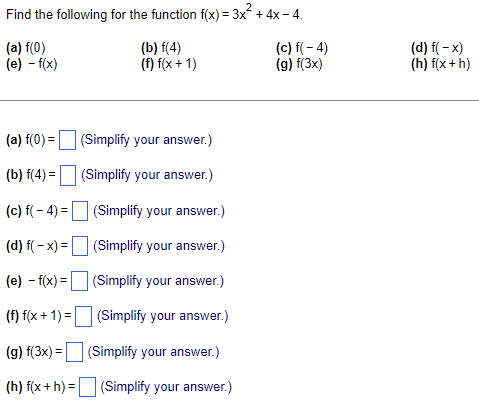
Question: Find the following for the function f(x) = 3x + 4x - 4. (a) f(0) (b) f(4) (c) f( - 4) (d) f( - x)
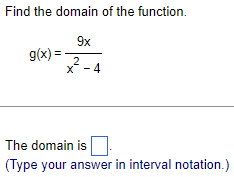
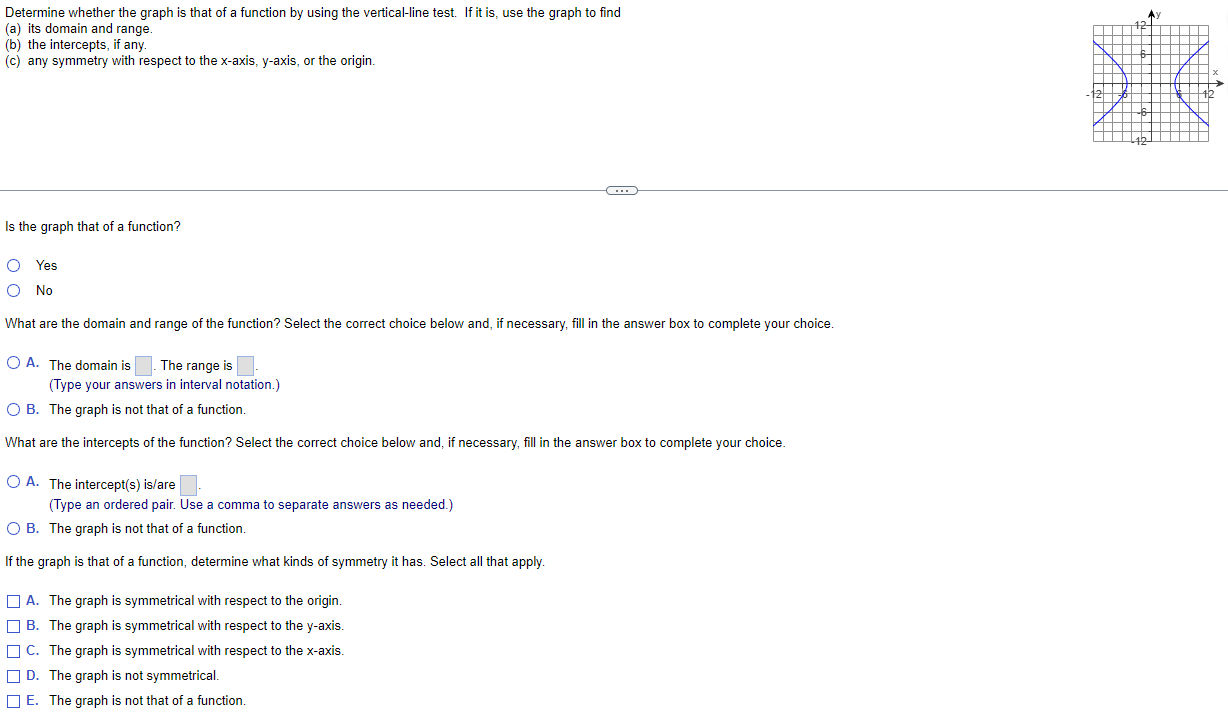
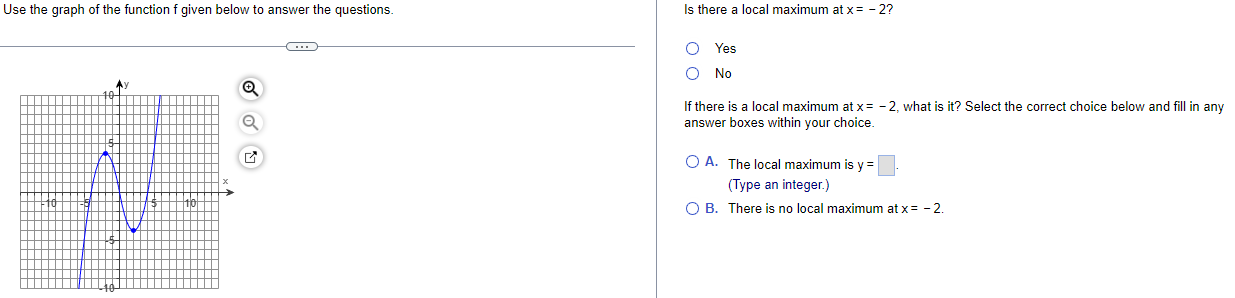
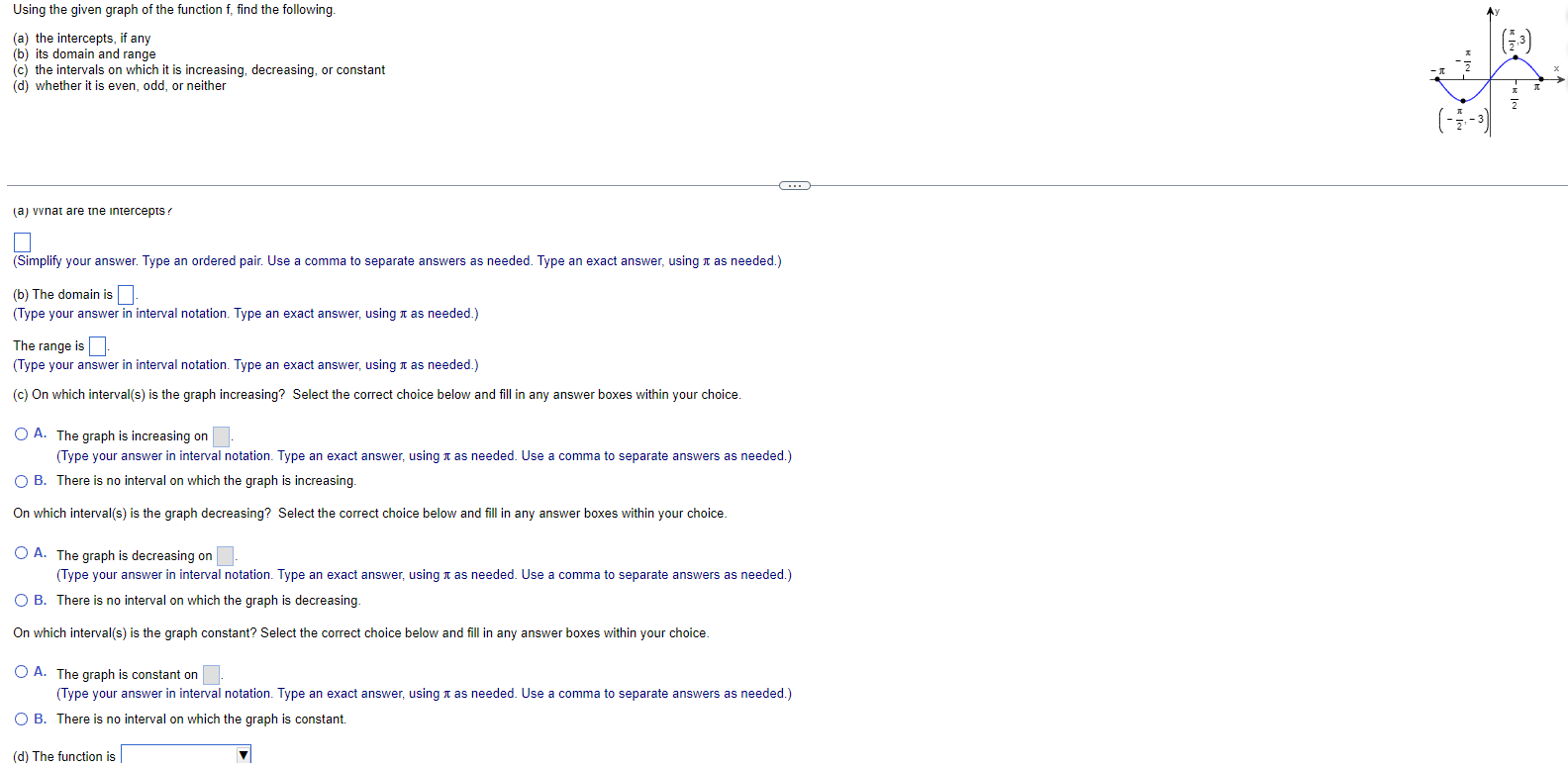
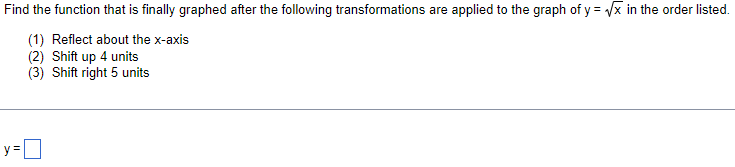
Find the following for the function f(x) = 3x" + 4x - 4. (a) f(0) (b) f(4) (c) f( - 4) (d) f( - x) (e) - f(x) (f) fix + 1) (g) f(3x) (h) f( x + h) (a) f(0) = (Simplify your answer.) (b) f(4) = (Simplify your answer.) (c) f( - 4) = (Simplify your answer.) (d) f( - x) = (Simplify your answer.) (e) - f(x) = (Simplify your answer.) (f) f(x + 1) = (Simplify your answer.) (g) f(3x) = (Simplify your answer.) (h) f(x + h) = (Simplify your answer.)Find to domain of the function. i} 92' BK: x24 The domain is E. {Type your answer in interval notation.) Determine whether the graph is that of a function by using the vertical-line test. If it is, use the graph to find (a) its domain and range (b) the intercepts, if any. (c) any symmetry with respect to the x-axis, y-axis, or the origin. Is the graph that of a function? Yes O No What are the domain and range of the function? Select the correct choice below and, if necessary, fill in the answer box to complete your choice. O A. The domain is . The range is. (Type your answers in interval notation.) O B. The graph is not that of a function. What are the intercepts of the function? Select the correct choice below and, if necessary, fill in the answer box to complete your choice. O A. The intercept(s) is/are (Type an ordered pair. Use a comma to separate answers as needed.) O B. The graph is not that of a function. If the graph is that of a function, determine what kinds of symmetry it has. Select all that apply. O A. The graph is symmetrical with respect to the origin. OB. The graph is symmetrical with respect to the y-axis. OC. The graph is symmetrical with respect to the x-axis. OD. The graph is not symmetrical. O E. The graph is not that of a function.Use the graph of the function f given below to answer the questions. Is there a local maximum at x = - 2? Yes O No If there is a local maximum at x= - 2, what is it? Select the correct choice below and fill in any answer boxes within your choice. O A. The local maximum is y = X (Type an integer.) O B. There is no local maximum at x = - 2.Using the given graph of the function f, find the following. (a) the intercepts, if any (# 3) b) its domain and range (c) the intervals on which it is increasing, decreasing, or constant d) whether it is even, odd, or neither - 51 -3 (a) vvnat are the intercepts ? (Simplify your answer. Type an ordered pair. Use a comma to separate answers as needed. Type an exact answer, using it as needed.) (b) The domain is] (Type your answer in interval notation. Type an exact answer, using It as needed.) The range is. (Type your answer in interval notation. Type an exact answer, using it as needed.) (c) On which interval(s) is the graph increasing? Select the correct choice below and fill in any answer boxes within your choice. O A. The graph is increasing on (Type your answer in interval notation. Type an exact answer, using It as needed. Use a comma to separate answers as needed.) O B. There is no interval on which the graph is increasing. On which interval(s) is the graph decreasing? Select the correct choice below and fill in any answer boxes within your choice. O A. The graph is decreasing on (Type your answer in interval notation. Type an exact answer, using it as needed. Use a comma to separate answers as needed.) O B. There is no interval on which the graph is decreasing On which interval(s) is the graph constant? Select the correct choice below and fill in any answer boxes within your choice. O A. The graph is constant on (Type your answer in interval notation. Type an exact answer, using it as needed. Use a comma to separate answers as needed.) O B. There is no interval on which the graph is constant. (d) The function isA telephone company offers a monthly cellular phone plan for $39.99. It includes 300 anytime minutes plus $0.25 per minute for additional minutes. The following function is used to compute the monthly cost for a subscriber, where x is the number of anytime minutes used. C(x) = 39.99 if 0 300 Compute the monthly cost of the cellular phone for use of the following anytime minutes. (a) 170 (b) 350 (c) 301 (a) C(170) =$ (Round to the nearest cent as needed.) (b) C(350) = $ (Round to the nearest cent as needed.) (c) C(301) =$ (Round to the nearest cent as needed.)Find the function that is finally graphed after the following transformations are applied to the graph of y = vx in the order listed. (1) Reflect about the x-axis (2) Shift up 4 units (3) Shift right 5 units V=
Step by Step Solution
There are 3 Steps involved in it
1 Expert Approved Answer
Step: 1 Unlock
Question Has Been Solved by an Expert!
Get step-by-step solutions from verified subject matter experts
Step: 2 Unlock
Step: 3 Unlock
Students Have Also Explored These Related Mathematics Questions!










 Study Help