







Question: Find the R0 value (basic reproductive number) for each case presented below. Use method of Jacobian or the next generation method. ASSUMPTIONS FOR THE BASIC
Find the R0 value (basic reproductive number) for each case presented below. Use method of Jacobian or the next generation method.
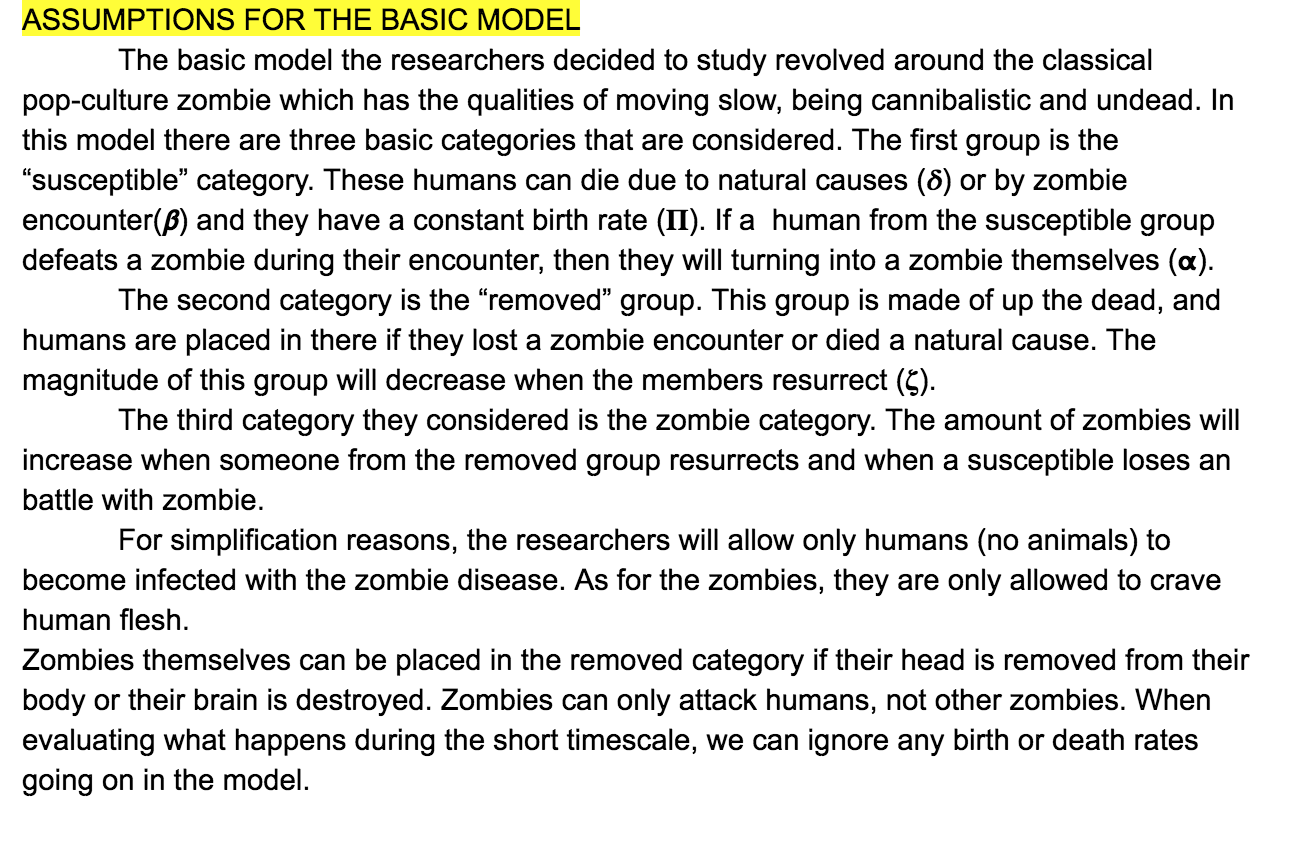
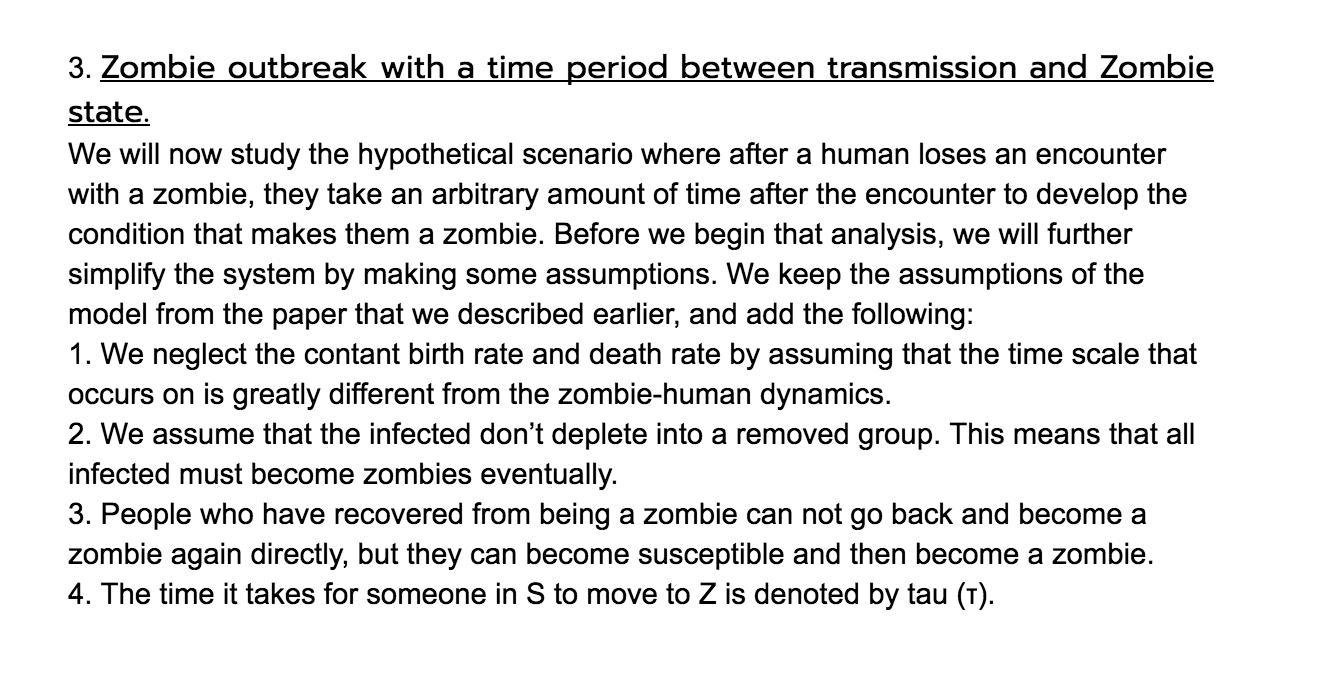
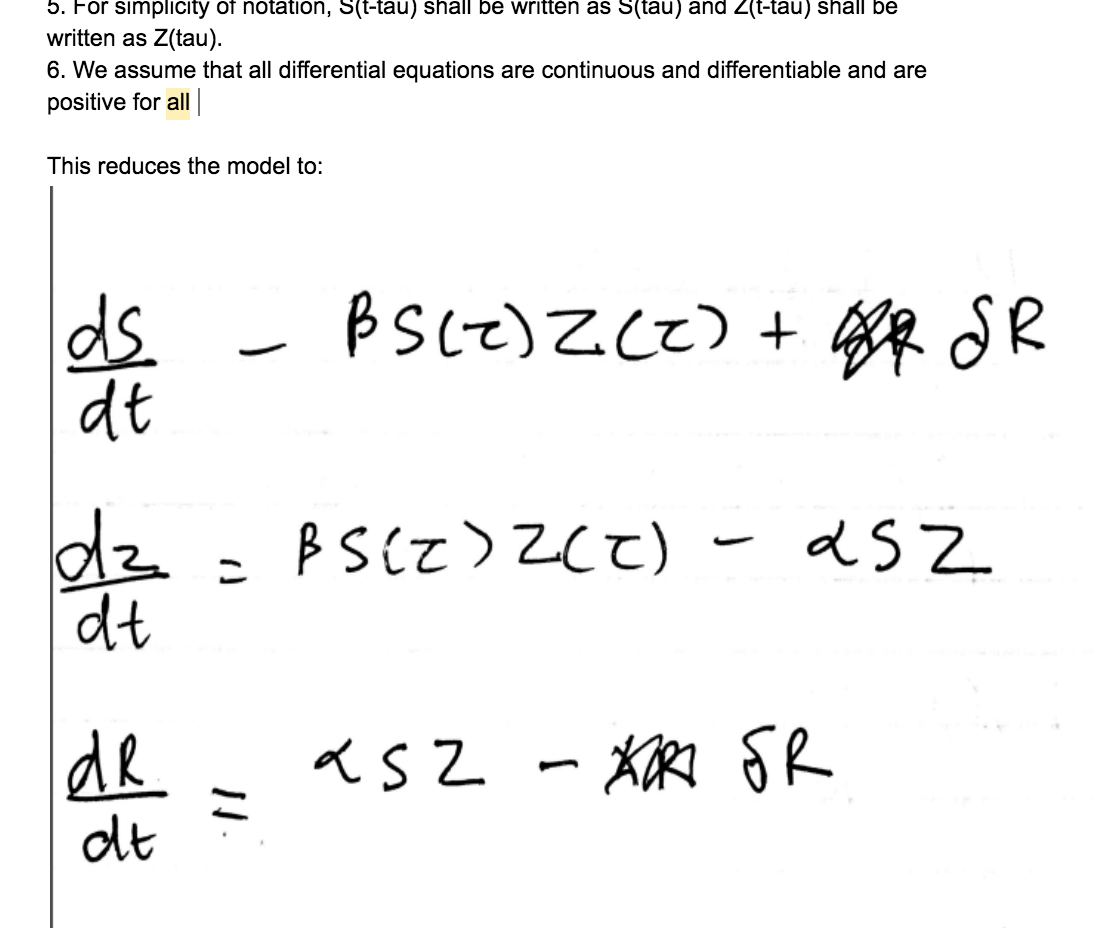
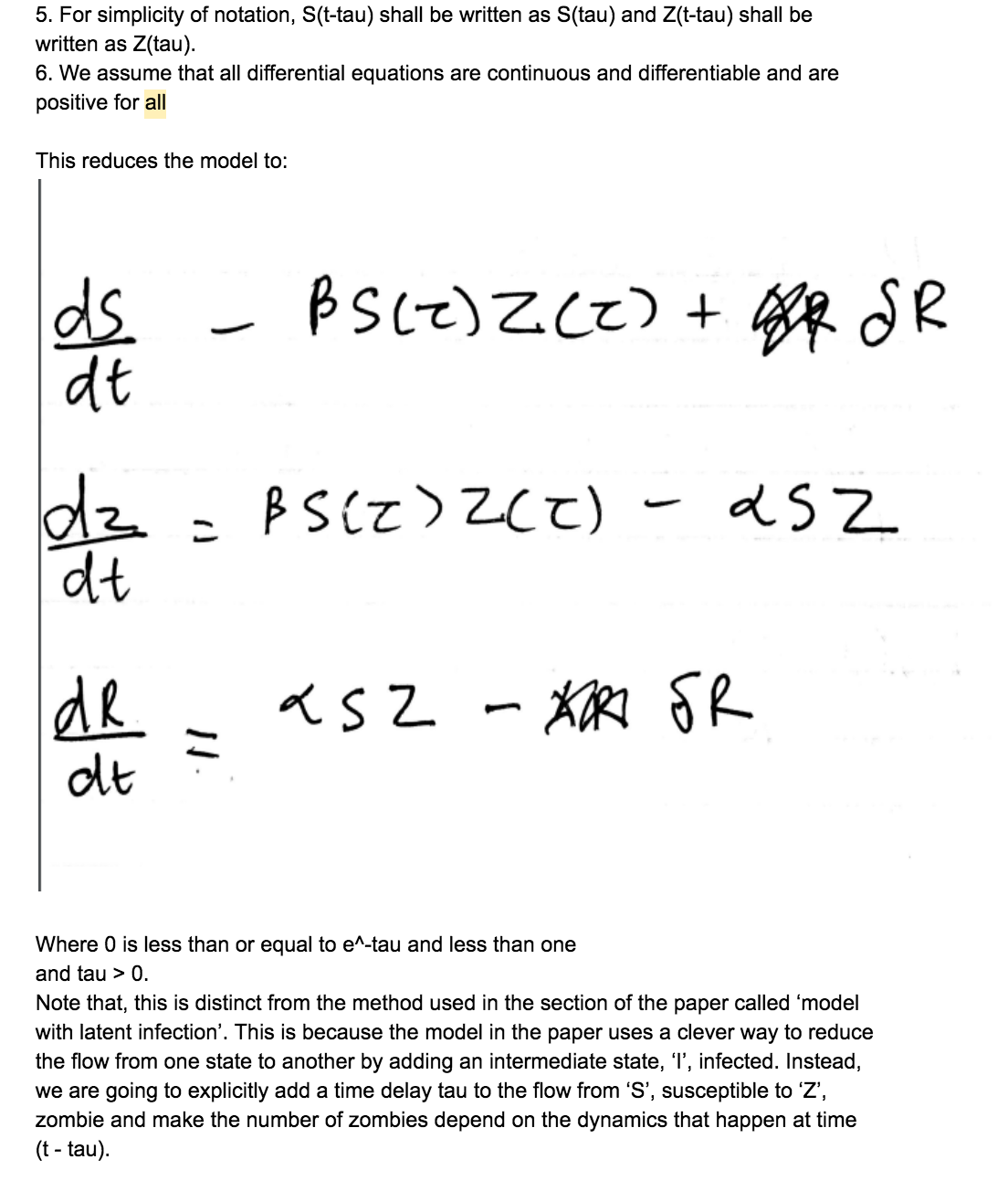
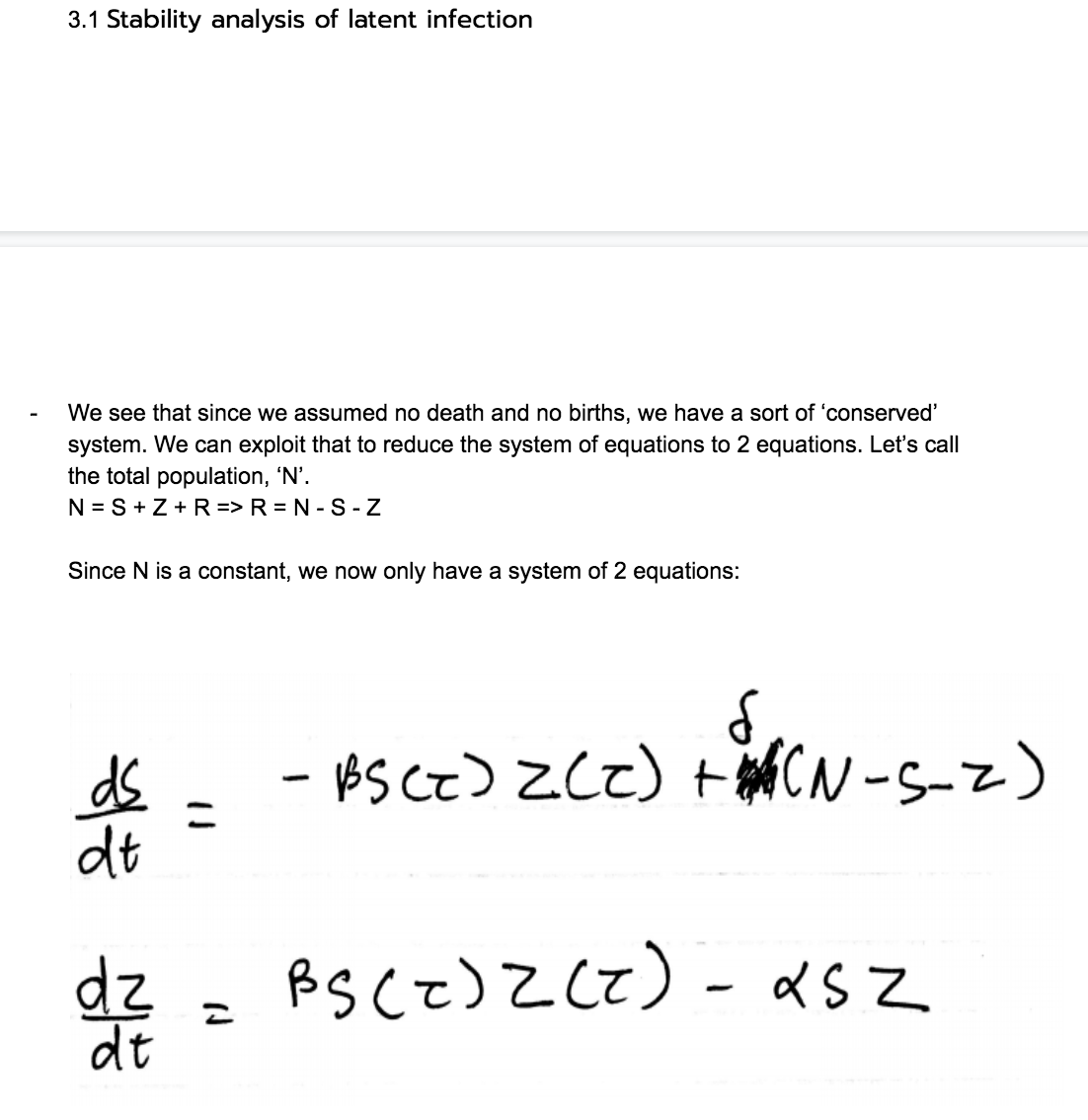
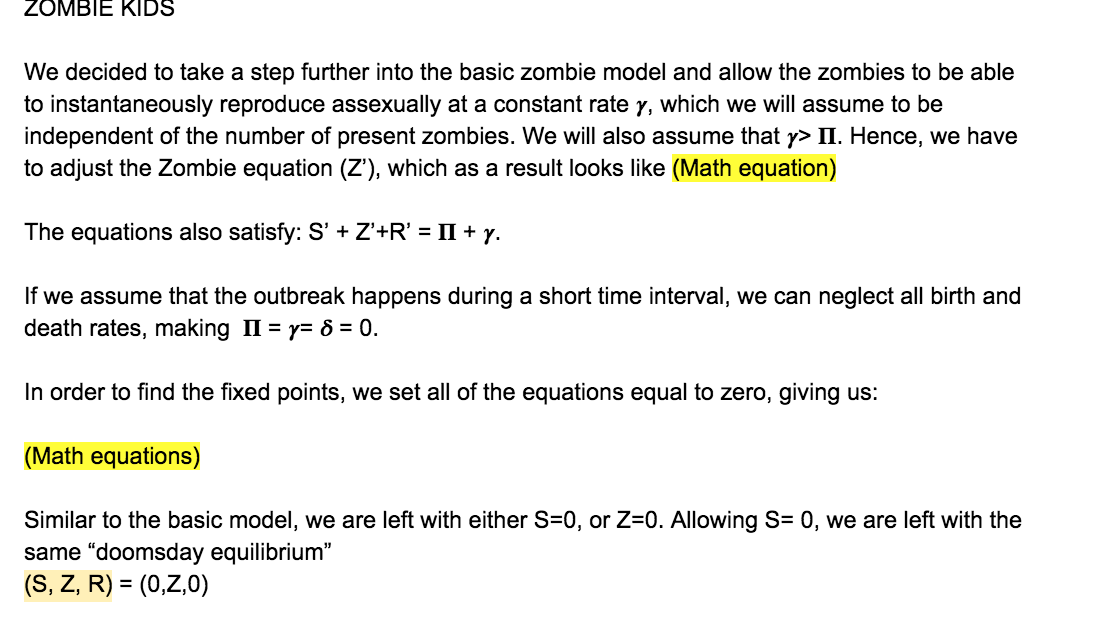
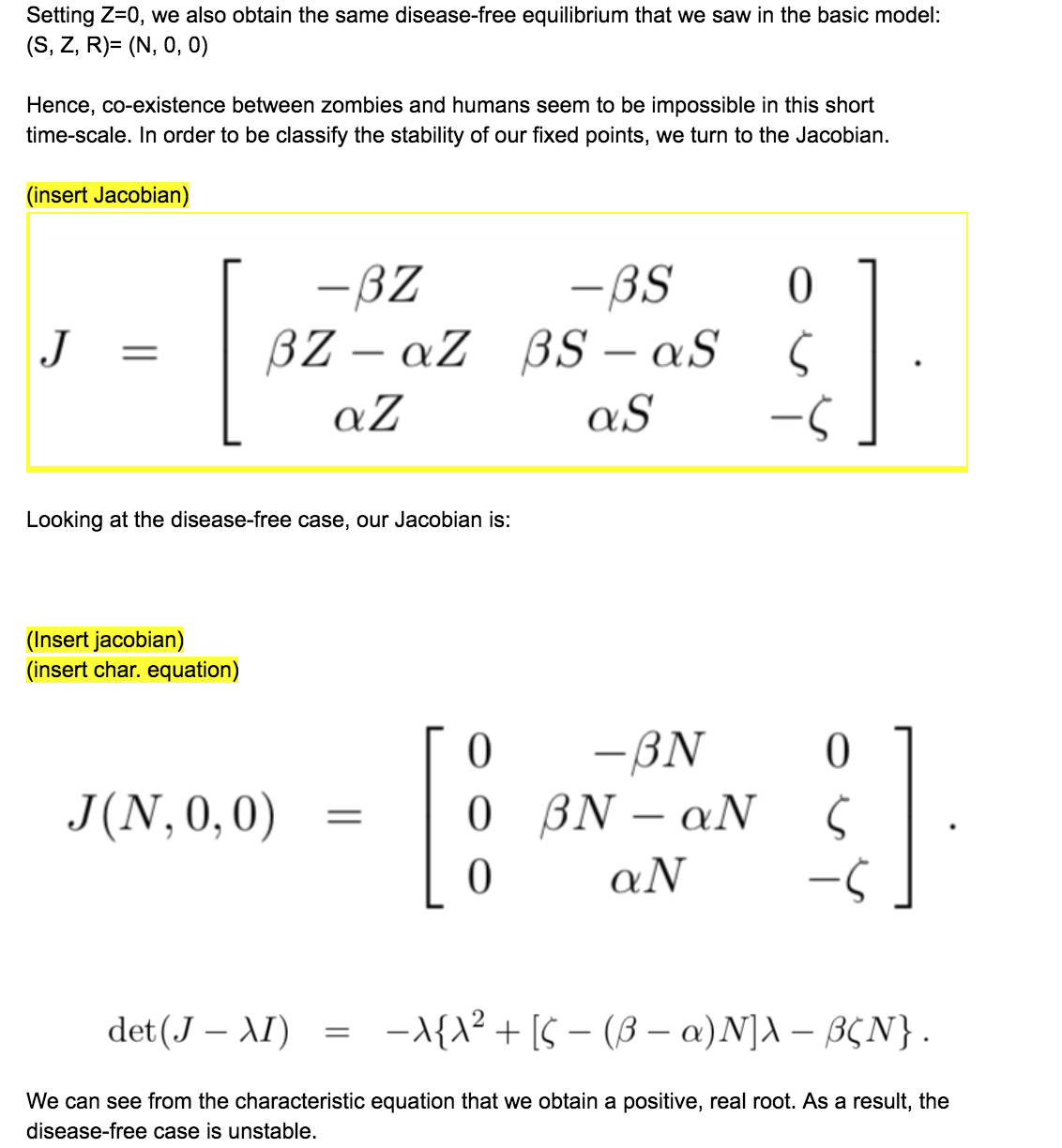
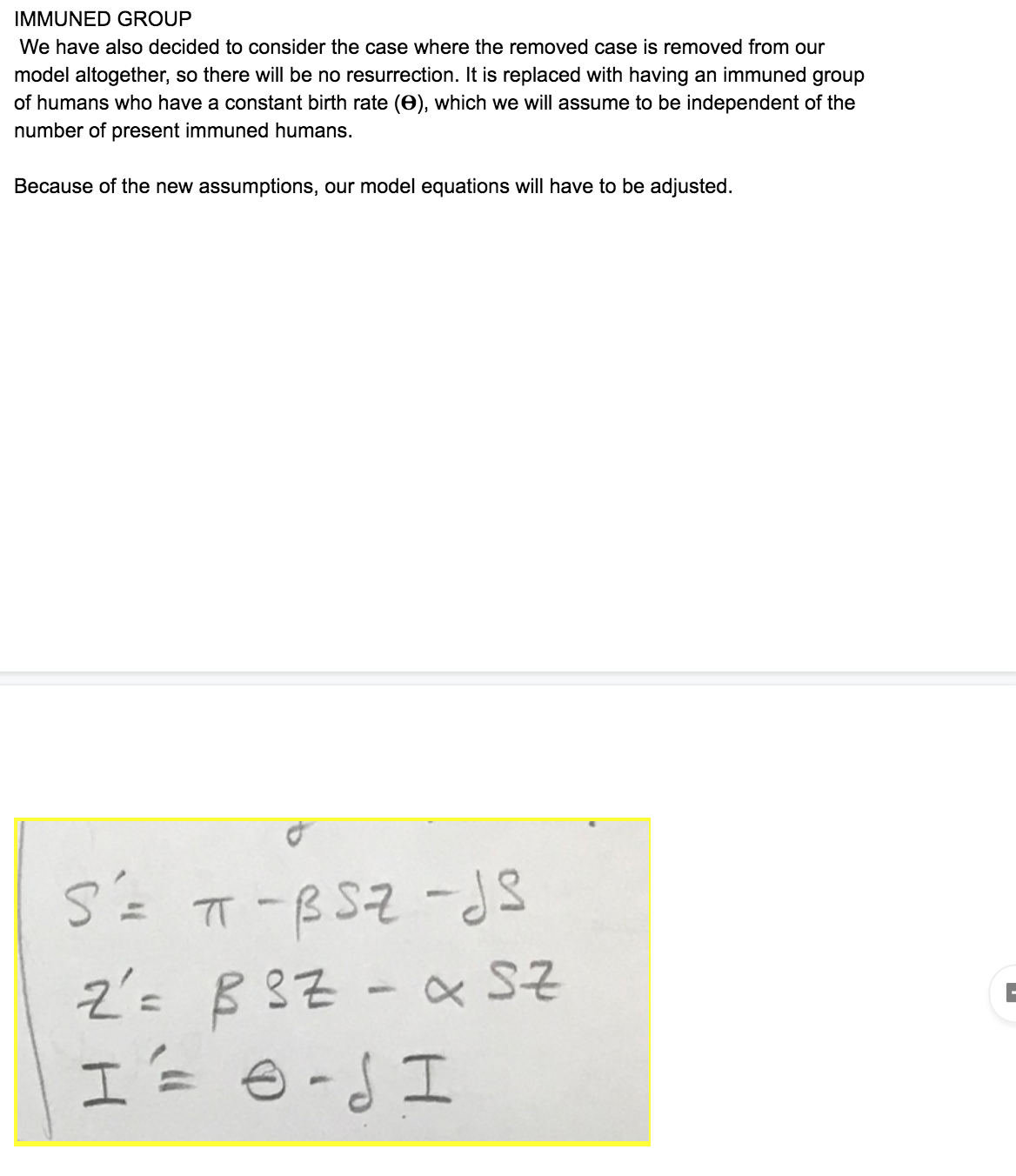
ASSUMPTIONS FOR THE BASIC MODEL The basic model the researchers decided to study revolved around the classical pop-culture zombie which has the qualities of moving slow, being cannibalistic and undead. In this model there are three basic categories that are considered. The rst group is the \"susceptible\" category. These humans can die due to natural causes (6) or by zombie encounter() and they have a constant birth rate (1'1). If a human from the susceptible group defeats a zombie during their encounter, then they will turning into a zombie themselves (a). The second category is the \"removed\" group. This group is made of up the dead, and humans are placed in there if they lost a zombie encounter or died a natural cause. The magnitude of this group will decrease when the members resurrect (g). The third category they considered is the zombie category. The amount of zombies will increase when someone from the removed group resurrects and when a susceptible loses an battle with zombie. For simplication reasons, the researchers will allow only humans (no animals) to become infected with the zombie disease. As for the zombies, they are only allowed to crave human flesh. Zombies themselves can be placed in the removed category if their head is removed from their body or their brain is destroyed. Zombies can only attack humans, not other zombies. When evaluating what happens during the short timescale, we can ignore any birth or death rates going on in the model. 3. Zombie outbreak with a time period between transmission and Zombie state. We will now study the hypothetical scenario where after a human loses an encounter with a zombie, they take an arbitrary amount of time after the encounter to develop the condition that makes them a zombie. Before we begin that analysis, we will further simplify the system by making some assumptions. We keep the assumptions of the model from the paper that we described earlier, and add the following: 1. We neglect the contant birth rate and death rate by assuming that the time scale that occurs on is greatly different from the zombie-human dynamics. 2. We assume that the infected don't deplete into a removed group. This means that all infected must become zombies eventually. 3. People who have recovered from being a zombie can not go back and become a zombie again directly, but they can become susceptible and then become a zombie. 4. The time it takes for someone in S to move to Z is denoted by tau (1). 5. For simplicity OF notation , all- Tau ) shall be written as oflaw ) and C ( 1- Tau ) Shall be written as Z ( tau ) . 6 . We assume that all differential equations are continuous and differentiable and are* positive for all\\ This reduces the model to :" - | BS ( X ) Z ( x ) + OR SR SP at dz = BS(Z ) Z ( * ) - a5 2 at AR 2 5 2 - KORI SR at5. For simplicity of notation, S(t-tau) shall be written as S(tau) and Z(ttau) shall be written as Z(tau). 6. We assume that all differential equations are continuous and differentiable and are positive for all This reduces the model to: Where 0 is less than or equal to eA-tau and less than one and tau > 0. Note that, this is distinct from the method used in the section of the paper called 'model with latent infection'. This is because the model in the paper uses a clever way to reduce the flow from one state to another by adding an intermediate state, 'l', infected. Instead, we are going to explicitly add a time delay tau to the ow from rS', susceptible to 'Z', zombie and make the number of zombies depend on the dynamics that happen at time (t - tau). 3.1 Stability analysis of latent infection - We see that since we assumed no death and no births, we have a sort of 'conserved' system. We can exploit that to reduce the system of equations to 2 equations. Let's call the total population, 'N'. N=S+Z+R=>R=N-S-Z Since N is a constant, we now only have a system of 2 equations: cl 3%. __ " W505) ZCI.) l'\"CU-_Z-) alt "' a; _ 9:50:31ch 91 t ZOMBIE KIDS We decided to take a step further into the basic zombie model and allow the zombies to be able to instantaneously reproduce assexually at a constant rate y, which we will assume to be independent of the number of present zombies. We will also assume that y> II. Hence, we have to adjust the Zombie equation (2'), which as a result looks like (Math equation) The equations also satisfy: 3' + Z'+R' = H + 7. If we assume that the outbreak happens during a short time interval, we can neglect all birth and death rates, making II = y: 5 = 0. In order to nd the xed points, we set all of the equations equal to zero, giving us: (Math equations) Similar to the basic model, we are left with either 8:0, or 2:0. Allowing S: 0, we are left with the same \"doomsday equilibrium" (8, Z, R) = (0,2,0) Setting Z = O , we also obtain the same disease-free equilibrium that we saw in the basic model : ( S , Z , R ) = ( N , 0 , 0 ) Hence , co- existence between zombies and humans seem to be impossible in this short. time- scale . In order to be classify the stability of our fixed points , we turn to the Jacobian . ( insert Jacobian ) - BZ - B.S U B Z - aL BS - as a Z as" - 5 Looking at the disease- free case , our Jacobian is :" ( Insert jacobian ) ( insert char . equation ) O - BN O J ( N , 0 , 0 ) = O BN - aN O aN det ( J - 1 1 ) = - 1( 1 2 + 15 - ( B - Q) N1 1 - BSN]. We can see from the characteristic equation that we obtain a positive , real root . As a result , the disease - free case is unstable .IMMUNED GROUP We have also decided to consider the case where the removed case is removed from our model altogether, so there will be no resurrection. It is replaced with having an immuned group of humans who have a constant birth rate (0). which we will assume to be independent of the number of present immuned humans. Because of the new assumptions. our model equations will have to be adjusted
Step by Step Solution
There are 3 Steps involved in it

Get step-by-step solutions from verified subject matter experts
 Study Help