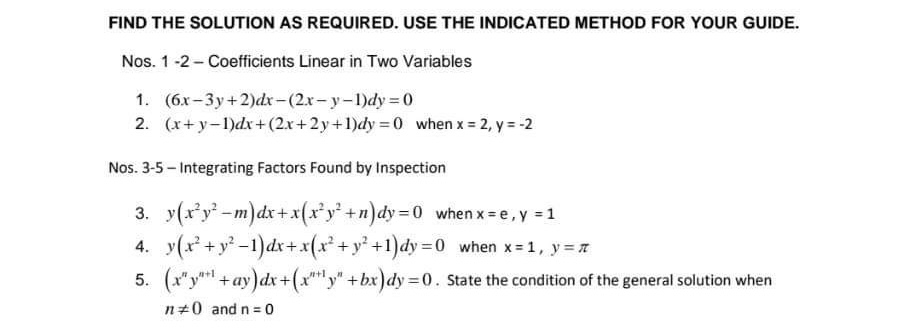
Question: FIND THE SOLUTION AS REQUIRED. USE THE INDICATED METHOD FOR YOUR GUIDE. Nos. 1 -2 - Coefficients Linear in Two Variables 1. (6x-3y+2)dx -(2x-y-1)dy =0
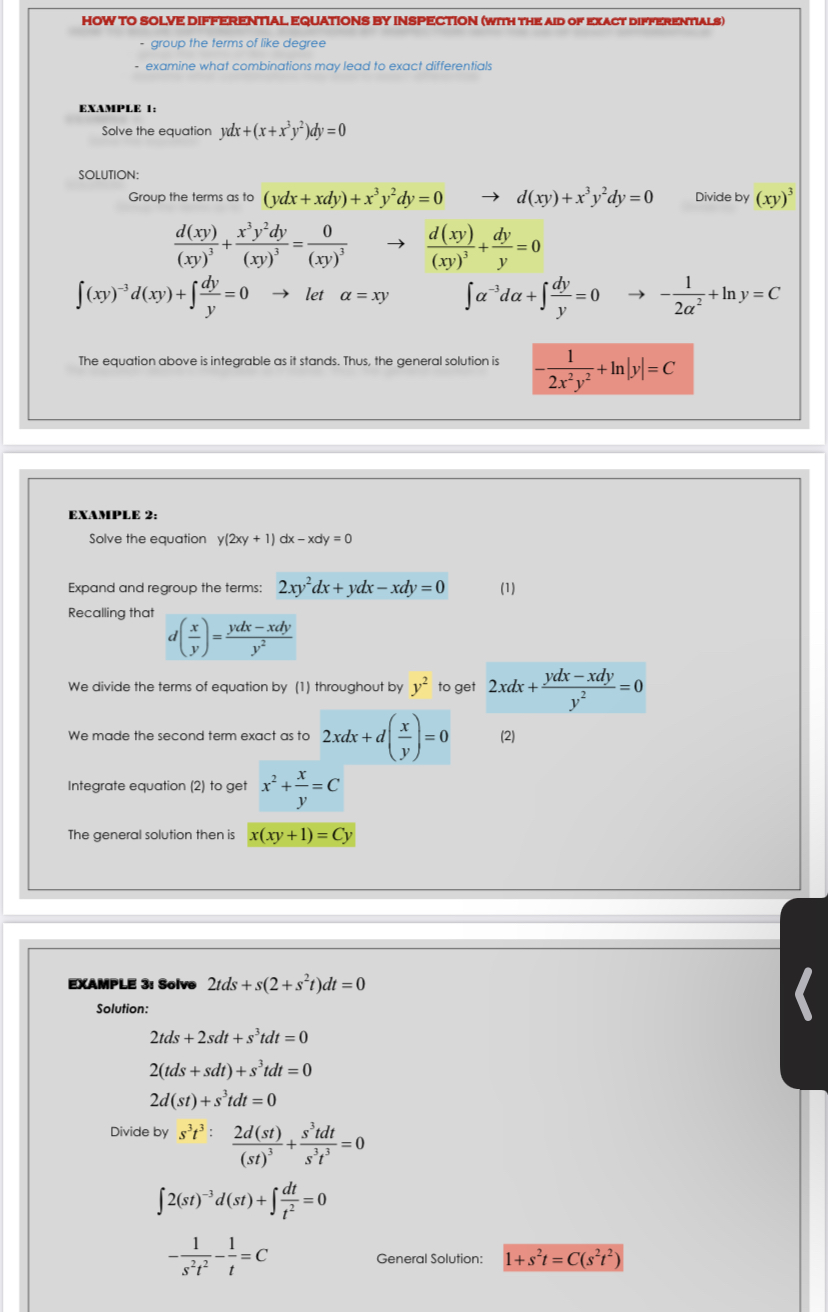
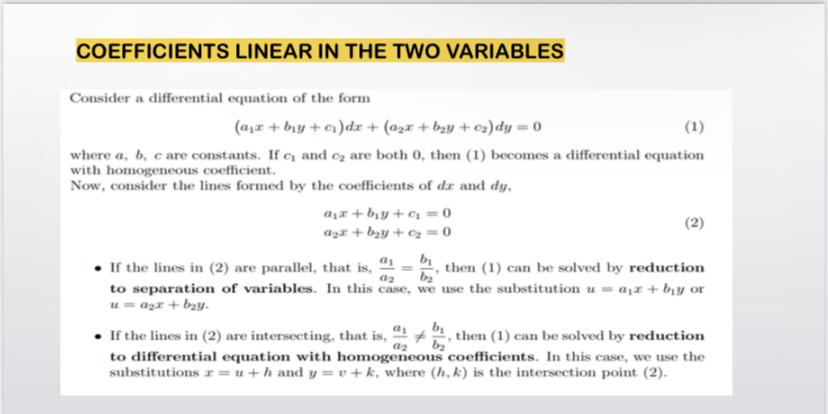
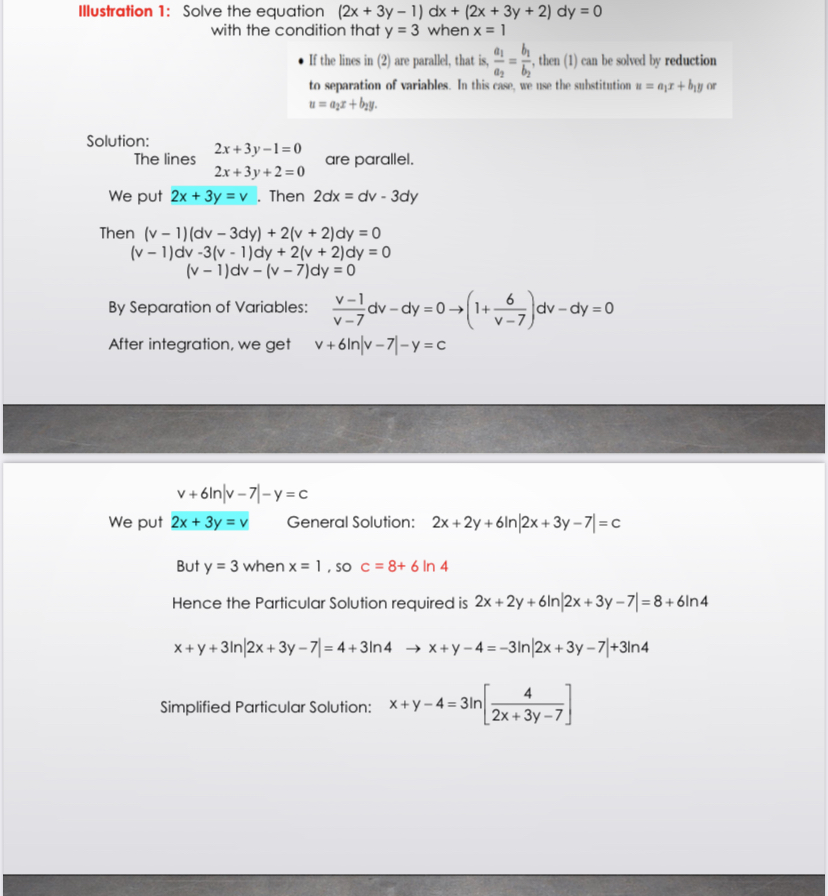
FIND THE SOLUTION AS REQUIRED. USE THE INDICATED METHOD FOR YOUR GUIDE. Nos. 1 -2 - Coefficients Linear in Two Variables 1. (6x-3y+2)dx -(2x-y-1)dy =0 2. (x+y-Ddx+ (2x+2y+1)dy =0 when x = 2, y= -2 Nos. 3-5 - Integrating Factors Found by Inspection 3. y(xy' -m)dx+x(xy' +n)dy=0 whenx=e, y = 1 4. y(x+ y2 -1)dx+x(x' + y'+1)dy=0 when x=1, y =* 5. (x"y" tay) dx + (x"y" + bx) dy =0. State the condition of the general solution when n #0 and n = 0HOW TO SOLVE DIFFERENTIAL EQUATIONS BY INSPECTION (WITH THE AID OF EXACT DIFFERENTIALS) - group the terms of like degree - examine what combinations may lead to exact differentials EXAMPLE 1: Solve the equation ydr+ (x+xy')dy =0 SOLUTION: Group the terms as to (ydx + xdy) + xy'dy =0 + d(xy)+xy-dy=0 Divide by (xy) d(xy) xy dy 0 - d(xy) dy =0 (xy ) (x) ( x ) (xV ) 3 y [( x) d(xy)+[=0 -+ let a=xy 1 + In y = C 2 0- The equation above is integrable as it stands. Thus, the general solution is 1 2.x2 12 + In y =c EXAMPLE 2: Solve the equation y(2xy + 1) dx - xdy = 0 Expand and regroup the terms: 2xy dx + ydx - xdy =0 (1) Recalling that ydx - xdy We divide the terms of equation by (1) throughout by y to get 2xdx + ydx -xdy We made the second term exact as to 2xdx + d * = 0 (2 ) Integrate equation (2) to get x + - = C The general solution then is x(xy + 1) = Cy EXAMPLE 3: Solve 2tds + s(2 + s't)dt =0 Solution: 2tds + 2sdt + s'tdt =0 2(tds + sdt) + s'tdt = 0 2d(st) + s'tdt = 0 Divide by s't : 2d(st) s'tdt ( st ) 3 s't [2(st) 'd(st ) + 2 =0 General Solution: 1 +s't = C(s't)COEFFICIENTS LINEAR IN THE TWO VARIABLES Consider a differential equation of the form (aja + by + ci)dx + (azz + bay + cz)dy = 0 (1) where a, b, care constants. If c, and ca are both 0, then (1) becomes a differential equation with homogeneous coefficient. Now, consider the lines formed by the coefficients of dr and dy, as+by+9 =0 (2) aga + bay + 02 = 0 . If the lines in (2) are parallel, that is, 01 - 91 then (1) can be solved by reduction to separation of variables. In this case, we use the substitution u = aja + by or u = azr + bay. . If the lines in (2) are intersecting, that is, 02 by " then (1) can be solved by reduction to differential equation with homogeneous coefficients. In this case, we use the substitutions r = u + h and y = v + k, where (h, k) is the intersection point (2).Illustration 1: Solve the equation (2x + 3y - 1) dx + (2x + 3y + 2) dy = 0 with the condition that y = 3 when x = 1 . If the lines in (2) are parallel, that is, "! = , then (1) can be solved by reduction to separation of variables. In this case, we use the substitution a = ajr + by or u = agr + bay. Solution: The lines 2x+3y-1=0 2.x +3y+2=0 are parallel. We put 2x + 3y = v . Then 2dx = dv - 3dy Then (v - 1)(dv - 3dy) + 2(v + 2)dy = 0 (v - 1)dv -3(v - 1)dy + 2(v + 2)dy = 0 (v - 1)dv - (v - 7)dy = 0 By Separation of Variables: V - 7 V -dv - dy = 0 -> (1+6_ dv - dy =0 After integration, we get v+6In/v -7-y = c v+6In/v-7-y = c We put 2x + 3y = v General Solution: 2x + 2y + 6In|2x + 3y -7| = c But y = 3 when x = 1 , so c = 8+ 6 In 4 Hence the Particular Solution required is 2x + 2y + 6In|2x +3y -7|=8+6In4 x +y+3In|2x +3y -7| = 4+3In4 -> x+y-4=-3In|2x +3y-7|+3In4 Simplified Particular Solution: x + y -4 =3In 4 2x + 3y-7
Step by Step Solution
There are 3 Steps involved in it
1 Expert Approved Answer
Step: 1 Unlock
Question Has Been Solved by an Expert!
Get step-by-step solutions from verified subject matter experts
Step: 2 Unlock
Step: 3 Unlock
Students Have Also Explored These Related Mathematics Questions!









 Study Help