







Question: finding the point wise limit results in zeros, does this indicate the point wise limit is 0? in 2. Consider f(:r) : n + 2:-
finding the point wise limit results in zeros, does this indicate the point wise limit is 0?
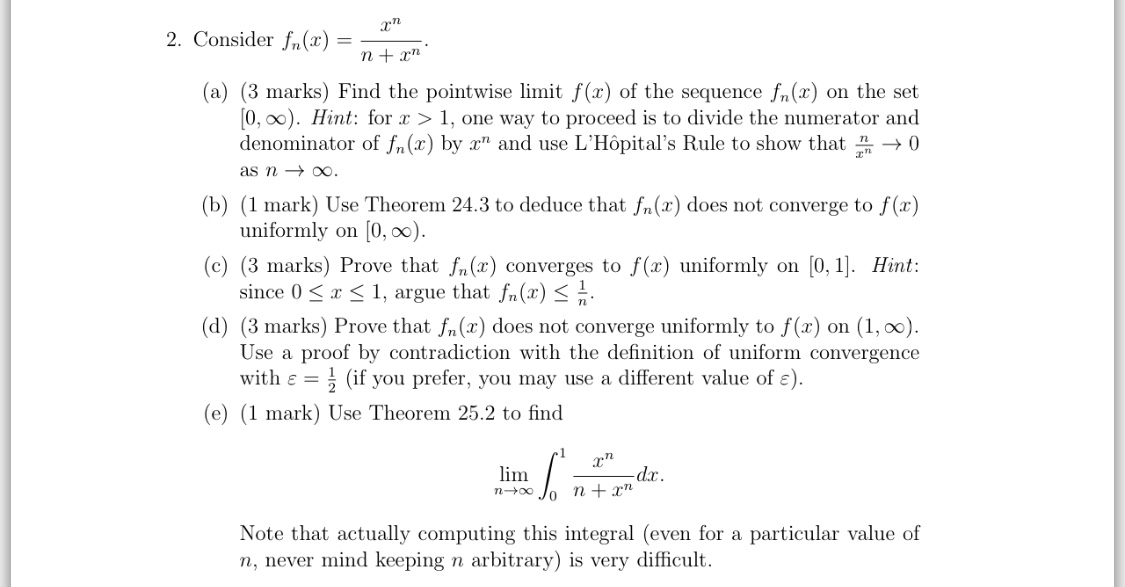
in 2. Consider f(:r) : n + 2:"- (a) (3 marks) Find the pointwise limit f(:r) of the sequence fab?) on the set [0, oo). Hint: for :c > 1, one way to proceed is to divide the numerator and denominator of f1" (3) by 2:\" and use L'Hopital's Rule to show that 1% -+ 0 as n > 00. (b) (1 mark) Use Theorem 24.3 to deduce that fn(:c) does not converge to f (1:) uniformly on [0, 00). (c) (3 marks) Prove that f,1 (at) converges to f (at) uniformly on [0,1]. Hint: since 0 S :1: S 1, argue that fn($) E %. (d) (3 marks) Prove that fn(:c) does not converge uniformly to f(:r) on (1, 00). Use a proof by contradiction with the denition of uniform convergence 1 with E = E (if you prefer, you may use a different value of 5). (e) (1 mark) Use Theorem 25.2 to nd 1 n _ 11: 1.1111 dz. n-qu 0 73. + I" Note that actually computing this integral (even for a particular value of 11, never mind keeping n arbitrary) is very difficult
Step by Step Solution
There are 3 Steps involved in it

Get step-by-step solutions from verified subject matter experts
 Study Help