







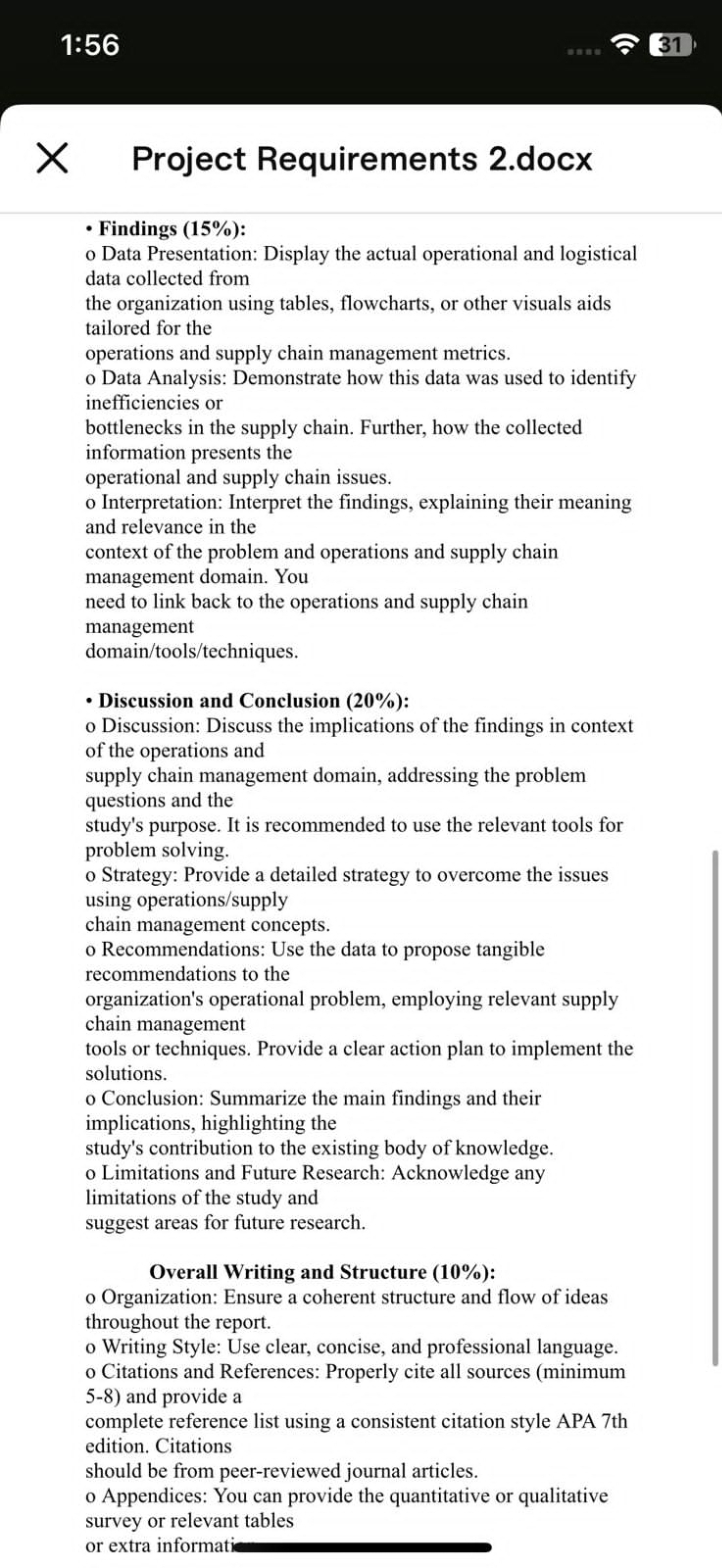
Question: Findings ( 1 5 % ) : o Data Presentation: Display the actual operational and logistical data collected from the organization using tables, flowcharts, or
Findings :
o Data Presentation: Display the actual operational and logistical
data collected from
the organization using tables, flowcharts, or other visuals aids
tailored for the
operations and supply chain management metrics.
o Data Analysis: Demonstrate how this data was used to identify
inefficiencies or
bottlenecks in the supply chain. Further, how the collected
information presents the
operational and supply chain issues.
o Interpretation: Interpret the findings, explaining their meaning
and relevance in the
context of the problem and operations and supply chain
management domain. You
need to link back to the operations and supply chain
management
domaintoolstechniques
Discussion and Conclusion :
o Discussion: Discuss the implications of the findings in context
of the operations and
supply chain management domain, addressing the problem
questions and the
study's purpose. It is recommended to use the relevant tools for
problem solving.
o Strategy: Provide a detailed strategy to overcome the issues
using operationssupply
chain management concepts.
o Recommendations: Use the data to propose tangible
recommendations to the
organization's operational problem, employing relevant supply
chain management
tools or techniques. Provide a clear action plan to implement the
solutions.
o Conclusion: Summarize the main findings and their
implications, highlighting the
study's contribution to the existing body of knowledge.
o Limitations and Future Research: Acknowledge any
limitations of the study and
suggest areas for future research.
Overall Writing and Structure :
o Organization: Ensure a coherent structure and flow of ideas
throughout the report.
o Writing Style: Use clear, concise, and professional language.
o Citations and References: Properly cite all sources minimum
and provide a
complete reference list using a consistent citation style APA th
edition. Citations
should be from peerreviewed journal articles.
o Appendices: You can provide the quantitative or qualitative
survey or relevant tables
or extra informatio
Methods: Research Design :
o Methodology: Clearly outline the methodology, including the sample size, data
collection methods, and data analysis techniques. Describe the practical steps taken
to investigate the problem, eg site visits, interviews with operations managers, or
review of logistical data.
o Process mapflow: Provide relevant supply chainoperational process maps for the
issue which is going to be studied and improved during the project. Should map out
the key processes in the supply chain, identifying bottlenecks.
o Ethical Considerations: Address any ethical considerations related to the research,
such as informed consent, confidentiality, or data privacy.
Findings :
o Data Presentation: Display the actual operational and logistical data collected from
the organization using tables, flowcharts, or other visuals aids tailored for the
operations and supply chain management metrics.
o Data Analysis: Demonstrate how this data was used to identify inefficiencies or
bottlenecks in the supply chain. Further, how the collected information presents the
operational and supply chain issues.
o Interpretation: Interpret the findings, explaining their meaning and relevance in the
context of the problem and operations and supply chain management domain. You
need to link back to the operations and supply chain management
domaintoolstechniques
Discussion and Conclusion :
o Discussion: Discuss the implications of the findings in context of the operations and
supply chain management domain, addressing the problem questions and the
study's purpose. It is recommended to use the relevant tools for problem solving.
o Strategy: Provide a detailed strategy to overcome the issues using operationssupply
chain management concepts.
o Recommendations: Use the data to propose tangible recommendations to the
organization's operational problem, employing relevant supply chain management
tools or techniques. Provide a clear action plan to implement the solutions.
o Conclusion: Summarize the main findings and their implications, highlighting the
study's contribution to the existing body of knowledge.
o Limitations and Future Research: Acknowledge any limitations of the study and
suggest areas for future research.
Overall Writing and Structure :
o Organization: Ensure a coherent structure and flow of ideas throughout the report.
o Writing Style: Use clear, concise, and professional language.
o Citations and References: Properly cite all sources minimum and provide a
complete reference list using a consistent citation style APA th edition. Citations
should be from peerreviewed journal articles.
o Appendices: You can provide the quantitative or qualitative survey or relevant tables
or extra information.
Step by Step Solution
There are 3 Steps involved in it
1 Expert Approved Answer
Step: 1 Unlock

Question Has Been Solved by an Expert!
Get step-by-step solutions from verified subject matter experts
Step: 2 Unlock
Step: 3 Unlock
 Study Help