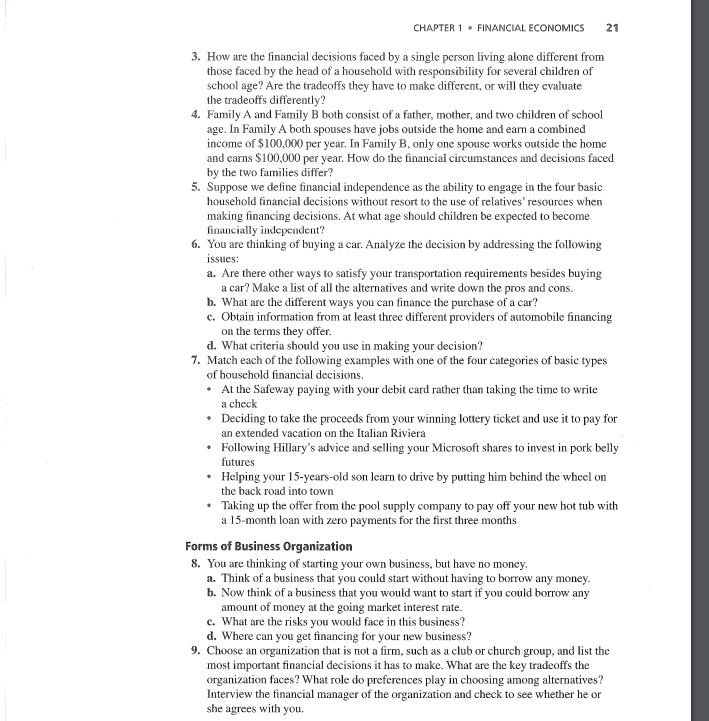
Question: Finish Problems #3, #4, #6, and #8 for chapters 1. Make sure to write down the equations and it should be able to be written
Finish Problems #3, #4, #6, and #8 for chapters 1. Make sure to write down the equations and it should be able to be written in google docs.
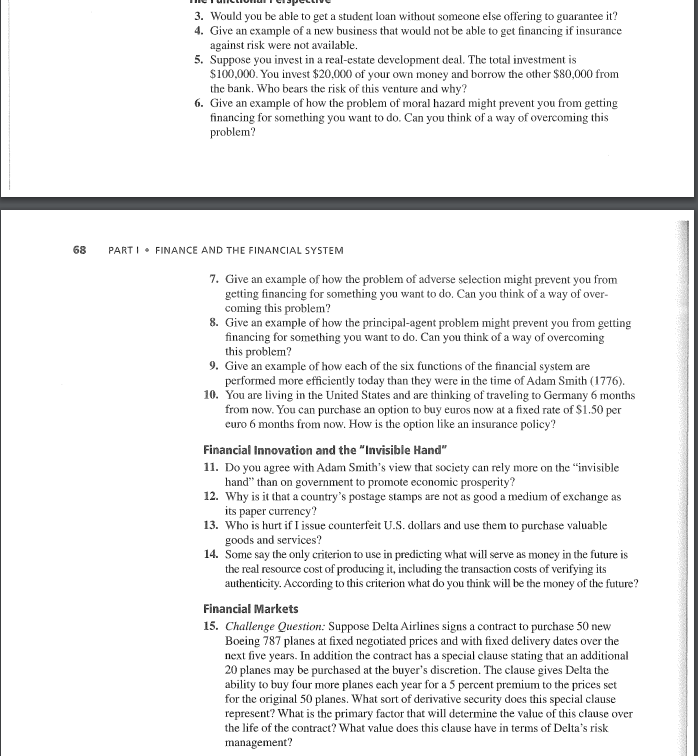
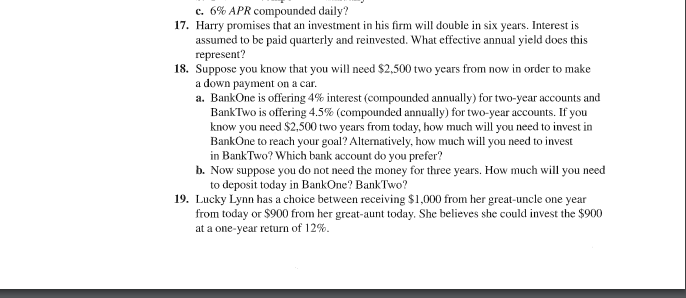
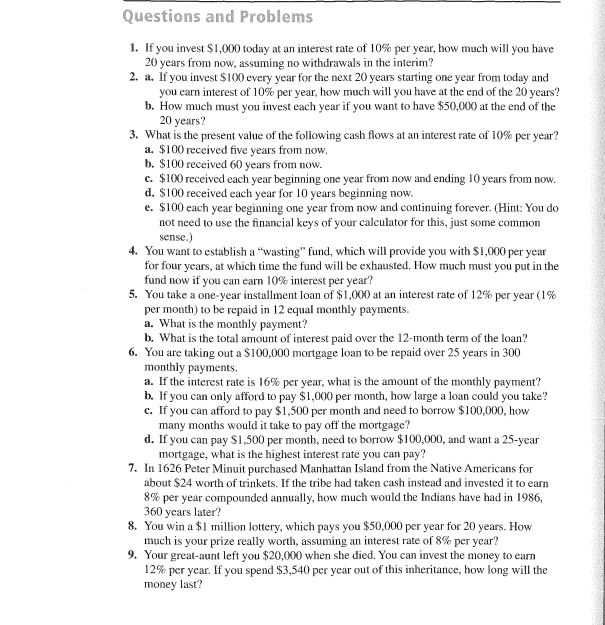
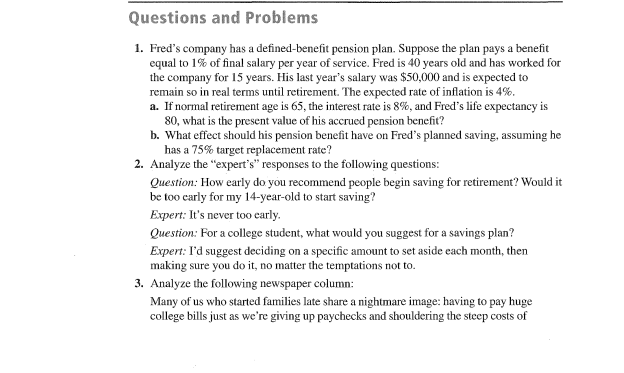
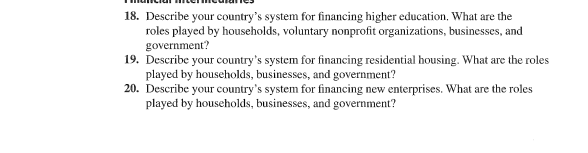
CHAPTER 1 . FINANCIAL ECONOMICS 21 3. How are the financial decisions faced by a single person living alone different from those faced by the head of a household with responsibility for several children of school age? Are the tradeoffs they have to make different, or will they evaluate the tradeoffs differently? 4. Family A and Family B both consist of a father, mother, and two children of school age. In Family A both spouses have jobs outside the home and earn a combined income of $100,000 per year. In Family B, only one spouse works outside the home and earns $100,000 per year. How do the financial circumstances and decisions faced by the two families differ? 5. Suppose we define financial independence as the ability to engage in the four basic household financial decisions without resort to the use of relatives' resources when making financing decisions. At what age should children be expected to become financially independent? 6. You are thinking of buying a car. Analyze the decision by addressing the following issues: a. Are there other ways to satisfy your transportation requirements besides buying a car? Make a list of all the alternatives and write down the pros and cons. b. What are the different ways you can finance the purchase of a car? c. Obtain information from at least three different providers of automobile financing on the terms they offer. d. What criteria should you use in making your decision? 7. Match each of the following examples with one of the four categories of basic types of household financial decisions. . At the Safeway paying with your debit card rather than taking the time to write a check * Deciding to take the proceeds from your winning lottery ticket and use it to pay for an extended vacation on the Italian Riviera Following Hillary's advice and selling your Microsoft shares to invest in pork belly futures Helping your 15-years-old son learn to drive by putting him behind the wheel on the back road into town Taking up the offer from the pool supply company to pay off your new hot tub with a 15-month loan with zero payments for the first three months Forms of Business Organization S. You are thinking of starting your own business, but have no money. a. Think of a business that you could start without having to borrow any money- b. Now think of a business that you would want to start if you could borrow any amount of money at the going market interest rate. c. What are the risks you would face in this business? d. Where can you get financing for your new business? 9. Choose an organization that is not a firm, such as a club or church group, and list the most important financial decisions it has to make. What are the key tradeoffs the organization faces? What role do preferences play in choosing among alternatives? Interview the financial manager of the organization and check to see whether he or she agrees with you.3. Would you be able to get a student loan without someone else offering to guarantee it? 4. Give an example of a new business that would not be able to get financing if insurance against risk were not available. 5. Suppose you invest in a real-estate development deal. The total investment is $100.000. You invest $20.000 of your own money and borrow the other $80,000 from the bank, Who bears the risk of this venture and why? 6. Give an example of how the problem of moral hazard might prevent you from getting financing for something you want to do. Can you think of a way of overcoming this problem? 68 PART I . FINANCE AND THE FINANCIAL SYSTEM 7. Give an example of how the problem of adverse selection might prevent you from getting financing for something you want to do. Can you think of a way of over- coming this problem? 8. Give an example of how the principal-agent problem might prevent you from getting financing for something you want to do. Can you think of a way of overcoming this problem? 9. Give an example of how each of the six functions of the financial system are performed more efficiently today than they were in the time of Adam Smith (1776). 10. You are living in the United States and are thinking of traveling to Germany 6 months from now. You can purchase an option to buy euros now at a fixed rate of $1.50 per euro 6 months from now. How is the option like an insurance policy? Financial Innovation and the "Invisible Hand" 11. Do you agree with Adam Smith's view that society can rely more on the "invisible hand" than on government to promote economic prosperity? 12. Why is it that a country's postage stamps are not as good a medium of exchange as its paper currency? 13. Who is hurt if I issue counterfeit U.S. dollars and use them to purchase valuable goods and services? 14. Some say the only criterion to use in predicting what will serve as money in the future is the real resource cost of producing it, including the transaction costs of verifying its authenticity. According to this criterion what do you think will be the money of the future? Financial Markets 15. Challenge Question: Suppose Delta Airlines signs a contract to purchase 50 new Boeing 787 planes at fixed negotiated prices and with fixed delivery dates over the next five years. In addition the contract has a special clause stating that an additional 20 planes may be purchased at the buyer's discretion. The clause gives Delta the ability to buy four more planes each year for a 5 percent premium to the prices set for the original 50 planes. What sort of derivative security does this special clause represent? What is the primary factor that will determine the value of this clause over the life of the contract? What value does this clause have in terms of Delta's risk management?C. 6% APR compounded daily? 17. Harry promises that an investment in his firm will double in six years. Interest is assumed to be paid quarterly and reinvested. What effective annual yield does this represent? 18. Suppose you know that you will need $2,500 two years from now in order to make a down payment on a car. a. BankOne is offering 4% interest (compounded annually) for two-year accounts and BankTwo is offering 4.5% (compounded annually) for two-year accounts. If you know you need $2,500 two years from today, how much will you need to invest in BankOne to reach your goal? Alternatively, how much will you need to invest in BankTwo? Which bank account do you prefer? b. Now suppose you do not need the money for three years. How much will you need to deposit today in BankOne? BankTwo? 19. Lucky Lynn has a choice between receiving $1,000 from her great-uncle one year from today or $900 from her great-aunt today. She believes she could invest the $900 at a one-year return of 12%.Questions and Problems 1. If you invest $1,000 today at an interest rate of 10% per year, how much will you have 20 years from now, assuming no withdrawals in the interim? 2. a. If you invest $100 every year for the next 20 years starting one year from today and you carn interest of 10% per year, how much will you have at the end of the 20 years? b. How much must you invest each year if you want to have $50,000 at the end of the 20 years? 3. What is the present value of the following cash flows at an interest rate of 10% per year? a. $100 received five years from now. b. $100 received 60 years from now. c. $100 received each year beginning one year from now and ending 10 years from now. d. $100 received each year for 10 years beginning now. e. $100 each year beginning one year from now and continuing forever. (Hint: You do not need to use the financial keys of your calculator for this, just some common sense.) 4. You want to establish a "wasting" fund, which will provide you with $1,000 per year for four years, at which time the fund will be exhausted. How much must you put in the fund now if you can earn 10% interest per year' 5. You take a one-year installment loan of $1,000 at an interest rate of 12% per year (1% per month) to be repaid in 12 equal monthly payments. a. What is the monthly payment? b. What is the total amount of interest paid over the 12-month term of the loan? 6. You are taking out a $100,000 mortgage loan to be repaid over 25 years in 300 monthly payments. a. If the interest rate is 16% per year, what is the amount of the monthly payment? b. If you can only afford to pay $1,000 per month, how large a loan could you take? c. If you can afford to pay $1,500 per month and need to borrow $100,090, how many months would it take to pay off the mortgage? d. If you can pay $1,500 per month, need to borrow $100,000, and want a 25-year mortgage, what is the highest interest rate you can pay? 7. In 1626 Peter Minuit purchased Manhattan Island from the Native Americans for about $24 worth of trinkets. If the tribe had taken cash instead and invested it to earn 8% per year compounded annually, how much would the Indians have had in 1986, 360 years later? 8. You win a $1 million lottery, which pays you $50,000 per year for 20 years. How much is your prize really worth, assuming an interest rate of 8%% per year? 9. Your great-aunt left you $20,000 when she died. You can invest the money to earn 12% per year. If you spend $3,540 per year out of this inheritance, how long will the money last?Questions and Problems 1. Fred's company has a defined-benefit pension plan. Suppose the plan pays a benefit equal to 1% of final salary per year of service. Fred is 40 years old and has worked for the company for 15 years. His last year's salary was $50,000 and is expected to remain so in real terms until retirement. The expected rate of inflation is 4%. a. If normal retirement age is 65, the interest rate is 8%, and Fred's life expectancy is 80, what is the present value of his accrued pension benefit? b. What effect should his pension benefit have on Fred's planned saving, assuming he has a 75% target replacement rate? 2. Analyze the "expert's" responses to the following questions: Question: How early do you recommend people begin saving for retirement? Would it be too early for my 14-year-old to start saving? Expert: It's never too early. Question: For a college student, what would you suggest for a savings plan? Expert: I'd suggest deciding on a specific amount to set aside each month, then making sure you do it, no matter the temptations not to. 3. Analyze the following newspaper column: Many of us who started families late share a nightmare image: having to pay huge college bills just as we're giving up paychecks and shouldering the steep costs of18. Describe your country's system for financing higher education, What are the roles played by households, voluntary nonprofit organizations, businesses, and government? 19. Describe your country's system for financing residential housing. What are the roles played by households, businesses, and government? 20. Describe your country's system for financing new enterprises. What are the roles played by households, businesses, and government
Step by Step Solution
There are 3 Steps involved in it
1 Expert Approved Answer
Step: 1 Unlock
Question Has Been Solved by an Expert!
Get step-by-step solutions from verified subject matter experts
Step: 2 Unlock
Step: 3 Unlock
Students Have Also Explored These Related Finance Questions!









 Study Help