





Question: Finish the marginal analysis Margin Analysis Form 4 Margin Analysis Product Price Material Labor Cost Second Contribution Margin Name Cost Shift (Y/N) % Traditional Low

Finish the marginal analysis
Finish the marginal analysis Margin Analysis Form
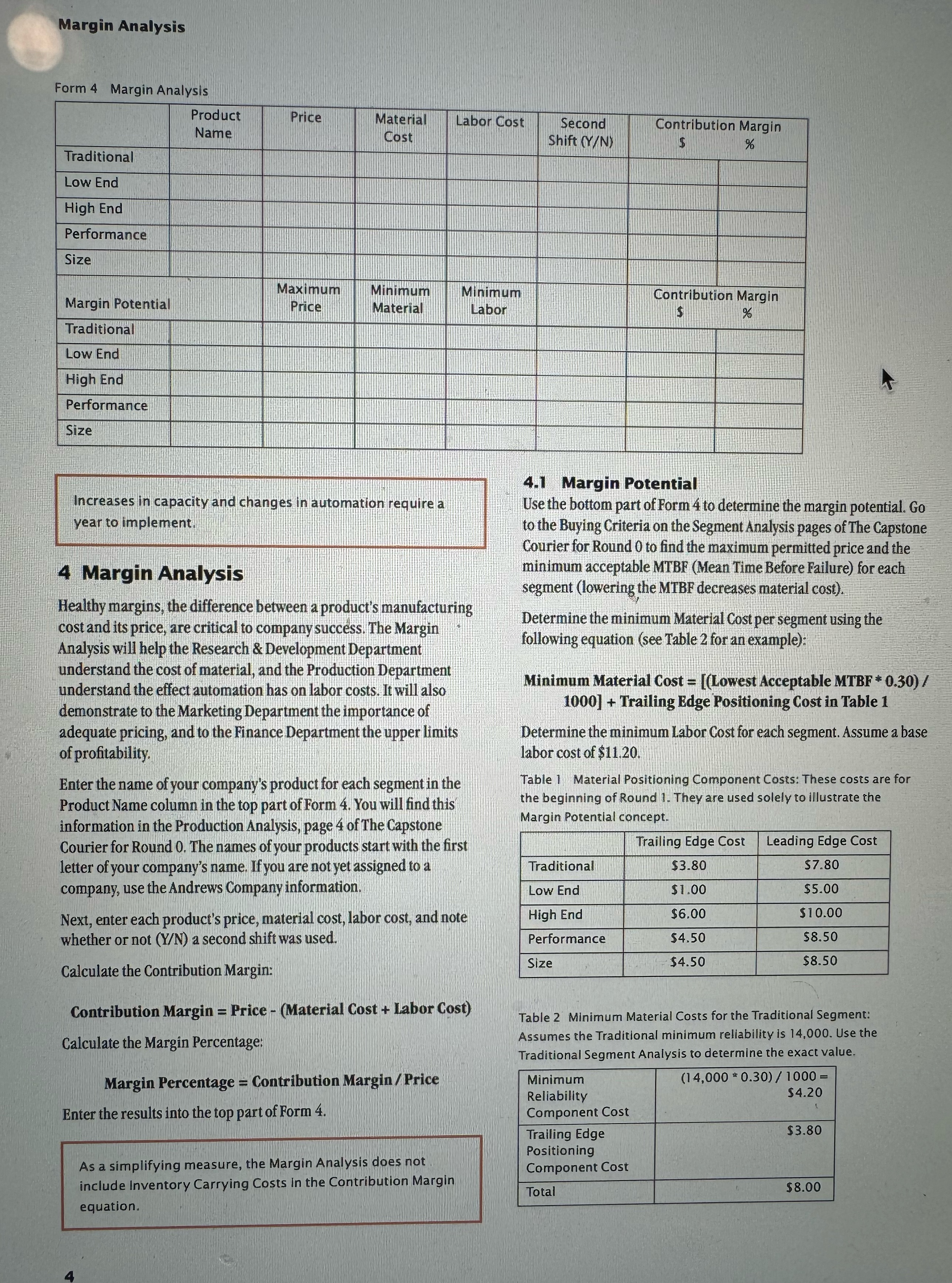
Margin Analysis Form 4 Margin Analysis Product Price Material Labor Cost Second Contribution Margin Name Cost Shift (Y/N) % Traditional Low End High End Performance Size Maximum Minimum Minimum Contribution Margin Margin Potential Price Material Labor % Traditional Low End High End Performance Size 4.1 Margin Potential Increases in capacity and changes in automation require a Use the bottom part of Form 4 to determine the margin potential. Go year to implement. to the Buying Criteria on the Segment Analysis pages of The Capstone Courier for Round 0 to find the maximum permitted price and the 4 Margin Analysis minimum acceptable MTBF (Mean Time Before Failure) for each segment (lowering the MTBF decreases material cost). Healthy margins, the difference between a product's manufacturing cost and its price, are critical to company success. The Margin Determine the minimum Material Cost per segment using the Analysis will help the Research & Development Department following equation (see Table 2 for an example): understand the cost of material, and the Production Department understand the effect automation has on labor costs. It will also Minimum Material Cost - [(Lowest Acceptable MTBF * 0.30) / demonstrate to the Marketing Department the importance of 1000] + Trailing Edge Positioning Cost in Table 1 adequate pricing, and to the Finance Department the upper limits Determine the minimum Labor Cost for each segment. Assume a base of profitability. labor cost of $11.20. Enter the name of your company's product for each segment in the Table 1 Material Positioning Component Costs: These costs are for Product Name column in the top part of Form 4. You will find this the beginning of Round 1. They are used solely to illustrate the Margin Potential concept. information in the Production Analysis, page 4 of The Capstone Courier for Round 0. The names of your products start with the first Trailing Edge Cost Leading Edge Cost letter of your company's name. If you are not yet assigned to a Traditional $3.80 $7.80 company, use the Andrews Company information. Low End $1.00 $5.00 Next, enter each product's price, material cost, labor cost, and note High End $6.00 $10.00 whether or not (Y/N) a second shift was used. Performance $4.50 $8.50 Size $4.50 $8.50 Calculate the Contribution Margin: Contribution Margin = Price - (Material Cost + Labor Cost) Table 2 Minimum Material Costs for the Traditional Segment: Assumes the Traditional minimum reliability is 14,000. Use the Calculate the Margin Percentage: Traditional Segment Analysis to determine the exact value. Margin Percentage = Contribution Margin / Price Minimum (14,000 * 0.30) / Reliability $4.20 Enter the results into the top part of Form 4. Component Cost Trailing Edge $3.80 Positioning As a simplifying measure, the Margin Analysis does not Component Cost include Inventory Carrying Costs In the Contribution Margin Total $8.00 equation

Step by Step Solution

There are 3 Steps involved in it

1 Expert Approved Answer
Step: 1 Unlock blur-text-image

Question Has Been Solved by an Expert!

Get step-by-step solutions from verified subject matter experts

Step: 2 Unlock
Step: 3 Unlock

Students Have Also Explored These Related General Management Questions!