







Question: Finite State Machine to Parse G3 6) Given: G3 = ({V, S, R, N}, {+, -, -, d, 1}, P, V) P: 1) V ->
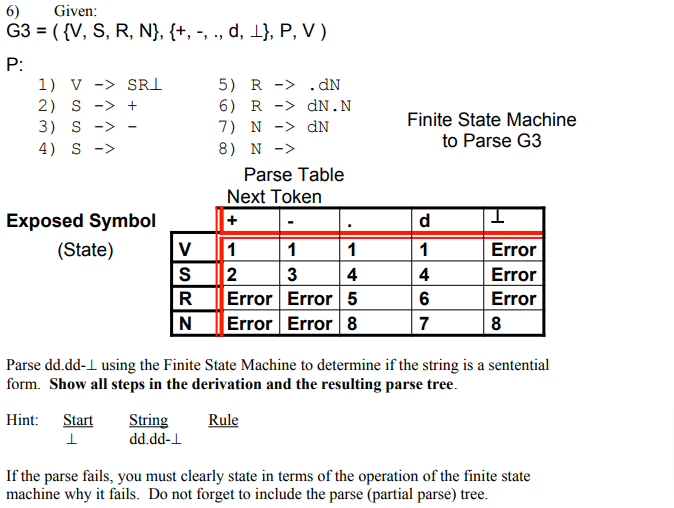
Finite State Machine to Parse G3 6) Given: G3 = ({V, S, R, N}, {+, -, -, d, 1}, P, V) P: 1) V -> SRI 5) R -> .dN 2) S-> + 6) R-> DN.N 3) S -> - 7) N -> DN 4) S-> 8) N-> Parse Table Next Token Exposed Symbol + (State) V 1 1 1 S 2 3 4 R Error Error 5 N Error Error 8 d 1 4 6 7 Error Error Error 8 Parse dd.dd-1 using the Finite State Machine to determine if the string is a sentential form. Show all steps in the derivation and the resulting parse tree. Hint: Rule Start 1 String dd.dd-1 If the parse fails, you must clearly state in terms of the operation of the finite state machine why it fails. Do not forget to include the parse (partial parse) tree. Finite State Machine to Parse G3 6) Given: G3 = ({V, S, R, N}, {+, -, -, d, 1}, P, V) P: 1) V -> SRI 5) R -> .dN 2) S-> + 6) R-> DN.N 3) S -> - 7) N -> DN 4) S-> 8) N-> Parse Table Next Token Exposed Symbol + (State) V 1 1 1 S 2 3 4 R Error Error 5 N Error Error 8 d 1 4 6 7 Error Error Error 8 Parse dd.dd-1 using the Finite State Machine to determine if the string is a sentential form. Show all steps in the derivation and the resulting parse tree. Hint: Rule Start 1 String dd.dd-1 If the parse fails, you must clearly state in terms of the operation of the finite state machine why it fails. Do not forget to include the parse (partial parse) tree
Step by Step Solution
There are 3 Steps involved in it

Get step-by-step solutions from verified subject matter experts
 Study Help