Question: First, determine the Experimental Unit upon which you are taking measurements. Then think what Variables are being measured. 1. Classify variables as Qualitative (Categorical) -
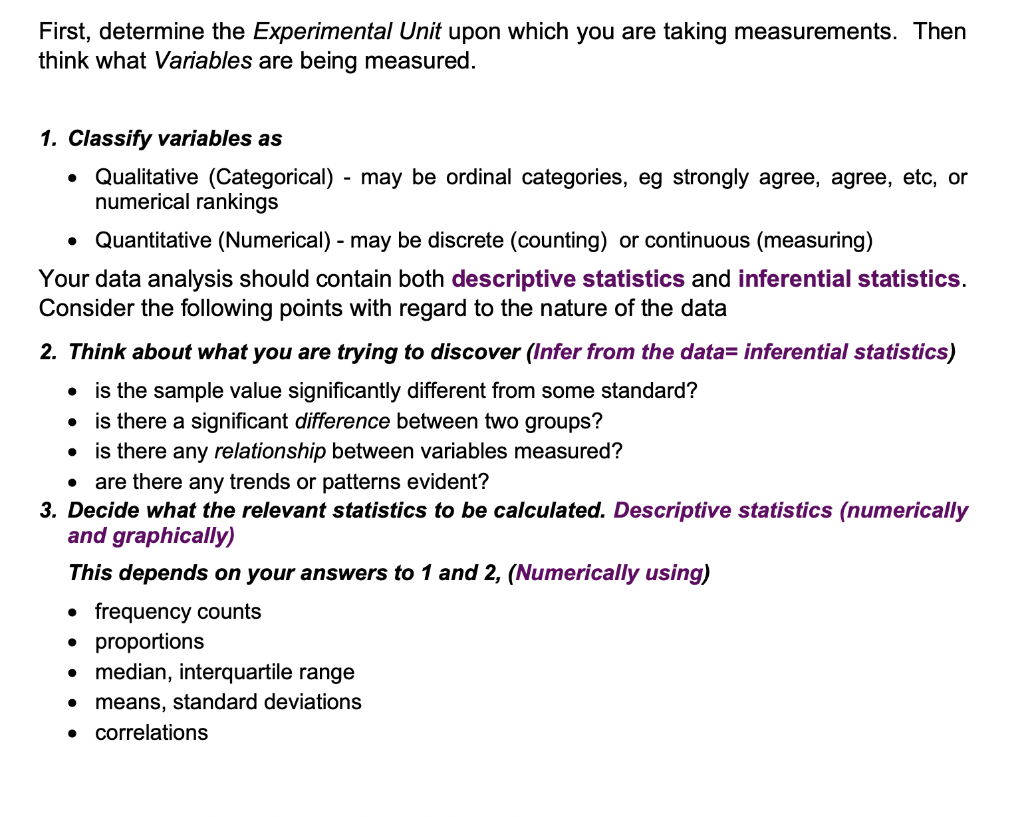
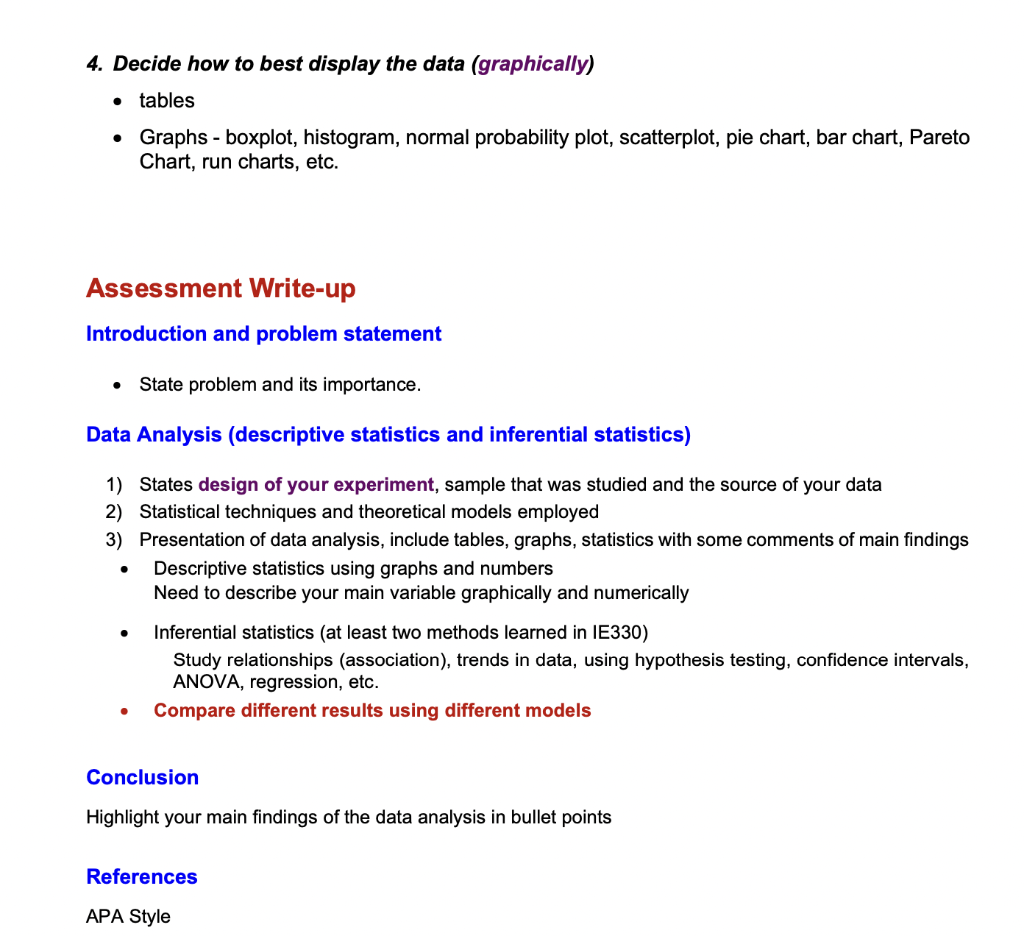
First, determine the Experimental Unit upon which you are taking measurements. Then think what Variables are being measured. 1. Classify variables as Qualitative (Categorical) - may be ordinal categories, eg strongly agree, agree, etc, or numerical rankings Quantitative (Numerical) - may be discrete (counting) or continuous (measuring) Your data analysis should contain both descriptive statistics and inferential statistics. Consider the following points with regard to the nature of the data 2. Think about what you are trying to discover (Infer from the data= inferential statistics) is the sample value significantly different from some standard? is there a significant difference between two groups? is there any relationship between variables measured? are there any trends or patterns evident? 3. Decide what the relevant statistics to be calculated. Descriptive statistics (numerically and graphically) This depends on your answers to 1 and 2, (Numerically using) frequency counts proportions median, interquartile range means, standard deviations correlations 4. Decide how to best display the data (graphically) tables Graphs - boxplot, histogram, normal probability plot, scatterplot, pie chart, bar chart, Pareto Chart, run charts, etc. Assessment Write-up Introduction and problem statement State problem and its importance. Data Analysis (descriptive statistics and inferential statistics) 1) States design of your experiment, sample that was studied and the source of your data 2) Statistical techniques and theoretical models employed 3) Presentation of data analysis, include tables, graphs, statistics with some comments of main findings Descriptive statistics using graphs and numbers Need to describe your main variable graphically and numerically Inferential statistics (at least two methods learned in IE330) Study relationships (association), trends in data, using hypothesis testing, confidence intervals, ANOVA, regression, etc. Compare different results using different models Conclusion Highlight your main findings of the data analysis in bullet points References APA Style First, determine the Experimental Unit upon which you are taking measurements. Then think what Variables are being measured. 1. Classify variables as Qualitative (Categorical) - may be ordinal categories, eg strongly agree, agree, etc, or numerical rankings Quantitative (Numerical) - may be discrete (counting) or continuous (measuring) Your data analysis should contain both descriptive statistics and inferential statistics. Consider the following points with regard to the nature of the data 2. Think about what you are trying to discover (Infer from the data= inferential statistics) is the sample value significantly different from some standard? is there a significant difference between two groups? is there any relationship between variables measured? are there any trends or patterns evident? 3. Decide what the relevant statistics to be calculated. Descriptive statistics (numerically and graphically) This depends on your answers to 1 and 2, (Numerically using) frequency counts proportions median, interquartile range means, standard deviations correlations 4. Decide how to best display the data (graphically) tables Graphs - boxplot, histogram, normal probability plot, scatterplot, pie chart, bar chart, Pareto Chart, run charts, etc. Assessment Write-up Introduction and problem statement State problem and its importance. Data Analysis (descriptive statistics and inferential statistics) 1) States design of your experiment, sample that was studied and the source of your data 2) Statistical techniques and theoretical models employed 3) Presentation of data analysis, include tables, graphs, statistics with some comments of main findings Descriptive statistics using graphs and numbers Need to describe your main variable graphically and numerically Inferential statistics (at least two methods learned in IE330) Study relationships (association), trends in data, using hypothesis testing, confidence intervals, ANOVA, regression, etc. Compare different results using different models Conclusion Highlight your main findings of the data analysis in bullet points References APA Style









 Study Help